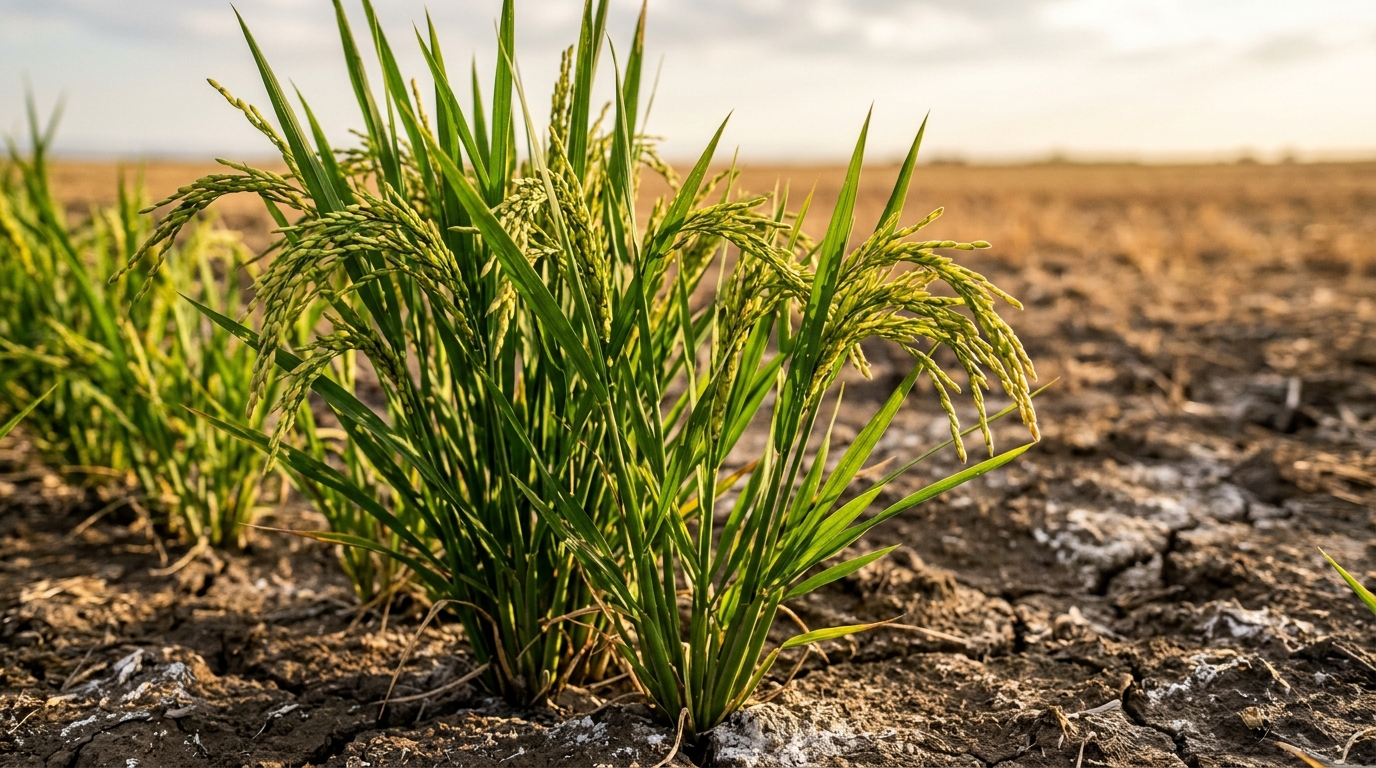
Rice feeds billions of people, yet its productivity is increasingly constrained by drought, salinity, heat, cold, submergence, heavy metal toxicity and herbicide-related stresses. A new review article in Frontiers in Plant Physiology examines how genome-editing technologies, including CRISPR/Cas systems, TALENs, ZFNs, base editors, prime editors and CRISPR-Combo, are being applied to modify stress-responsive genes and regulatory pathways in rice, with the goal of developing climate-resilient cultivars.
The review, authored by researchers from Texas A&M University, Lincoln University of Missouri, the University of Florida, the University of Minnesota Twin Cities, the University of Georgia and Tribhuvan University in Nepal, notes that conventional breeding has improved stress tolerance in rice, but progress remains limited by the complex, polygenic and environment-dependent nature of abiotic stress responses. Because tolerance traits typically involve many genes acting across different tissues and growth stages, single-gene approaches often fall short, making precise, multiplexed editing an attractive alternative.
At the core of the review is a summary of validated editing targets organized by biological function. These include genes governing reactive oxygen species homeostasis, which determines how plant cells manage the oxidative damage that accumulates under drought, salt and heat; components of abscisic acid signaling, the hormonal pathway that closes stomata and triggers protective responses when water is scarce; and calcium- and MAPK-mediated cascades that translate external stress cues into cellular action. Transcriptional regulators, ion transporters that control sodium and other ion accumulation, epigenetic control mechanisms and cross-stress signaling networks round out the catalog of candidate targets.
The technical breadth of the editing toolbox is a central theme. CRISPR/Cas systems allow targeted knockouts and precise allele swaps, while base editors and prime editors enable single-base changes and small insertions without double-strand breaks. TALENs and ZFNs, the older protein-guided platforms, remain relevant for targets that CRISPR struggles to reach. CRISPR-Combo, which combines editing with gene regulation, extends the approach to tuning rather than simply disabling genes. Multiplex editing, in which several loci are modified simultaneously, is highlighted as particularly valuable for polygenic stress traits.
The review also catalogs the practical obstacles that keep these tools from routine deployment. Off-target effects, in which editors alter unintended genomic sites, remain a safety and regulatory concern. Delivery constraints, including the difficulty of getting editing machinery into rice cells, and low knock-in efficiency, which limits the insertion of larger beneficial sequences, further slow progress. Transformation efficiency varies strongly by genotype, meaning elite cultivars are not always the easiest to edit. Regulatory frameworks differ across countries and continue to shape which edited lines can reach farmers.
Despite these hurdles, the authors conclude that genome editing offers a powerful strategy for developing climate-resilient rice cultivars, especially when integrated with multiplex editing, precision allele engineering and modern breeding approaches such as speed breeding and genomic selection. The review positions editing not as a replacement for breeding but as a complementary precision layer that can introduce or refine specific stress-tolerance alleles within elite genetic backgrounds.
As a review article, the work synthesizes published findings rather than presenting new experimental data, and the authors note that all claims are their own and do not necessarily represent those of their affiliated organizations or the publisher. The article was received in August 2026 and accepted in October 2026, and the final formatted version is pending publication. The corresponding author is Dipak Khanal of Texas A&M University.
For researchers and breeders, the review’s value lies in consolidating which stress-response genes have been validated as editing targets and which technical bottlenecks still need solving. As droughts intensify and saline soils expand in rice-growing regions, the ability to precisely tune ROS scavenging, ABA sensitivity, ion exclusion and stress-signaling cascades could determine how quickly new tolerant varieties reach the field. The review frames the next phase as one of integration, where editing platforms, delivery methods and regulatory pathways must advance together to translate laboratory precision into agronomic resilience.
Subject of Research: Genome editing approaches for improving abiotic stress tolerance in rice
Article Title: Engineering rice for enhanced abiotic stress tolerance using genome editing
Article References: Khanal, D., Chapagain, S., Yadav, S. P. S., Poudel, K., Dhakal, N., Joshi, L. P., & Banjade, D. (2026). Engineering rice for enhanced abiotic stress tolerance using genome editing. Frontiers in Plant Physiology, 4, Article 1969774. https://doi.org/10.3389/fphgy.2026.1969774
Image Credits: AI Generated
DOI: 10.3389/fphgy.2026.1969774
Keywords: rice, genome editing, CRISPR, abiotic stress, drought, salinity, heat tolerance, ROS homeostasis, ABA signaling, gene regulation, plant biotechnology, climate resilience
News Source: Juliet Wilcox. (November 5, 2026). Scientists Map How Genome Editing Could Arm Rice Against Drought, Salt and Heat. Scienmag.