• HOME
  • NEWS
  • EXPLORE
    • CAREER
      • Companies
      • Jobs
    • EVENTS
    • iGEM
      • News
      • Team
    • PHOTOS
    • VIDEO
    • WIKI
  • BLOG
  • COMMUNITY
    • FACEBOOK
    • INSTAGRAM
    • TWITTER
Thursday, November 5, 2026
BIOENGINEER.ORG
No Result
View All Result
  • Login
  • HOME
  • NEWS
  • EXPLORE
    • CAREER
      • Companies
      • Jobs
        • Lecturer
        • PhD Studentship
        • Postdoc
        • Research Assistant
    • EVENTS
    • iGEM
      • News
      • Team
    • PHOTOS
    • VIDEO
    • WIKI
  • BLOG
  • COMMUNITY
    • FACEBOOK
    • INSTAGRAM
    • TWITTER
No Result
View All Result
Bioengineer.org
No Result
View All Result
Home NEWS Science News Technology

In-sensor computing lets artificial nose sniff out gases in milliseconds

by
November 5, 2026
in Technology
Reading Time: 2 mins read
0
In-sensor computing lets artificial nose sniff out gases in milliseconds

In-sensor computing lets artificial nose sniff out gases in milliseconds

Share on FacebookShare on TwitterShare on LinkedinShare on RedditShare on Telegram

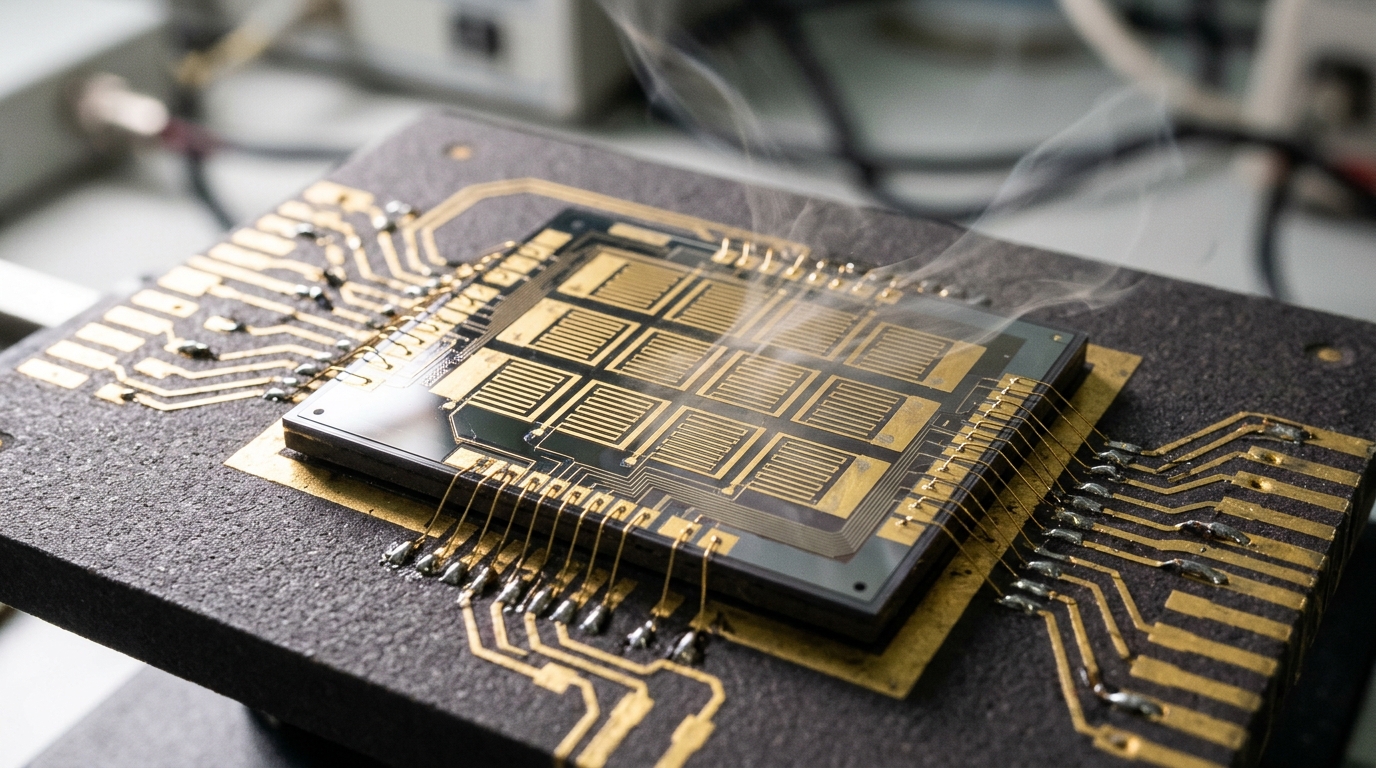
Artificial olfaction has long lagged behind its biological counterpart, largely because conventional gas sensors must wait for adsorption equilibrium to be established before they can deliver a reliable reading. Researchers have now reported an ultrafast artificial olfaction system that sidesteps this bottleneck by performing computation directly inside the sensor itself. According to the study, published in Nature Sensors, the architecture enables gas concentration readout within milliseconds, a speed regime that approaches the millisecond timescales on which biological olfaction operates.

The key innovation lies in an in-sensor feature extraction architecture that performs analogue differential computation within the sensing element. Rather than waiting for the resistive sensing film to reach a stable equilibrium signal, the system extracts a kinetic descriptor from the transient adsorption response according to a pseudo-first-order kinetic model. By relying on adsorption kinetics instead of equilibrium signals, the researchers report that the system determines gas concentration ten to 1,000 times faster than conventional resistive sensors.

The architecture was designed and verified using a hydrogen-sensing unit, in which the in-sensor differential computation extracted a kinetic descriptor from the transient adsorption response. The researchers further present the architecture as universal across different sensing materials, indicating that the approach is not limited to a single chemistry.

Beyond speed, the extracted kinetic features proved readily compatible with machine learning models. In mixed-gas detection experiments, the researchers showed that these features enable reliable analysis of complex odour mixtures.

To demonstrate practical utility, the researchers coupled the sensor system with an unmanned aerial vehicle, creating an ultrafast olfaction platform for real-time gas leak detection and autonomous monitoring.

The researchers state that these results establish a route towards biomimetic, high-speed artificial olfaction for dynamic sensing environments.

Subject of Research: An ultrafast artificial olfaction system using in-sensor feature extraction for millisecond-scale gas detection.

Article Title: Millisecond olfaction system with in-sensor feature extraction

Article References: Yuan, Z., Yang, R., Huang, T., Zhang, X., Zeng, W., Duan, Z., Wu, Y., Zhou, J., Jiang, Y., Fan, Z., & Tai, H. (2026). Millisecond olfaction system with in-sensor feature extraction. Nature Sensors, 1(11), 1021-1032. https://doi.org/10.1038/s44460-026-00148-7

Image Credits: AI Generated

DOI: 10.1038/s44460-026-00148-7

Keywords: artificial olfaction, in-sensor computing, gas sensors, adsorption kinetics, machine learning, unmanned aerial vehicle, resistive sensors, hydrogen detection, pseudo-first-order kinetics, gas leak detection, Nature Sensors, biomimetic sensing

News Source: Denise Maddox. (November 5, 2026). In-sensor computing lets artificial nose sniff out gases in milliseconds. Scienmag.


Tags: adsorption kineticsartificial olfactionbiomimetic sensinggas leak detectiongas sensorshydrogen detectionin-sensor computingMachine LearningNature Sensorspseudo-first-order kineticsresistive sensorsunmanned aerial vehicle
Share12Tweet7Share2ShareShareShare1

Related Posts

Microbial Protease SP02 Shows Faster, Cooler Route to Greener Leather Dehairing

Microbial Protease SP02 Shows Faster, Cooler Route to Greener Leather Dehairing

November 5, 2026
Compression sleeve for female NCAA athletes eased soreness perceptions but not performance

Compression sleeve for female NCAA athletes eased soreness perceptions but not performance

November 5, 2026

AI learns to translate official EV range labels between EPA, WLTP and NEDC test standards

November 5, 2026

Green finance shows the most consistent link to renewable energy across Europe and Africa

November 5, 2026

POPULAR NEWS

  • County Incarceration Linked to Elevated Cancer Mortality-to-Incidence Ratios

    County Incarceration Linked to Elevated Cancer Mortality-to-Incidence Ratios

    29 shares
    Share 12 Tweet 7
  • Systematic review maps how 5G and 6G sensing could ease urban traffic congestion

    29 shares
    Share 12 Tweet 7
  • New AdamMAD Optimizer Swaps Squared Gradients for Mean Absolute Deviation to Cut Training Oscillations

    29 shares
    Share 12 Tweet 7
  • Poor blood sugar control linked to resistant bacteria in Taiwanese diabetes study

    29 shares
    Share 12 Tweet 7

About

We bring you the latest biotechnology news from best research centers and universities around the world. Check our website.

Follow us

Recent News

Physical Activity Unlinked to Lower Anxiety or Depression in Autistic Children

Staged Surgery Saves Woman From Deadly Aortic Graft Fistula

Surface temperature filters harvestman communities in isolated Slovak forest fragment

Subscribe to Blog via Email

Enter your email address to subscribe to this blog and receive notifications of new posts by email.

Join 86 other subscribers
  • Contact Us

Bioengineer.org © Copyright 2023 All Rights Reserved.

Welcome Back!

Login to your account below

Forgotten Password?

Retrieve your password

Please enter your username or email address to reset your password.

Log In
No Result
View All Result
  • Homepages
    • Home Page 1
    • Home Page 2
  • News
  • National
  • Business
  • Health
  • Lifestyle
  • Science

Bioengineer.org © Copyright 2023 All Rights Reserved.