A theoretical framework and physical architecture demonstrate that cascaded three-wave mixing processes within a multimode optical cavity can generate bright, continuous-variable quantum entanglement and strong quantum correlations across multiple distinct optical frequency combs. Developed by researchers Sahil Pontula, Debasmita Banerjee, Marin Soljačić, and Yannick Salamin and published in Light: Science and Applications, the system exploits a shared low-frequency idler comb to coherently couple an entire family of high-frequency subcombs. While traditional quantum frequency comb research has largely concentrated on generating single broadband combs or below-threshold squeezed supermodes within isolated microresonators, this nested architecture establishes long-range quantum correlations that span both intra-comb and inter-comb spectral domains. The resulting optical output produces two-mode squeezing and multi-mode continuous-variable entanglement directly in the physical frequency basis, spanning disparate spectral regimes from the ultraviolet and visible to the mid-infrared. By distributing quantum correlations across distinct but nonlinearly coupled combs rather than compressing bandwidth into a single continuum, the platform provides a robust foundation for entanglement-assisted spectroscopy, spectrally multiplexed quantum information processing, and multispectral quantum metrology.
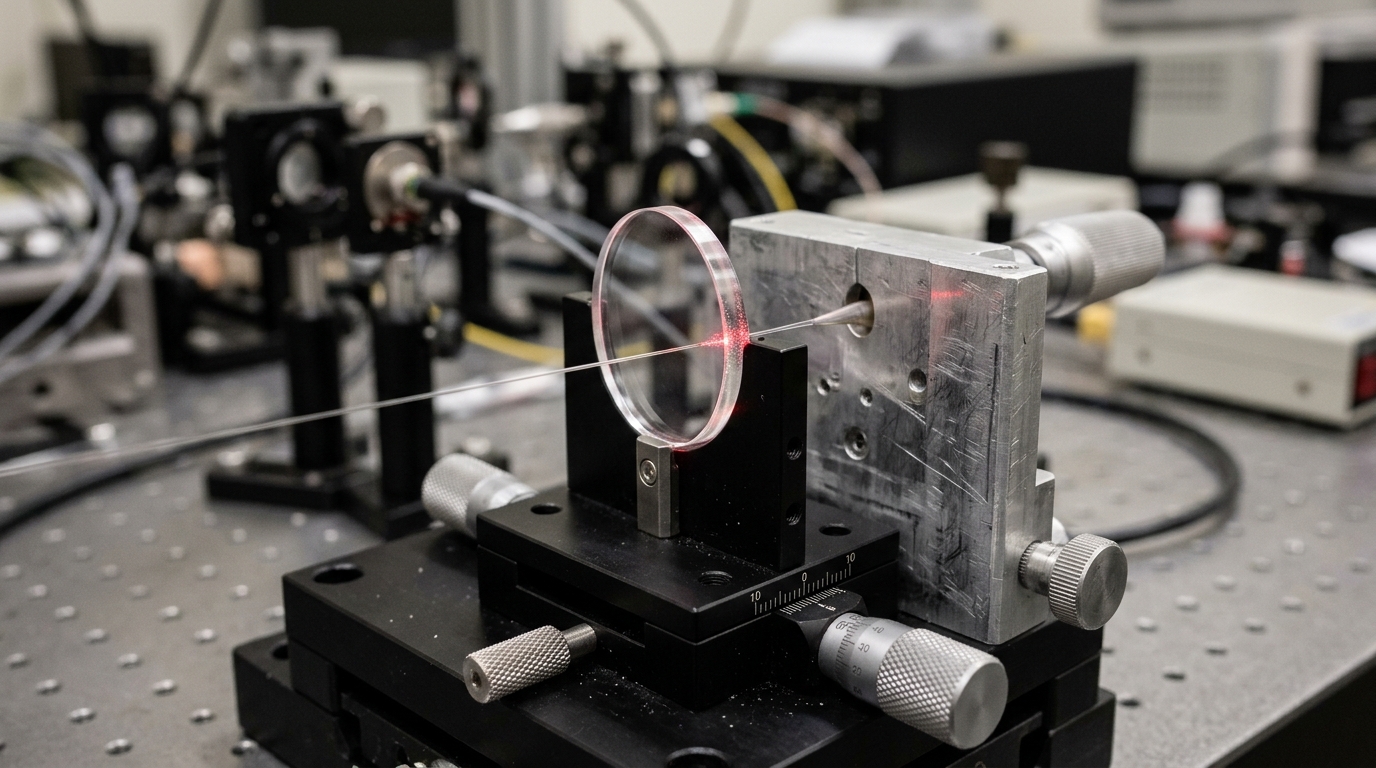
The physical mechanism investigated by the authors relies on cascaded second-order nonlinear interactions taking place inside a multimode optical cavity. In the general implementation, an optical pump comb centered at frequency omega-zero and a secondary seed comb at frequency omega-one are injected into the cavity, where difference frequency generation produces an idler comb centered at the difference frequency. This newly generated idler comb is continuously recycled within the resonant cavity to mediate cascaded sum-frequency and difference-frequency generation processes, synthesizing a ladder of blueshifted and redshifted optical subcombs around the original pump frequency. Together, these subcombs form a primary frequency comb whose overarching intercomb spacing equals the large center frequency of the shared idler, while each individual subcomb contains closely spaced discrete lines separated by a frequency interval chosen to match a multiple of the cavity free spectral range. The authors specifically modeled a ten-centimeter free-space cavity containing a multi-poled lithium niobate crystal, pumped at 465 nanometers with an idler centered at 4.07 micrometers, corresponding to a frequency of 73.7 terahertz, and an intracomb line spacing of 3.00 gigahertz, yielding a sequence of optical subcombs at 708, 603, 525, 465, 417, 378, and 346 nanometers.
To rigorously describe the nonlinear cavity dynamics, the authors formulated Heisenberg equations of motion for the discrete frequency modes governed by the second-order nonlinear Hamiltonian. The coupling between individual modes depends on the second-order susceptibility of the crystal, mode frequencies, and a sinc-shaped phase-matching factor determined by the wavevector mismatch and crystal poling grating vectors. Roundtrip outcoupling losses and intrinsic absorption are incorporated for each optical comb line and the mediating idler modes. As cascaded mixing transfers optical energy away from the initial pump, secondary three-wave mixing populates peripheral comb lines, causing spectral broadening across each subcomb that manifests temporally as pulse narrowing. Phase matching serves as an intrinsic filter that dictates which modes interact within the available nonlinear bandwidth. By tuning the intracomb frequency spacing, the effective phase mismatch sampled by the comb teeth is modified, introducing a form of dispersion engineering that directly influences both classical mean-field energy distributions and the underlying quantum noise dynamics.
Quantum fluctuations were evaluated by linearizing the Heisenberg-Langevin equations about the calculated mean-field steady states and applying temporal coupled-mode theory to derive the output field operators. The authors computed single-mode intensity fluctuations and pairwise photon flux noise at an analysis frequency of one megahertz, which lies well within the flat noise spectrum of the cavity. Individual optical modes typically exhibit intensity noise above the standard quantum limit because concurrent sum-frequency and difference-frequency processes exchange noise between interacting channels, though increasing seed comb power suppresses this single-mode excess noise. Using a gain-optimized noise reduction factor, the calculations uncovered quantum correlations exceeding ten decibels below the uncorrelated limit across the multi-comb network, alongside multiple low-noise states exceeding ten decibels below the shot noise limit. Notably, strong quantum correlations emerge even between modes belonging to different subcombs that do not interact directly through the nearest-neighbor nonlinear coupling, confirming that the circulating idler comb acts as an effective quantum mediator across the complete spectral system.
The presence of genuine continuous-variable entanglement throughout the multi-comb structure was verified using the Peres-Horodecki positive partial transpose criterion and logarithmic negativity calculations. Output field fluctuations were expressed in terms of dimensionless position and momentum quadratures to assemble the multimode covariance matrix, which must satisfy the Robertson-Schrödinger uncertainty relation for physical Gaussian states. By inverting the sign of the momentum quadrature for chosen partitions, the authors computed the symplectic eigenvalues of the partially transposed covariance matrix, where a minimum symplectic eigenvalue falling below unity proves the existence of entanglement across that bipartition. System evaluations revealed that both single-mode bipartitions, pairing one comb line against all other modes in the system, and comb-group bipartitions, pairing an entire subcomb against the rest of the cavity field, exhibit minimum symplectic eigenvalues significantly below unity. These results demonstrate that idler-mediated second-order mixing weaves an extensive, spectrally addressable multipartite entanglement web that extends across both synthetic frequency dimensions.
Beyond pairwise entanglement, the researchers investigated the formation of cluster states, which represent essential resources for measurement-based quantum computing and distributed quantum networks. Scanning four-mode subsets among the central comb lines while optimizing local phase rotations and graph edge weights, the authors identified candidate submatrices whose graph-nullifier variances fall below the unity-normalized vacuum noise level, successfully synthesizing four-mode line-graph and star-graph cluster states. Furthermore, capitalizing on the two-dimensional synthetic lattice spanned by the subcomb indices and intracomb line numbers, they demonstrated a six-mode ladder-graph cluster state across a two-by-three patch of modes. The resulting cluster nodes exist as distinct, bright spectral channels that can be individually addressed or routed for transduced quantum communications and multispectral network protocols.
To tailor the generated quantum states for specific technological tasks, the study introduced covariance matrix engineering through dissipation, pump pulse shaping, and dispersion control. Frequency-dependent dissipation engineering manipulates outcoupling losses across individual combs using optical elements such as dichroic mirrors or intracavity filters, modifying the balance between loss and nonlinear gain to channel quantum correlations into selected modes. Concurrently, pump engineering applies spectral pulse shaping to control input amplitude profiles across the pump and seed lines. The authors illustrated this capability by optimizing remote-pair squeezing between a mid-infrared idler mode at 4.07 micrometers and an optical mode in one of the visible subcombs under constraints that maintained mode brightness and bounded total input power.
To extend their findings beyond discrete continuous-wave regimes, the authors analyzed ultrafast pulsed systems using coupled generalized nonlinear Schrödinger equations that account for second-order nonlinearity, third-order Kerr effects, self-steepening, and material dispersion in lithium niobate. Simulating a regenerative cavity configuration where pulses circulate through a two-millimeter nonlinear crystal across multiple roundtrips, quantum statistics were tracked using quantum sensitivity analysis, which computes the covariance matrix from the Jacobian of the classical forward trajectory and associated dissipation channels without demanding a static steady state. By performing pulse shaping and tuning the temporal delay between the 50-kilowatt pump pulse and the 500-watt seed pulse, the authors concentrated squeezing between the 4.07-micrometer idler pulse and a 525-nanometer optical pulse. The shaped ultrafast interaction produced two decibels of whole-pulse noise reduction below the shot noise limit, representing an eleven-decibel enhancement compared to the unshaped case, despite individual pulses exhibiting excess intensity noise exceeding ten decibels above shot noise.
The multi-comb architecture establishes a versatile quantum optics paradigm that links bright optical carriers across widely separated wavelength bands. Operating natively in the physical frequency basis and above laser threshold, the platform overcomes brightness limitations inherent in conventional squeezed-vacuum sources, enabling practical multispectral sensing schemes where a target sample is interrogated at mid-infrared molecular fingerprint wavelengths while correlated readout is conducted in the visible or near-infrared spectrum using high-efficiency detectors. Furthermore, the nested intercomb and intracomb frequency axes constitute a two-dimensional synthetic space capable of supporting topological and non-Hermitian quantum states of light.
Subject of Research: Multimode quantum frequency comb generation and continuous-variable entanglement
Article Title: Long-range spectral entanglement and quantum correlations in highly nondegenerate multi-comb and ultrafast systems
Article References: Pontula, S., Banerjee, D., Soljačić, M., & Salamin, Y. (2026). Long-range spectral entanglement and quantum correlations in highly nondegenerate multi-comb and ultrafast systems. Light: Science & Applications, 15(1), Article 394. https://doi.org/10.1038/s41377-026-02491-3
Image Credits: AI Generated
DOI: 10.1038/s41377-026-02491-3
Keywords: quantum optics, frequency combs, continuous-variable entanglement, three-wave mixing, quantum squeezing, cluster states, nonlinear photonics, lithium niobate, multispectral sensing, Long-range, spectral, entanglement
News Source: Katie Riggs. (November 5, 2026). Cascaded Nonlinear Interactions in Optical Cavities Generate Multimode Frequency Comb Entanglement. Scienmag.