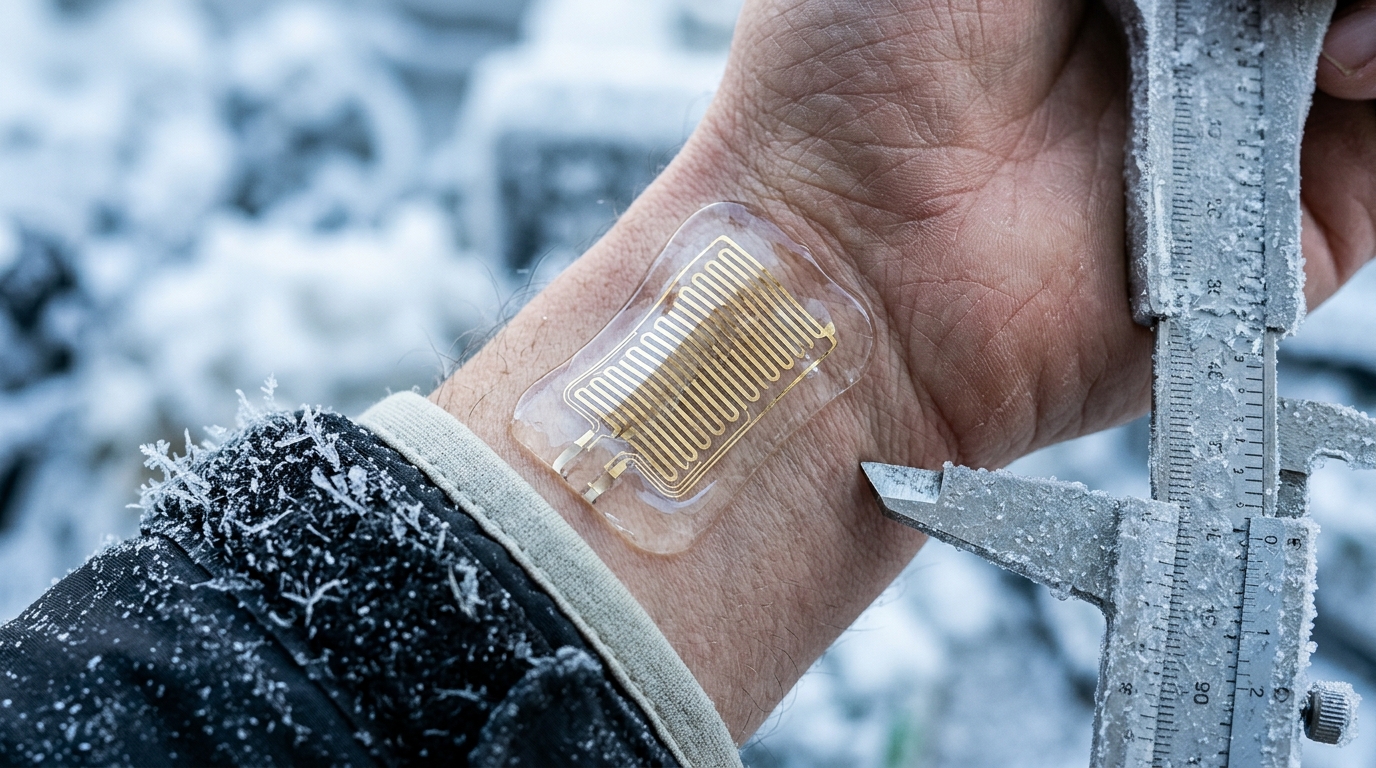
Engineers have built a flexible zinc-ion battery and pressure sensor on a single chip-like platform that can sense touch, process the signal and transmit it wirelessly without any external power source. The device, described in npj Flexible Electronics, relies on a tough hydrogel electrolyte that stays functional at low temperatures, allowing the wearable system to operate in conditions that would disable most conventional soft electronics.
The team, led by researchers including Xinzu Yue and Guoshen Yang, used a material–device–system co-design strategy. At the material level, the core of the device is a PAM/CMCS-DMSO-Zn hydrogel that combines a low freezing point with high mechanical toughness, fatigue resistance and strong ionic conductivity. This single gel performs two jobs at once: it acts as the active pressure-sensing layer and as the stable electrolyte of the zinc-ion battery.
At the device level, the researchers introduced a co-anode architecture spaced by a nylon mesh. This structure keeps the hydrogel physically separated from the zinc anode when the device is at rest, creating a zero-output state that eliminates standby power drain. When a load is applied, the interfacial impedance changes, enabling both static and dynamic pressure detection. The sensor responds in 20 milliseconds and recovers in 30 milliseconds, fast enough to track rapid pressure changes.
At the system level, the battery–sensor unit was integrated with a custom printed circuit board to form an end-to-end microsystem capable of signal acquisition, processing and wireless transmission. The researchers report that they validated this complete chain across diverse harsh conditions, demonstrating the concept of an untethered, all-weather sensing node.
The work addresses a persistent challenge in wearable electronics: combining self-powering capability, reliable static and dynamic pressure detection and miniaturized wireless signal processing in one device. By merging the energy storage and sensing functions into a single monolithic structure, the design removes the need for separate power and sensing components.
The dual-function design means the same material that stores energy also converts mechanical force into an electrical signal through impedance modulation.
The zero-output standby state is a key efficiency feature. Because the co-anode architecture isolates the hydrogel from the zinc anode until a load is applied, the device consumes no power when idle.
The researchers suggest that this co-design approach bridges hydrogel chemistry under extreme conditions with self-powered wearable electronics, offering a versatile paradigm for all-weather wireless IoT sensing. The published version is an accepted manuscript shared early for faster access; it is citable and carries a permanent DOI, with a final Version of Record to follow.
Subject of Research: A monolithic flexible zinc-ion battery–pressure sensor using a tough anti-freezing hydrogel electrolyte for self-powered wireless wearable sensing
Article Title: Wireless monolithic flexible zinc-ion battery–pressure sensor enabled by a tough anti-freezing hydrogel electrolyte
Article References: Yue, X., Liu, Q., Zhao, J., Wang, W., Liu, X., Zhou, H., Xu, Z., Yu, J., Nathan, A., & Yang, G. (2026). Wireless monolithic flexible zinc-ion battery–pressure sensor enabled by a tough anti-freezing hydrogel electrolyte. npj Flexible Electronics. https://doi.org/10.1038/s41528-026-00661-2
Image Credits: AI Generated
DOI: 10.1038/s41528-026-00661-2
Keywords: zinc-ion battery, pressure sensor, anti-freezing hydrogel, wearable electronics, self-powered sensor, wireless sensing, flexible electronics, IoT sensing node, hydrogel electrolyte, co-anode architecture, Wireless, monolithic
News Source: Denise Maddox. (November 5, 2026). Anti-freezing hydrogel powers a self-charging wearable pressure sensor. Scienmag.