Fine particulate matter and artificial light at night, two environmental exposures usually studied in isolation, appear to act together in ways that magnify their association with death, according to a large cohort analysis of Chinese adults published in Archives of Public Health. The study, which pooled four nationally representative longitudinal surveys, found that the combined effect of the two exposures on all-cause mortality exceeded what would be expected from either exposure alone.
The research drew on the China Family Panel Studies, the China Health and Retirement Longitudinal Study, the China Health and Nutrition Survey, and the Chinese Longitudinal Healthy Longevity Survey. Exposure estimates came from remote sensing: PM2.5 concentrations and their chemical components were taken from the ChinaHighAirPollutants dataset, while artificial light at night was derived from a DMSP-OLS-like nighttime light dataset for China. The investigators used time-varying covariate Cox proportional hazards models to quantify the associations between exposure and mortality.
Over 532,773 person-years of follow-up between 2011 and 2020, 9,897 deaths were recorded. For each interquartile range increase in exposure, PM2.5 was associated with a hazard ratio of 1.177 (95% CI: 1.106–1.252) for mortality. The chemical components of the particulate mixture also showed elevated risks: sulfate carried the highest hazard ratio at 1.255 (95% CI: 1.196–1.317), followed by organic matter at 1.151 (95% CI: 1.088–1.217), ammonium at 1.096 (95% CI: 1.042–1.153), nitrate at 1.076 (95% CI: 1.024–1.131), and black carbon at 1.087 (95% CI: 1.004–1.177).
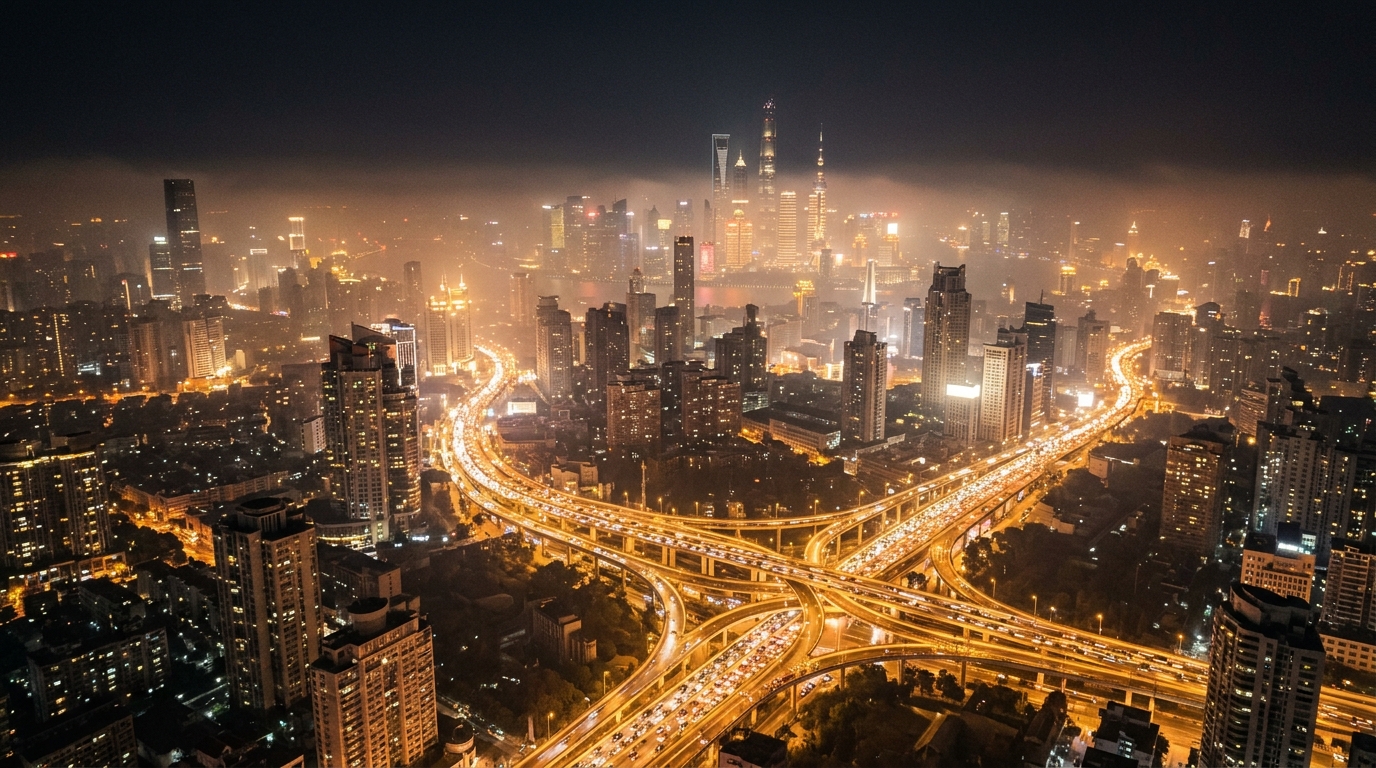
Artificial light at night, on its own, showed a smaller but statistically detectable association, with a hazard ratio of 1.047 (95% CI: 1.023–1.071) per interquartile range increase.
The central finding of the paper concerns synergy. Using three standard measures of additive interaction — the relative excess risk due to interaction, the attributable proportion, and the synergy index — the authors reported significant synergistic interaction between PM2.5 and artificial light at night on mortality. The relative excess risk due to interaction was 0.570 (95% CI: 0.240–0.900), the attributable proportion was 0.173 (95% CI: 0.155–0.191), and the synergy index was 1.330 (95% CI: 1.258–1.402). Values above zero for the first two measures and above one for the third indicate that the joint effect of the two exposures is greater than the sum of their individual effects.
A mixture exposure analysis, which weighs the relative contribution of co-occurring exposures, identified sulfate as the dominant component, with a weight of 39.9%, followed by PM2.5 at 28.2% and artificial light at night at 27.6%. This suggests that within the combined exposure profile, the sulfate fraction of particulate pollution and the night-time light environment together accounted for a substantial share of the estimated mixture effect.
The study also examined which groups were most susceptible. Individuals older than 75 years, people who were single, and those with lower levels of education showed greater vulnerability to the joint exposures. Restricted cubic spline analysis was used to characterise dose-response relationships, and subgroup analyses were conducted across the cohort.
The authors conclude that PM2.5 and its components show synergistic associations with artificial light at night on mortality, with combined exposure associated with greater risks than individual exposures. Because the analysis is observational, the findings describe statistical associations rather than proven causal mechanisms, and the reported hazard ratios reflect relative risks per interquartile range increase in exposure within the studied Chinese cohorts. The work was published as an open access article on 4 November 2026, and the version released carries a note that it is subject to further editorial edits before the final Version of Record appears.
The authors note that the combined associations of these exposures with human health had previously remained largely unexplored, which motivated the joint analysis of the two environmental factors within a single cohort framework.
Subject of Research: Joint associations of fine particulate matter and artificial light at night with all-cause mortality in China
Article Title: Beyond individual effects: joint impacts of fine particulate matter and artificial light at night on mortality in China
Article References: Wang, Z., Du, Y., Liu, Y., Zheng, B., & Qian, J. (2026). Beyond individual effects: joint impacts of fine particulate matter and artificial light at night on mortality in China. Archives of Public Health. https://doi.org/10.1186/s13690-026-02101-z
Image Credits: AI Generated
DOI: 10.1186/s13690-026-02101-z
Keywords: PM2.5, artificial light at night, all-cause mortality, air pollution, cohort study, China, synergistic interaction, sulfate, environmental health, Cox proportional hazards, public health, Beyond
News Source: Russell Cooper. (November 5, 2026). Air pollution and night-time light exposure jointly linked to mortality risk in China. Scienmag.