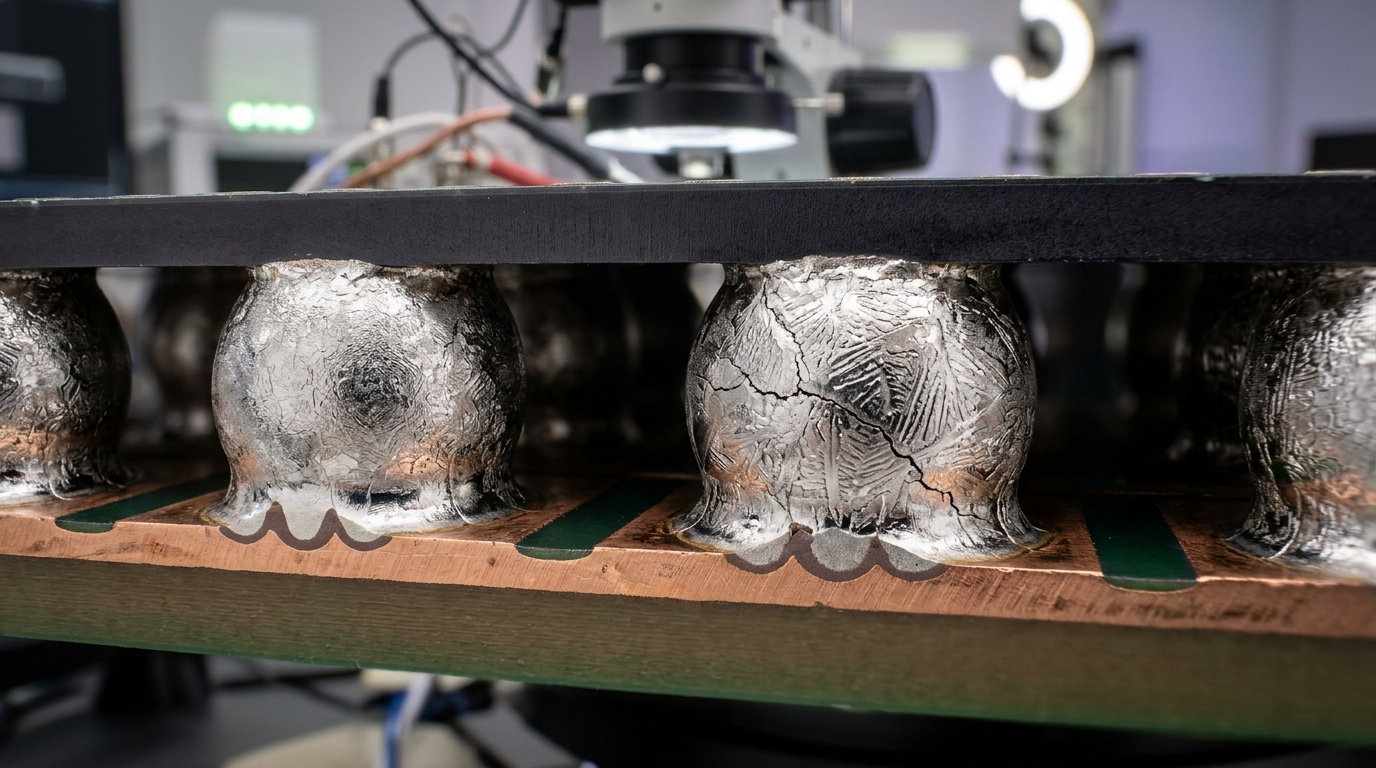
Cracking in high-temperature solder joints anomalously relocates to heterophase intermetallic interfaces rather than conventional solder-intermetallic boundaries, despite the pronounced stress-buffering capability of the lead-rich matrix. Using double spherical aberration-corrected scanning transmission electron microscopy and first-principles calculations, researchers resolved the atomic-scale origins of this cracking behavior under thermal excursions associated with high computational density and elevated operating temperatures in microelectronics.
Investigations of the solder-and-pad interface identified a two-layered intermetallic compound architecture. This structure consists of a Layer I Ni3Sn phase with trace gold incorporation adjacent to the pad, beneath an overlying Layer II composed of (Ni, Au)3Sn2 and (Ni, Au)Sn phases. First-principles calculations revealed that among substitutional configurations, gold atoms occupying Ni1 sites display the lowest relaxed total energy. During experimental thermal cycling, interlayer cracking was first detected after 700 cycles and propagated further following 1000 cycles.
Thermomechanical mismatch between the two intermetallic layers generates an estimated thermal stress of approximately 40 MPa, acting as the driving force for interlayer cracking. Triple junctions connecting grains from both layers function as preferred sites for defect accumulation. Y-type triple junctions demonstrate disconnection activity and pile-up that induce strain concentration and mobility depletion, whereas T-type triple junctions experience stagnation alongside lattice distortion, atomic shuffling, and disordering, establishing structurally weakened pathways for crack propagation.
Subject of Research: Atomic-scale origins of anomalous crack relocation at heterophase intermetallic interfaces in solder interconnects
Article Title: Atomic-scale origin of anomalous crack relocation at heterophase intermetallic interfaces in high-temperature solder interconnects
Article References: Bi, N., Liu, J., Fang, X., Nie, Q., & Wu, Y. (2026). Atomic-scale origin of anomalous crack relocation at heterophase intermetallic interfaces in high-temperature solder interconnects. Advanced Composites and Hybrid Materials. https://doi.org/10.1007/s42114-026-02165-z
Image Credits: AI Generated
DOI: 10.1007/s42114-026-02165-z
Keywords: solder interconnects, heterophase interfaces, intermetallic compounds, thermal cycling, crack propagation, transmission electron microscopy, first-principles calculations, microelectronics reliability, Atomic-scale, origin, anomalous, crack
News Source: Denise Maddox. (November 5, 2026). Atomic Origins of Anomalous Crack Relocation in High-Temperature Solder Interconnects. Scienmag.