Chemotherapy can leave behind senescent breast cancer cells that secrete inflammatory factors. In breast cancer, a new multi-omics study shows that surviving cells enter a senescent state in which their metabolism rewires toward intense lactate production, and that this lactate chemically modifies histone proteins to switch on the senescence-associated secretory phenotype, or SASP. The work, published in Breast Cancer Research, links a metabolic byproduct directly to the epigenetic control of inflammatory gene expression in senescent tumor cells.
The SASP is a major driver of chemotherapy-induced adverse effects in cancer therapy, yet how senescent cells regulate it through metabolic reprogramming has remained poorly understood. The researchers began with metabolomic profiling of chemotherapy-induced senescent breast cancer cells. These cells showed both enhanced respiratory potential and markedly increased lactate production.
To test whether lactate itself matters, the team targeted lactate dehydrogenase A, the enzyme that converts pyruvate into lactate. Genetic ablation or pharmacological inhibition of LDHA significantly attenuated SASP expression. In other words, blocking a single metabolic enzyme significantly attenuated SASP expression in senescent cells.
The functional consequences were tested in a co-inoculation xenograft model. In this model, LDHA depletion impaired the capacity of senescent cells to stimulate mammary tumor growth and to inhibit dendritic cell infiltration. This connects lactate metabolism to two behaviors observed in the xenograft model: senescent cells stimulating mammary tumor growth and inhibiting dendritic cell infiltration.
Mechanistically, the investigators screened nine metabolism-related lysine post-translational modifications and found a global increase in lysine lactylation within senescent cells. Among histone marks, H3K9la, H3K14la, and H3K18la were significantly upregulated. The screen of nine metabolism-related lysine post-translational modifications revealed a global increase in lysine lactylation within senescent cells.
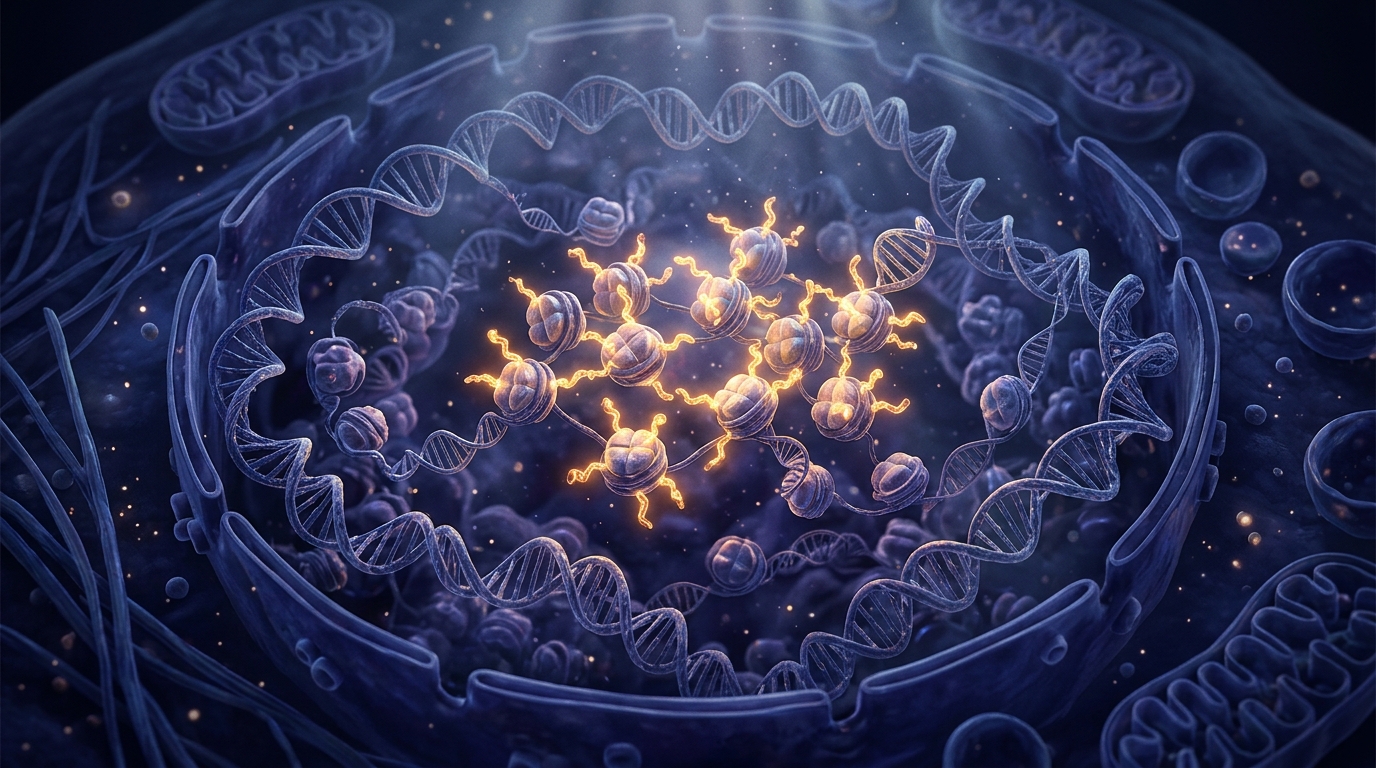
Where do these histone lactylation marks land? Integrated CUT&Tag-seq and ATAC-seq analyses identified increased enrichment of H3K9la and H3K18la at SASP gene loci, coinciding with enhanced chromatin accessibility at their respective promoters. The integrated analyses showed increased enrichment of H3K9la and H3K18la at SASP gene loci, coinciding with enhanced chromatin accessibility at their respective promoters.
The study also asked which enzymes write these marks. The study identified general control nonderepressible 5 (GCN5) and P300/CBP-associated factor (PCAF) as lactyltransferases in senescent cells. Either knockdown or pharmacological inhibition of GCN5 or PCAF reduced H3K9la and H3K18la levels, subsequently suppressing SASP transcription and secretion. In senescent cells, reducing H3K9la and H3K18la levels suppressed SASP transcription and secretion.
Collectively, the findings delineate the metabolic landscape of senescent breast cancer cells and establish a mechanistic framework linking lactate production, histone H3 lactylation, and SASP regulation. The work is presented as an early-release, peer-reviewed accepted article carrying a permanent DOI, with the final Version of Record to follow.
For patients, the implications are conceptual rather than immediate. The study was conducted in cell models and a co-inoculation xenograft model, and it identifies LDHA, GCN5, and PCAF as points at which the lactylation-driven SASP was attenuated experimentally. No clinical intervention follows directly from these data, but the study delineates the metabolic landscape of senescent breast cancer cells and links lactate production, histone H3 lactylation, and SASP regulation.
Subject of Research: Epigenetic regulation of the chemotherapy-induced senescence-associated secretory phenotype in breast cancer cells by histone H3 lactylation
Article Title: Histone H3 lactylation drives chemotherapy-induced SASP in breast cancer cells: a multi-omics analysis
Article References: Yang, D., Li, S., Wang, X., Chen, S., Xu, R., Cao, H., Lin, B., & Yang, Y. (2026). Histone H3 lactylation drives chemotherapy-induced SASP in breast cancer cells: a multi-omics analysis. Breast Cancer Research. https://doi.org/10.1186/s13058-026-02420-7
Image Credits: AI Generated
DOI: 10.1186/s13058-026-02420-7
Keywords: breast cancer, chemotherapy-induced senescence, SASP, histone lactylation, H3K9la, LDHA, lactate metabolism, GCN5, PCAF, CUT&Tag-seq, ATAC-seq, epigenetics
News Source: Nathaniel Bowman. (November 4, 2026). Chemotherapy-Induced Senescence in Breast Cancer Cells Is Driven by Histone Lactylation. Scienmag.