One-part alkali-activated mortars promise the convenience of ordinary dry-mix products: the solid activator is blended directly with the precursor, and only water needs to be added on site. Yet sodium carbonate, the mild and widely available activator most attractive for such formulations, has a stubborn reputation.
The research, published in Case Studies in Construction Materials, was carried out by Keyu Zhu, Mingsheng He and Mingru Wang. The team combined ground granulated blast-furnace slag, fly ash and ordinary Portland cement in an 8:1:1 mass ratio as the precursor, at a total of 455 kg per cubic metre of mortar, with 1250 kg per cubic metre of river sand. The activating blend consisted of industrial-grade sodium carbonate, at least 99.2 percent pure, and silica fume containing 96.3 percent SiO2. Water was fixed at a water-to-total-solid-binder ratio of 0.45 for every mixture, and specimens were cured at 20 degrees Celsius and at least 96 percent relative humidity before testing at 3, 7, 28 and 56 days.
The experimental design proceeded in two stages. First, pure sodium carbonate mixtures were prepared at activator-to-precursor ratios of 10, 20, 30 and 40 percent by mass. Then, at each of those dosages, part of the sodium carbonate was replaced by silica fume at sodium carbonate-to-silica fume mass ratios of 2.0, 1.5, 1.0 and 0.5. Because the replacement changes both the carbonate dose and the reactive silica supply simultaneously, the authors note that the two effects travel together in the mixture designations. Flow was measured on a flow table, setting by penetration resistance, and strength on 40 by 40 by 160 mm prisms under standard flexural and compressive loading procedures.
The pure carbonate results confirmed the double hazard of high dosage in a calcium-rich system. As the activator dose rose from 10 to 40 percent, setting time collapsed from 93 minutes to 61, 29 and finally 24 minutes, even though the absolute water content increased. Flowability first edged up from 187.5 to 194 mm and then fell sharply to 145 and 138 mm at the two highest doses. Early strength moved in the opposite direction to setting speed: the 3-day compressive strength dropped from 25.08 MPa at the lowest dose to 14.14 MPa at 30 percent and 6.49 MPa at 40 percent. Fast structuring, in other words, did not coincide with the formation of an effective load-bearing skeleton, a pattern the authors link to abundant carbonate precipitation in the early stage.
At later ages the picture changed. The 28-day and 56-day strengths of the pure carbonate system first rose and then fell with increasing dose, peaking at the 20 percent mixture, which reached 50.22 MPa at 28 days and 55.61 MPa at 56 days. The 40 percent mixture managed only 41.05 and 46.54 MPa at those ages. The authors attribute this to a balance: a moderate carbonate dose supplies enough alkalinity to drive continued slag dissolution and gel refinement, while an excessive dose generates more carbonate by-products that delay the sustained growth of the effective gel phases.
Introducing silica fume transformed the behaviour of the high-dose mixtures. Setting times lengthened across the board relative to the pure carbonate system at the same dose, and the response became strongly non-monotonic at the two highest activator levels. At 30 percent, the pure mixture set in 29 minutes, but the blend with a carbonate-to-silica fume ratio of 2.0 took 352 minutes. At 40 percent, the effect was even more dramatic: the pure mixture set in 24 minutes, while the ratio-2.0 blend needed 35.7 hours.
Strength followed a favourable middle path. When the activator dose was 30 percent or more, partial carbonate replacement by silica fume markedly increased strength within a certain replacement range. The standout mixture, with a 30 percent activator dose and a carbonate-to-silica fume ratio of 1.0, reached 35.62 MPa at 3 days, 2.52 times the pure carbonate value, and 59.34 MPa at 28 days and 65.07 MPa at 56 days, among the best results in the study. Pushing the replacement further reversed the gain: at 30 percent dose, the 28-day strength fell from 59.34 MPa at ratio 1.0 to 55.26 MPa at ratio 0.5, and at 40 percent dose it dropped from 58.58 to 51.29 MPa.
Microstructural analysis of the 30 percent series at 28 days helped explain these trends. X-ray diffraction of the pure carbonate mixture showed distinct gaylussite peaks near 13.9, 27.7, 32.8 and 34 degrees two-theta, calcite-related peaks near 29.4 and 39.4 degrees, and pronounced hydrotalcite-like reflections. Thermogravimetry told the same story: the pure mixture lost 3.02 percent mass in the 650 to 750 degree Celsius carbonate-decomposition window, while the ratio-1.0 blend lost only 0.86 percent, the lowest of the series, and showed the highest mass loss below 100 degrees, suggesting a greater contribution from water-bearing gel products.
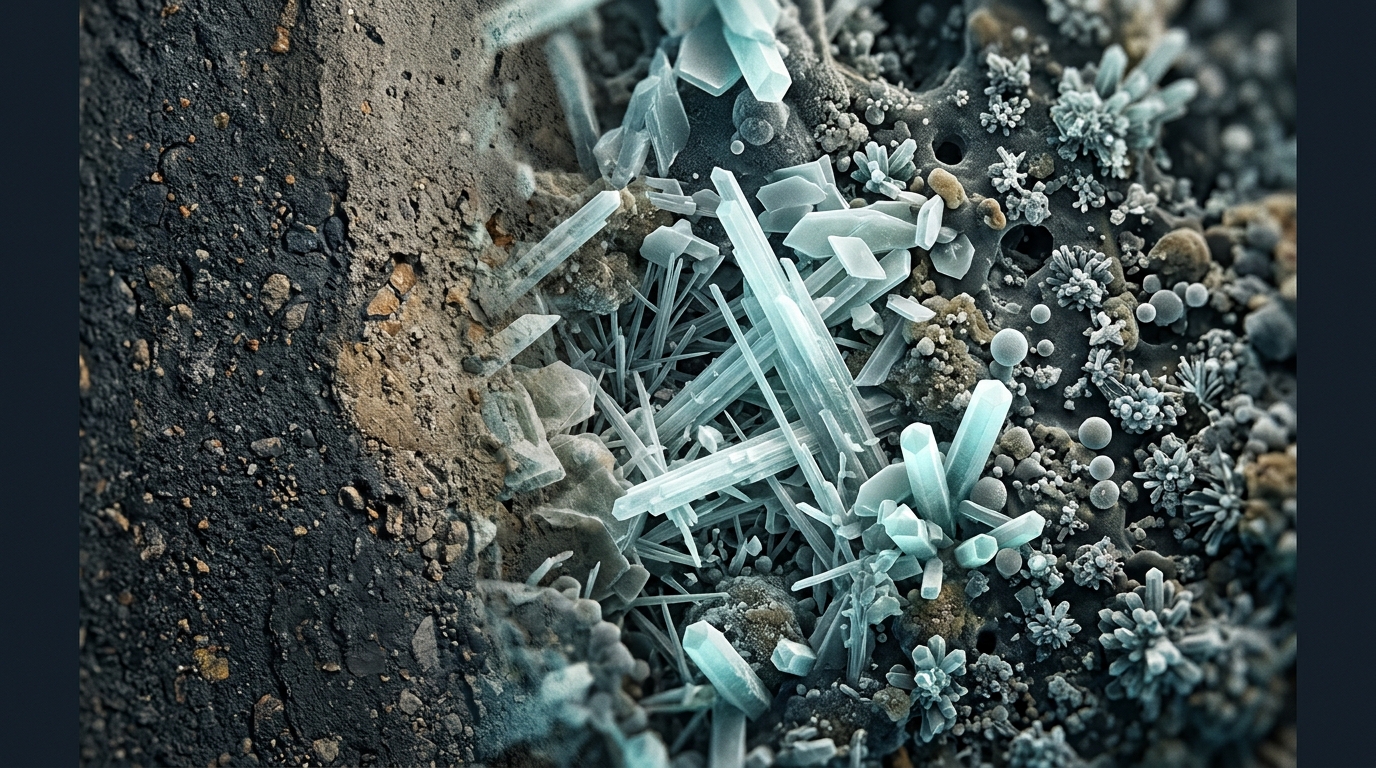
Scanning electron microscopy with energy-dispersive X-ray spectroscopy added spatial detail, though the authors caution that only ten point analyses were taken, two from each of five mixtures, so the compositions describe selected local regions rather than the whole specimen. In the pure carbonate mixture the examined fields showed a rough, loose and discontinuous matrix with visible pores and microcracks, and one spot dominated by calcium, oxygen and carbon suggested calcium-rich carbonate precipitates. The ratio-1.0 mixture instead displayed a comparatively uniform and dense microstructure in the examined regions, with unreacted particles largely surrounded by continuous reaction products and blurred interfacial transition zones. Local calcium-to-silicon ratios of roughly 0.61 and 0.62, with aluminium-to-silicon near 0.30 and 0.25, were consistent with calcium-rich aluminosilicate gel-like regions that may contain C-(N)-A-S-H-type products.
The authors conclude that, under the conditions investigated, mixtures with a 30 percent activator dose and carbonate-to-silica fume ratios of 1.0 to 1.5 offered the best overall balance of flowability, setting time and mechanical performance; the ratio-1.0 mixture flowed 198.25 mm, set in 133 minutes and reached 7.36 MPa in flexural strength at 28 days. They also flag an important caveat: because the water-to-total-solid-binder ratio was held constant while the activator dose changed, the absolute water content and the water-to-precursor ratio varied between dose levels, so the contribution of water content to the performance differences among dose levels cannot be excluded.
Subject of Research: One-part alkali-activated slag mortar activated by a sodium carbonate and silica fume solid blend
Article Title: Properties and microstructure of Ca-rich slag-based mortar prepared with a one-part sodium carbonate–silica fume solid activating blend
Article References: Zhu, K., He, M., & Wang, M. (2026). Properties and microstructure of Ca-rich slag-based mortar prepared with a one-part sodium carbonate–silica fume solid activating blend. Case Studies in Construction Materials, 25, Article e06693. https://doi.org/10.1016/j.cscm.2026.e06693
Image Credits: AI Generated
DOI: 10.1016/j.cscm.2026.e06693
Keywords: alkali-activated materials, one-part mortar, sodium carbonate activation, silica fume, slag, compressive strength, setting time, workability, XRD, SEM-EDS, thermogravimetric analysis, construction materials
News Source: Denise Maddox. (November 4, 2026). Research report: Properties and microstructure of Ca-rich slag-based mortar prepared with a one-part sodium carbonate–silica fume solid activating blend. Scienmag.