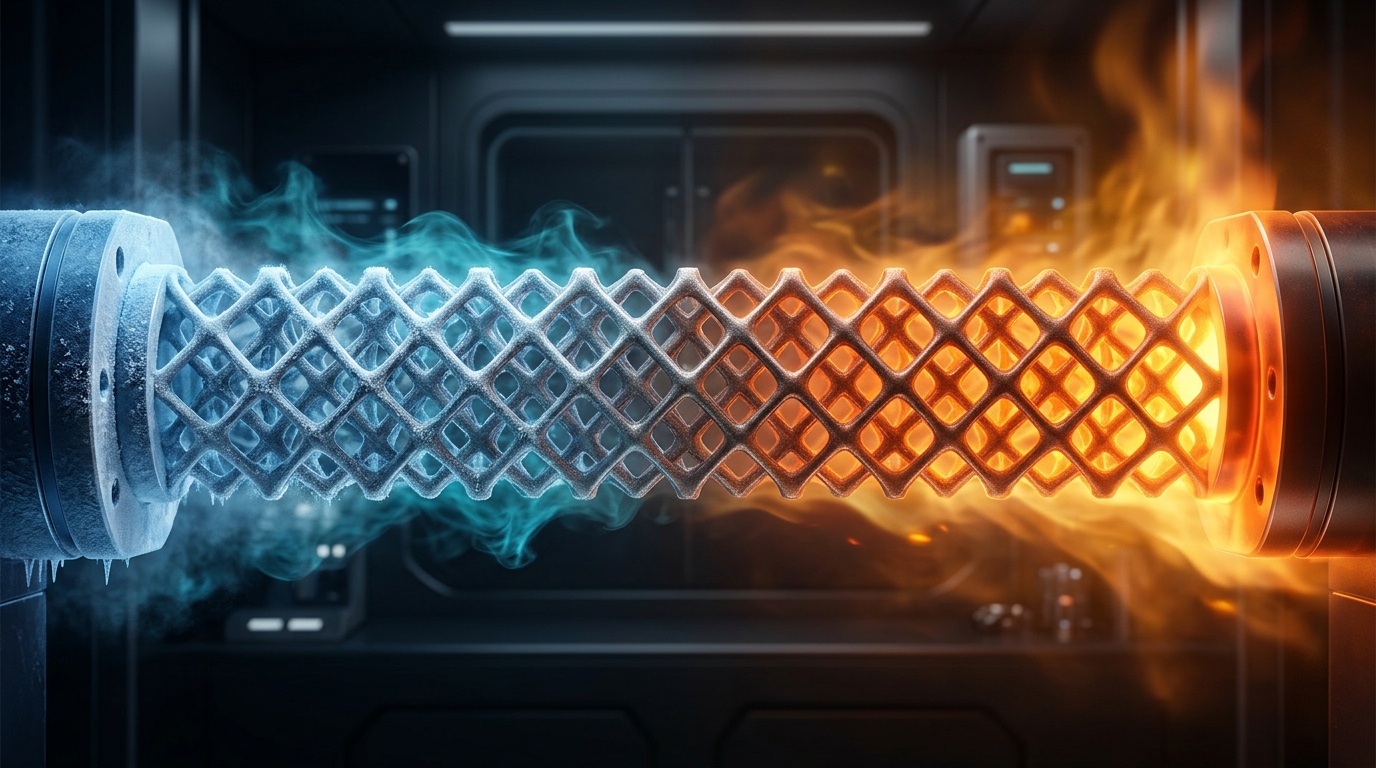
A laser-based 3D-printing process has produced a multi-principal element alloy that holds a yield strength above 1 gigapascal and a uniform elongation of roughly 20 percent across a temperature span from 77 to 873 kelvin, according to a study published in Nature Materials. The alloy, with the composition (CrFeCo)48Ni34Al7Ti5V5Ta1, forms its strengthening microstructure during printing itself, removing the need for the post-processing heat treatments that similar alloys normally require.
Multi-principal element alloys contain several principal elements in substantial proportions rather than one dominant metal. Cr–Fe–Co–Ni–Al–Ti-based members of this family typically depend on L12-type precipitate strengthening, which is introduced through post-processing. The authors note that such treatments rarely ensure stable mechanical performance over a wide temperature range, which motivated their search for a route in which the strengthening structure emerges intrinsically during laser-based additive manufacturing.
Using laser powder bed fusion, the team obtained a self-assembled cellular network of body-centred cubic and L21 precipitates inside the as-built material. The precipitate network forms during the process itself, so the printed part arrives with its strengthening architecture already in place. Figures in the paper document this cellular network in the as-built alloy and the tensile response of the laser powder bed fusion-fabricated material.
The mechanical behaviour rests on two pillars described in the study. The first is interface-mediated plasticity: slip transfer and back-stress hardening operate across Kurdjumov–Sachs and Nishiyama–Wassermann interfaces, the crystallographic relationships that connect the precipitate network to the surrounding matrix. Transmission electron microscopy and transmission Kikuchi diffraction analyses of samples tensile-deformed at 298 kelvin, and of samples deformed to 15 percent true strain at 77 and 873 kelvin, trace how the microstructure responds under load at these temperatures.
The second pillar is thermal stability of the deformation mechanism itself. The researchers report a weakly temperature-dependent stacking fault energy in the alloy, and they calculated intrinsic stacking fault energies for different alloys to support this comparison. Because the energy landscape governing dislocation motion changes little with temperature, the dislocation-mediated deformation remains stabilised from 77 to 873 kelvin. Stacking fault energy is a key materials parameter that influences how crystals deform, and its weak temperature dependence here helps explain why strength and ductility persist together across such a wide thermal range.
The resulting tensile performance is notable for its consistency. The alloy maintains a yield strength above 1 gigapascal and a uniform elongation of approximately 20 percent over the wide temperature range studied, which the authors describe as relatively stable tensile performance. A comparison figure in the paper places the tensile properties of this material alongside conventional alloys and other Cr–Fe–Co–Ni–Al–Ti-based multi-principal element alloys.
Because the cellular network is process-intrinsic, the pathway circumvents the need for post-treatment. That matters for manufacturing economics and for geometric fidelity: parts can be printed into their final form with the strengthening structure already built in, rather than being sent through additional thermal cycles that can distort complex geometries. The authors state that their findings demonstrate that interface coherency engineering provides a foundation for designing strong yet ductile alloys with reduced temperature sensitivity via laser-based additive manufacturing.
The work also reveals interface-mediated plasticity mechanisms as a design lever in their own right. By engineering the coherency of the interfaces between precipitates and matrix, the study suggests, alloy designers can control how dislocations transfer through the microstructure and how back-stresses accumulate, tuning strength and ductility simultaneously rather than trading one against the other.
The study was published in Nature Materials in 2026 by Hyojin Park, Renhao Wu, Jae Heung Lee, Yoon-Uk Heo, Do Won Lee, Ji-Su Lee, Seon-Gyu Kim, Farahanz Haftlang, Sang Guk Jeong, Byeong-Joo Lee, Donghwa Lee and Hyoung Seop Kim, with the DOI 10.1038/s41563-026-02792-3. Its combination of a self-assembled precipitate architecture, coherent-interface plasticity and weakly temperature-dependent stacking fault energy points toward 3D-printed structural alloys whose mechanical properties hold steady whether they serve in cryogenic equipment or in high-temperature machinery.
Subject of Research: A 3D-printed multi-principal element alloy with a self-assembled precipitate cellular network that sustains strength and ductility across a wide temperature range.
Article Title: Process-intrinsic cellular network for sustained strength–ductility across temperatures in a 3D-printed multi-principal-element alloy
Article References: Park, H., Wu, R., Lee, J. H., Heo, Y.-U., Lee, D. W., Lee, J.-S., Kim, S.-G., Haftlang, F., Jeong, S. G., Lee, B.-J., Lee, D., & Kim, H. S. (2026). Process-intrinsic cellular network for sustained strength–ductility across temperatures in a 3D-printed multi-principal-element alloy. Nature Materials. https://doi.org/10.1038/s41563-026-02792-3
Image Credits: AI Generated
DOI: 10.1038/s41563-026-02792-3
Keywords: additive manufacturing, multi-principal element alloys, laser powder bed fusion, precipitate strengthening, stacking fault energy, interface coherency, yield strength, ductility, high-temperature alloys, cryogenic materials, dislocation plasticity, alloy design
News Source: Denise Maddox. (November 4, 2026). 3D-printed alloy keeps strength and ductility from cryogenic to high temperatures. Scienmag.