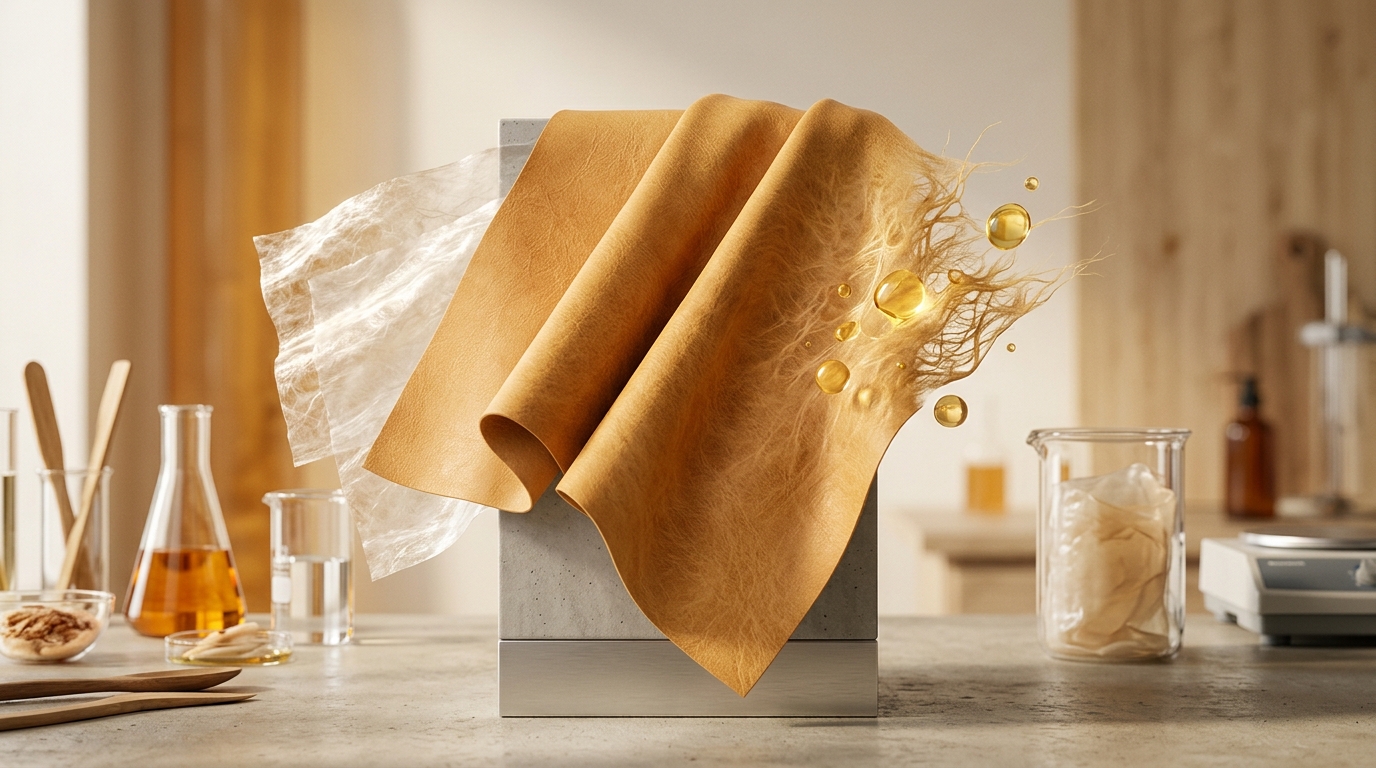
Researchers in China have engineered a bio-inspired leather material from bacterial cellulose, collagen, and a fully bio-based adhesive made from epoxidized soybean oil and citric acid, and the resulting composite reaches a tensile strength of 57.3 megapascals with an elongation at break of 32.2 percent. The work, published on 1 November 2026 in Collagen and Leather, addresses two long-standing weaknesses of bacterial cellulose as a leather substitute: brittleness after drying and rapid water uptake.
Bacterial cellulose has attracted attention as a candidate for bio-inspired leather because it is renewable and mechanically strong, produced by bacteria in static liquid cultures that take days to a week rather than the weeks-long solid-state fermentation needed for mycelium materials. But the material carries up to 98 percent water in its native state, and when it dries, an extensive hydrogen-bonding network pulls the nanofibers together, leaving thin, brittle films that deform when rehydrated. In previous work, the researchers deposited collagen into the bacterial cellulose through repeated immersion in collagen and tannic acid solutions, producing a composite with a tensile strength of 53.42 megapascals and an elongation at break of 21.3 percent. That material retained a porous structure and improved toughness, yet it remained strongly hydrophilic and prone to wrinkling, two problems the new adhesive strategy was designed to solve.
The adhesive itself is a cross-linked network formed by heating epoxidized soybean oil with an aqueous citric acid solution at 90 degrees Celsius. Epoxidized soybean oil contains long fatty acid chains that contribute hydrophobicity and reactive epoxy groups that undergo ring-opening addition reactions with the carboxyl groups of citric acid, forming ester bonds and a three-dimensional network. The team monitored viscosity with an Ubbelohde viscometer and found that a formulation designated ESO-30/CA, containing 30 grams of epoxidized soybean oil, reached gelation fastest at 60 minutes at 90 degrees Celsius, which they selected as the optimal preparation condition. Fourier transform infrared spectroscopy confirmed the chemistry: the epoxy absorption peak at 827 per centimeter disappeared in the cross-linked network, part of the citric acid hydroxyl bending band diminished, and the carbonyl peak shifted to a higher wavenumber, together indicating consumption of epoxy groups and formation of new ester linkages.
Bonding tests showed the adhesive performs best on porous, cellulose-rich surfaces. On wood substrates it achieved a lap shear bond strength of 14.11 megapascals, compared with 7.26 megapascals on plastic, a difference the authors attribute to the porous structure and rough surface of wood, which lets the adhesive penetrate and anchor mechanically, plus possible chemical interactions between wood components such as lignin and cellulose and the functional groups in the adhesive. Because bacterial cellulose and wood share a cellulose-based composition and porous architecture, the researchers judged the adhesive suitable for their composite.
To build the leather-like material, the team coated the bacterial cellulose–collagen layer with the adhesive and pressed it onto a woven fabric substrate at 95 degrees Celsius under 1.0 megapascal for 5 minutes, then cured the assembly at 90 degrees Celsius for 12 hours. They also prepared composites on knitted and non-woven fabrics for comparison. The knitted and non-woven composites had lower moduli but elongation at break above 25 percent, indicating favorable flexibility. Ashby plots comparing tensile strength, Young’s modulus, and density against typical ranges for natural leather showed significant overlap, which the authors present as evidence of the composite’s potential as a leather alternative.
Tear and peel tests reinforced the case for the woven substrate. The woven composite reached a tear strength of approximately 50 newtons per millimeter, while the knitted and non-woven composites ranged from 10 to 20 newtons per millimeter, a gap the researchers link to the dense interlaced structure of woven fabric, which distributes stress during tearing. Peel strengths between the bacterial cellulose–collagen layer and all three substrates fell between 6 and 9 newtons per millimeter, with the woven and knitted versions slightly above 8 newtons per millimeter. Those values exceed the benchmarks the authors cite for practical leather goods, where bonding between shoe uppers and soles should not fall below 5 newtons per millimeter and leather bags generally require at least 3 newtons per millimeter.
Flexibility and wrinkle resistance improved markedly. The knitted composite performed poorly in recovery, with rapid and delayed recovery angles of 46.4 and 52.3 degrees, while the woven and non-woven substrates reached delayed recovery angles near 100 degrees. Durability has limits, however: after 5000 flexing cycles in a leather flexometer, surface cracking appeared on the composite, a result the authors acknowledge as a constraint on long-term service life.
Water resistance was a central goal, and the measurements show a dramatic shift from the starting material. Untreated bacterial cellulose was strongly hydrophilic, with a water contact angle of only 32.7 degrees, and a droplet vanished within about 5 minutes. Collagen and tannic acid treatment raised the contact angle to 87.2 degrees and extended wetting time to 7 minutes. The cured adhesive alone reached 118.8 degrees with a wetting time of 28 minutes, thanks to its non-polar alkyl chains and newly formed ester groups. In water soaking tests, the composite gained only 1.54 percent mass in the first 2 hours with nearly unchanged thickness, and after 24 hours the mass and thickness change rates reached approximately 33 percent and 12 percent. Water vapor transmission dropped to 0.026 kilograms per square meter per 24 hours after adhesive incorporation, a trade-off the authors accept, positioning the material for shoe uppers and bags rather than high-breathability garment leather.
Chemical and thermal testing mapped the material’s vulnerabilities. The cross-linked network remained stable in neutral and acidic conditions, with mass change below 20 percent and negligible tensile strength loss in water, detergent, sodium chloride, and hydrochloric acid solutions. But in 10 percent sodium hydroxide, mass change exceeded 70 percent and tensile strength fell by nearly 50 percent, reflecting alkaline hydrolysis of the ester bonds, and ethyl acetate exposure caused mass and strength losses above 30 percent. Thermogravimetric analysis showed the composite lost 88.1 percent of its mass on heating to 600 degrees Celsius, with decomposition peaks at 210, 348, and 397 degrees Celsius corresponding to glycerin, cellulose, and epoxidized soybean oil respectively, and no significant mass loss in the adhesive below 300 degrees Celsius.
Biodegradability, the property that motivates the entire project, survived the modifications. In soil burial tests, the bacterial cellulose–collagen layer alone was nearly fully degraded after 50 days, with a degradation rate of 98.8 percent. The pure adhesive began showing visible surface degradation after 50 days and reached 24.17 percent degradation after 100 days. The full woven composite lost 42.4 percent of its weight in the first 50 days, driven mainly by the bacterial cellulose–collagen portion, and reached 69.77 percent weight loss after 150 days of burial. The authors conclude that the composite offers a viable route to environmentally friendly leather alternatives for footwear, bags, and packaging, while noting that further work is needed on long-term durability, life-cycle environmental assessment, interfacial engineering, and scale-up under realistic service conditions.
Subject of Research: Development of a flexible, hydrophobic bio-inspired leather material from bacterial cellulose, collagen, and an epoxidized soybean oil–citric acid bio-adhesive laminated onto textile substrates
Article Title: A novel bio-inspired leather material engineered from bacterial cellulose–collagen and epoxidized soybean oil–citric acid adhesive
Article References: Yu, Q., Ji, Q., Tan, W., Zhang, Z., Zhang, Y., Xu, J., Ma, B., & Yuan, J. (2026). A novel bio-inspired leather material engineered from bacterial cellulose–collagen and epoxidized soybean oil–citric acid adhesive. Collagen and Leather, 8(1), Article 42. https://doi.org/10.1186/s42825-026-00266-5
Image Credits: AI Generated
DOI: 10.1186/s42825-026-00266-5
Keywords: bacterial cellulose, collagen, epoxidized soybean oil, citric acid, bio-inspired leather, biodegradable materials, hydrophobicity, textile lamination, tensile strength, sustainable materials, soil burial biodegradation, woven fabric composite
News Source: Denise Maddox. (November 4, 2026). Bacterial Cellulose and Soybean Oil Adhesive Yield Flexible Bio-Inspired Leather. Scienmag.