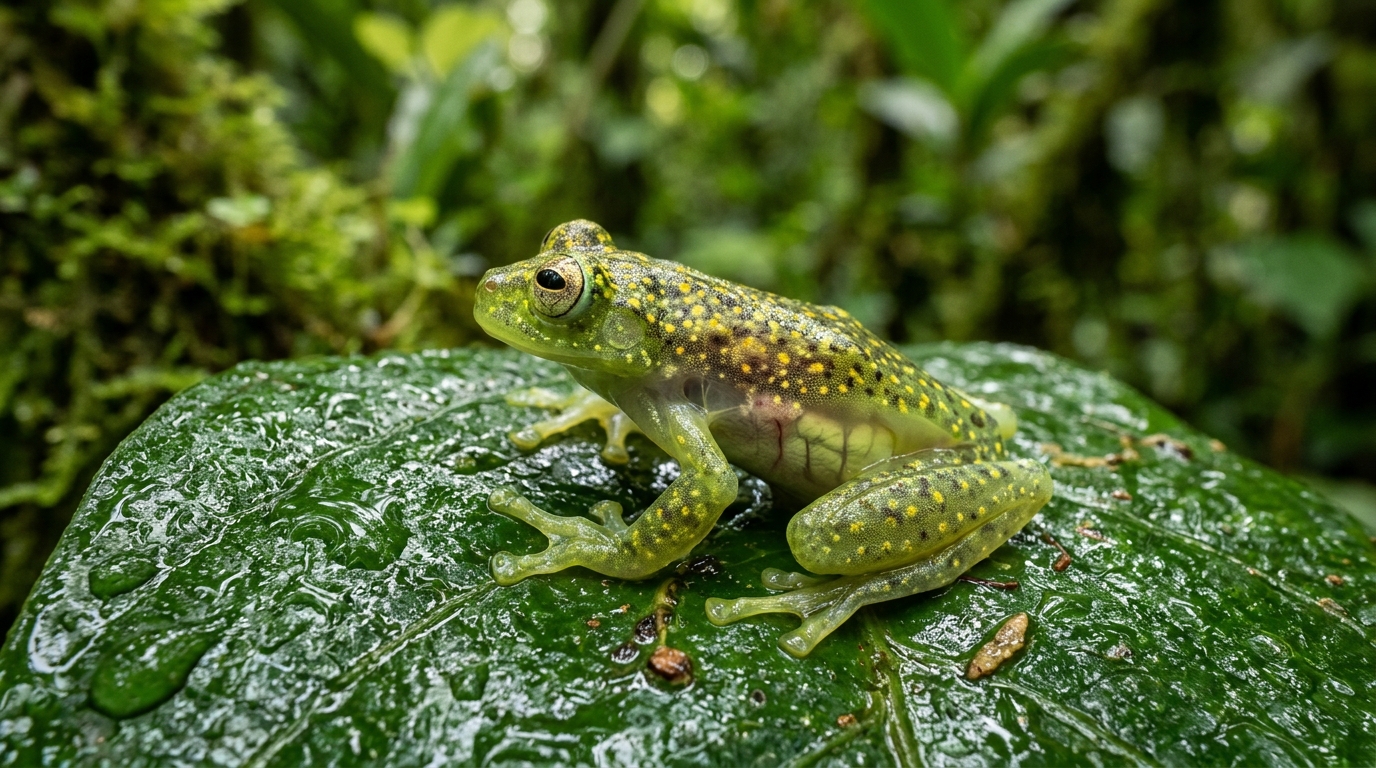
Spotted patterns on glass frogs can significantly reduce predation risk by partially concealing the opaque internal organs that would otherwise undermine the animals’ translucent camouflage, according to a field experiment conducted in an Ecuadorian rainforest. The study, published in Ecology and Evolution, found that model frogs bearing green spots on their dorsal surface were attacked far less often than unspotted models, regardless of whether the rest of the body was opaque or translucent.
Glass frogs are famous for their see-through skin, which in many species allows a direct view of the heart, bones, and other internal organs. Yet transparency in this family varies enormously, from species such as Hyalinobatrachium that rank among the most transparent terrestrial vertebrates to nearly fully opaque species such as Sachatamia orejuela. Even in the most transparent forms, the dorsal skin remains pigmented, producing a translucent green appearance rather than perfect invisibility. Because these frogs spend much of their time on living green leaves, that green-biased translucency is thought to provide effective background matching across a range of natural substrates.
Transparency, in theory, offers unusually precise camouflage because the substrate itself remains visible through the body. In practice, however, concealment is limited by the difficulty of producing effective transparency across large portions of the body, and by the presence of obligate opaque structures such as bones and viscera. Some species have evolved specialist adaptations to boost transparency, including storing red blood cells in the liver while at rest. But the question of how opaque internal features interact with translucent body tissue has remained largely unresolved, and the role of the opaque dorsal spots found in many glass frog species was essentially unknown.
To test whether spots could rescue the camouflaging benefits of translucency, researchers built on a previous field predation experiment. That earlier work had shown that when opaque, saliently colored structures representing the frogs’ viscera were visible inside gelatin models, the survival advantage of translucent camouflage was significantly weakened. The new study asked whether opaque green spots on the dorsum could reduce the detectability of those internal structures while preserving the benefits of translucency.
The team constructed four types of gelatin model frogs, each scaled to 25 millimeters to match the body length of the glass frog Espadarana prosoblepon. The models varied in opacity and in the presence of a spotted pattern: opaque-spotted, opaque-unspotted, translucent-spotted, and translucent-unspotted. Every model contained an opaque white dorsolateral stripe embedded in the gelatin to represent the internal organs. The spots, made from flattened green clay disks roughly the size of spots seen in some Hyalinobatrachium species at the site, partially covered the internal stripe but did not hide it completely. The pattern treatments were not designed to mimic any particular species but to examine fundamental questions about opaque patterning in translucent camouflage.
The researchers deployed 960 models along a roughly 780-meter transect in the Mashpi-Tayra Wildlife Refuge in Pichincha, Ecuador, in a randomized block design. Each of 60 blocks contained one of each of the eight model type and height combinations, with models placed at about 0.5 meters or 1.5 meters above the forest floor. Models were attached to living leaves and checked at 24, 48, and 72 hours for signs of predation. Predator identity was inferred from marks left in the gelatin: V-shaped slices indicated bird beaks, parallel lines indicated rodent incisors, U-shaped patterns of holes indicated lizard teeth, and small rough pits or scratches indicated invertebrates. The experiment was run in two sequential rounds in December 2025, with model locations independently randomized between rounds.
In the analysis including all likely vertebrate predation events and missing models, 493 of the 960 models, or 51 percent, showed evidence of predation, including 388 attacked and 105 missing. Model survival did not differ significantly by height, but there was a significant effect of model type. Pairwise contrasts revealed no significant effect of translucency: spotted opaque models survived at rates statistically indistinguishable from spotted translucent models, and the same held for unspotted pairs. In contrast, spotted models had significantly lower predation risk than unspotted models, whether the underlying body was opaque or translucent. The conservative analysis restricted to confirmed bird attacks, which accounted for 219 of 960 models, or 23 percent, produced the same pattern: no effect of translucency, but a clear survival advantage for spotted models over unspotted ones in both opacity categories.
The findings suggest that opaque structures within the body, such as the viscera, can reduce the survival benefits of translucent camouflage, but that patches of dorsal pigmentation can significantly reduce the heightened predation risk associated with visible internal organs. Crucially, the spots did not restore the cryptic effects of translucency reported in earlier work with models lacking visible internal structures. The authors suggest this may be because the opaque internal stripe, even when partially covered by spots, remained too salient to be effectively counterbalanced by the translucent areas. The benefit of the spots is therefore best explained as partially blocking the conspicuous internal stripe from view, effectively increasing the area of background matching rather than producing disruptive camouflage.
Disruptive camouflage through differential blending, in which different pattern components match different parts of the background so the target appears broken up, has been proposed to explain the wings of moths that combine transparent and opaque patches. Small transparent patches on otherwise cryptic moth wings can reduce detectability, and partial transparency along wing edges can provide edge disruption. The glass frog results contrast with those studies, possibly because the translucent patches in the frog models were comparatively small, the opaque regions did not match the background well enough, or the pattern edges exceeded the contrast boundaries found in the substrate. The homogeneous surface of living leaves may also provide too little variation in color and luminance for differential blending, unlike the more complex backgrounds used in the moth experiments. Alternative mechanisms such as edge diffusion, in which a smooth gradient from opaque to translucent blends the target into the background, may be more effective on leaves, and small opaque spots overlaid on such gradients could mimic leaf imperfections such as damage or fungal growth.
Unlike a previous experiment in which models placed lower to the ground were attacked more often, height had no significant effect on survival in this study. The difference may reflect seasonal variation in predation pressure, since this experiment ran in the wetter December season while the earlier work took place in the drier June season, though the authors note they lack precise data on which predator species attack the models and how predator behavior changes with height, time of day, or season. The broader implication is that transparency does not always confer effective concealment, and that camouflage may be limited by both the degree of transparency and the efficacy of opaque background matching. Opaque dorsal patterns, which range from small brightly colored spots to large blotches and reticulations across glass frog species, may function to conceal the animals’ highly salient internal organs from view, and the authors call for more work on how background structure affects the evolution and detectability of partial and imperfect transparency.
Subject of Research: How opaque dorsal spots affect the camouflage and predation risk of translucent glass frogs
Article Title: Spotted Patterns of Glass Frogs Can Disguise Imperfections in Transparency to Improve Camouflage
Article References: Yeager, J., Ávila, L., & Barnett, J. B. (2026). Spotted Patterns of Glass Frogs Can Disguise Imperfections in Transparency to Improve Camouflage. Ecology and Evolution, 16(11), Article e74623. https://doi.org/10.1002/ece3.74623
Image Credits: AI Generated
DOI: 10.1002/ece3.74623
Keywords: glass frogs, camouflage, transparency, predation, dorsal spots, Ecuador, field experiment, gelatin models, background matching, disruptive camouflage, Centrolenidae, animal coloration
News Source: Drew Townsend. (November 4, 2026). Spots on Glass Frogs Hide Internal Organs and Cut Predation Risk. Scienmag.