Direct seeding of upland rice together with legume intercropping has delivered striking gains on one of Cameroon’s most widely cultivated tropical soils, according to a field study published in BMC Agriculture. On a Haplic Ferralsol at Mendong, rice intercropped with beans under no-till direct seeding reached grain yields of 3.30 tonnes per hectare with NERICA 8 and 2.40 tonnes per hectare with the local variety known as rice two months, outperforming conventional tillage monoculture. On a contrasting Dystric Nitisol at Goufan 2, rice plants never reached the reproductive phase at all, leaving no grain yield to record under any treatment. The contrast between the two soils, the researchers report, was the dominant factor shaping every stage of the cropping system.
The experiment ran from April to July 2018 at two sites in Cameroon’s bimodal rainforest zone, an agroecological region receiving more than 1,600 millimetres of rain annually. Mendong, at 717 metres above sea level, sits on a Haplic Ferralsol under a sheltered subequatorial climate, while Goufan 2, at 479 metres, lies on a Dystric Nitisol under a continental subequatorial climate. Goufan 2 recorded higher maximum, minimum and mean temperatures of 29.4, 20.8 and 25.1 degrees Celsius respectively, compared with 28.1, 19.0 and 23.6 degrees Celsius at Mendong. Mean rainfall during the experimental period was nearly identical between the sites, at 147 millimetres at Mendong and 146 millimetres at Goufan 2, but the warmer conditions at Goufan 2 likely increased evaporative demand and water stress on the already constrained soil.
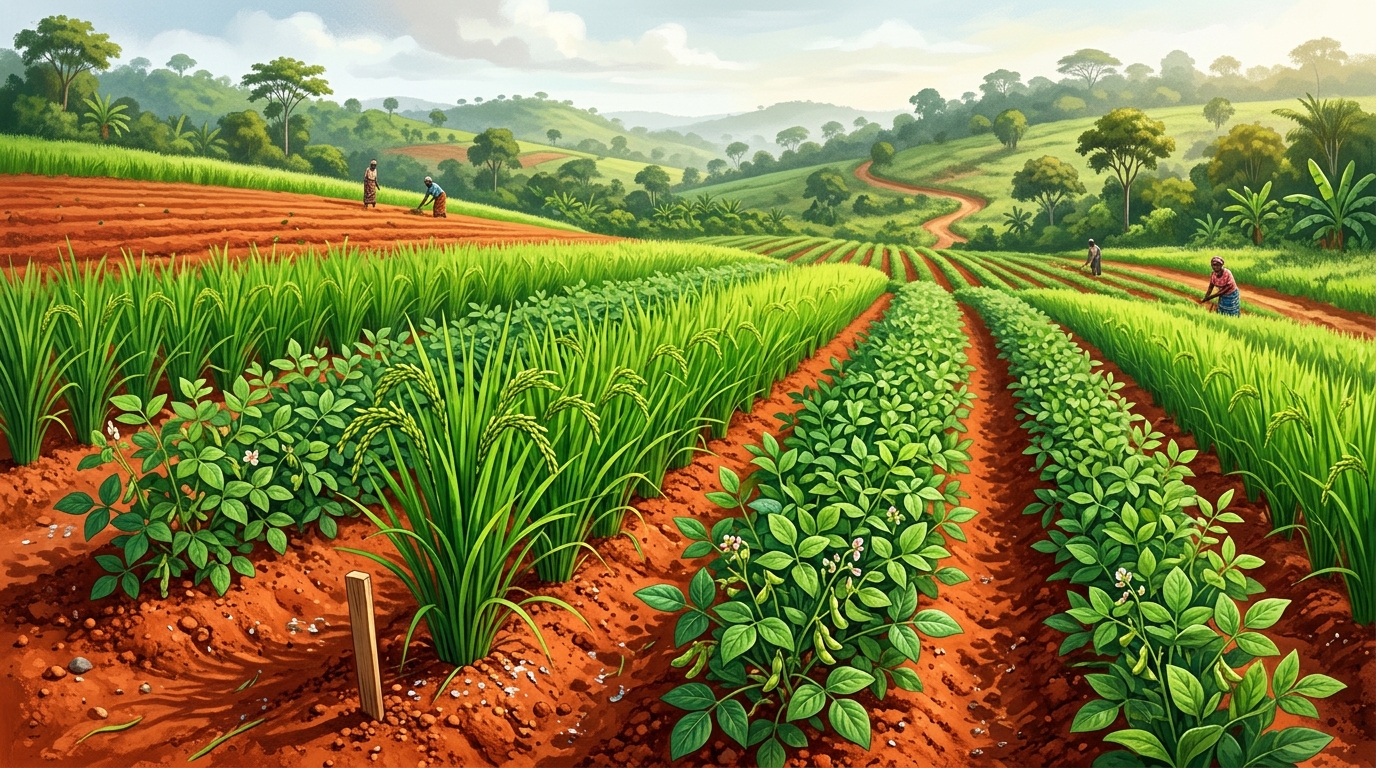
The trial used a split-split-plot design with three replications and plots of four square metres. Soil type served as the whole-plot factor, cropping system as the subplot factor, and rice variety or intercropping combination as the sub-subplot factor. Two rice varieties were tested: NERICA 8, an improved variety developed by AfricaRice, and the local rice two months. Under conventional tillage, each variety was grown alone in hand-plowed plots. Under direct seeding with legume intercropping, the no-till plots carried four rice-legume combinations, pairing each variety with beans, Phaseolus vulgaris var. Nitu, or cowpea, Vigna unguiculata. Rice was sown in mid-April at six seeds per hill spaced 30 by 30 centimetres, and legumes followed two weeks after rice emergence, placed midway between adjacent rice rows.
Soil analysis explained much of what followed in the field. The Dystric Nitisol was coarser, with 90 percent sand and 4 percent clay, a higher bulk density of 1.675 kilograms per cubic decimetre, and lower porosity of 36.79 percent. The Haplic Ferralsol held 73 percent sand and 22 percent clay, a bulk density of 1.034 kilograms per cubic decimetre, and 60.98 percent porosity. The Ferralsol also contained substantially more organic carbon, 2.09 percent against 0.78 percent, and more organic matter, 3.61 percent against 1.34 percent. Although the Nitisol scored higher on the soil fertility index, 14 against 10, the soil evaluation factor was slightly higher for the Ferralsol, 12 against 11, indicating that the Ferralsol’s physical and chemical properties better support nutrient availability and plant growth under field conditions.
Rice establishment and growth diverged sharply between the soils. Emergence rates were consistently higher on the Ferralsol, where tillage produced the highest rates of 85 to 98 percent and direct seeding with legume intercropping averaged 75 to 85 percent. On the Nitisol, emergence fell to 50 to 65 percent under tillage and 40 to 55 percent under direct seeding. By week nine after sowing, plant heights on the Ferralsol ran 50 to 65 percent above those on the Nitisol, with the tallest rice, 31 centimetres, in the NERICA 8-cowpea association under direct seeding. Leaf production on the Nitisol plateaued at four to six leaves, a 58 percent decrease relative to the Ferralsol, and stem diameters there reached only 0.20 to 0.25 centimetres, against 0.47 centimetres for the best Ferralsol treatment. Legumes showed the same pattern: cowpea in the local rice association stretched to 73 centimetres with up to 20 leaves on the Ferralsol, while legumes on the Nitisol stopped at 23 centimetres and six to eight leaves.
Root development, tillering and dry matter followed suit. At week nine, rice root height on the Ferralsol ranged from 12.4 centimetres under local rice tillage to 22.0 centimetres under local rice-cowpea direct seeding, while Nitisol treatments spanned only 6.5 to 15 centimetres. At harvest, local rice intercropped with cowpea on the Ferralsol reached 70.0 centimetres in plant height and 22.0 centimetres in root height, and direct seeding significantly enhanced root development and dry matter content, particularly in cowpea treatments. Dry matter content rose 15 to 20 percent under rice two months-bean systems, according to the study’s results summary.
Grain yield told the clearest story of all. Rice yield was recorded only on the Ferralsol, because Nitisol plants failed to reach the reproductive phase. Among the Ferralsol treatments, direct-seeded intercrops outperformed conventional tillage monoculture by 13 to 30 percent in grain yield, with NERICA 8-beans at 3.30 tonnes per hectare and local rice-beans at 2.40 tonnes per hectare the strongest performers. Grain weight was also higher in the intercropped treatments, which the authors interpret as enhanced grain filling and yield stability. Legume productivity mirrored this advantage: beans intercropped with local rice achieved the highest legume yield at 6.78 tonnes per hectare, while cowpea intercropped with NERICA 8 recorded the highest legume dry matter content at 33.54 percent.
Nodulation added a nuance that the researchers flag as functionally important. The Dystric Nitisol actually promoted higher nodule numbers, with beans forming up to 83 nodules and cowpea 60, yet the Ferralsol supported greater nodule dry matter content and volume, indicating superior functional nodulation. The authors argue that nodule quality, not just quantity, determines how effectively legumes can facilitate rice growth, and they attribute the Nitisol’s many but small nodules to intermittent moisture stress that restricted nodule enlargement and biomass accumulation. They caution, however, that soil temperature, evaporative losses and nitrogen fixation rates were not directly measured in this study, so conclusions about these mechanisms rest on inference from indirect indicators such as plant growth, nodule biomass and yield.
The intercropping efficiency indices quantified the system’s biological and economic performance. Land equivalent ratios ranged from 2.57 to 3.67 across all intercropped treatments, indicating substantial productivity gains per unit of land compared with sole cropping. The highest monetary advantage index, 4.94, was observed for local rice intercropped with beans, which the researchers cite as confirmation of the economic and biological advantages of combining short-duration rice with beans. Direct seeding of the local rice variety with legumes achieved the highest overall productivity in the trial, with a land equivalent ratio of 3.67 and a monetary advantage index of 4.94.
The authors conclude that direct seeding with legume intercropping on Haplic Ferralsol is a productive, resource-efficient and economically viable strategy for strengthening rainfed rice production in Cameroon’s bimodal rainforest zone. But they are explicit about the limits of the evidence. The findings come from two locations and a single growing season, the absence of grain yield data on the Nitisol prevents complete performance assessment under poor soil conditions, and pest pressure, disease incidence and weed dynamics were not systematically quantified. Key mechanisms were inferred rather than measured, and sample size limits statistical power for assessing soil-climate interactions. Broader validation across multiple agroecological zones, longer-term monitoring and investigation of adaptive strategies for marginal soils, they write, are necessary before these systems can be judged sustainable and generalizable for sub-Saharan African farming contexts.
Subject of Research: Agronomic performance of direct-seeded upland rice-legume intercropping on two contrasting tropical soils in Cameroon's bimodal rainforest zone
Article Title: Agronomical performance and sustainability of direct-seeded upland rice–legume intercropping on contrasting tropical soils in the bimodal rainforest zone of Cameroon
Article References: Kenmogne-Nuemsi, P.-P., Na-Ah, R.-F., Mir, B.-A., Temegne-Nono, C., Kamtchoum, S.-M., Ntsomboh-Ntsefong, G., Ngouana-Tchinda, L.-S., Youmbi, E., & Tonfack, L.-B. (2026). Agronomical performance and sustainability of direct-seeded upland rice–legume intercropping on contrasting tropical soils in the bimodal rainforest zone of Cameroon. BMC Agriculture, 2(1), Article 34. https://doi.org/10.1186/s44399-026-00058-6
Image Credits: AI Generated
DOI: 10.1186/s44399-026-00058-6
Keywords: upland rice, legume intercropping, direct seeding, no-till, Haplic Ferralsol, Dystric Nitisol, Cameroon, NERICA 8, cowpea, beans, land equivalent ratio, soil fertility
News Source: Alan Morgan. (November 4, 2026). Direct-Seeded Rice and Legumes Thrive on Cameroon’s Ferralsol, Study Finds. Scienmag.