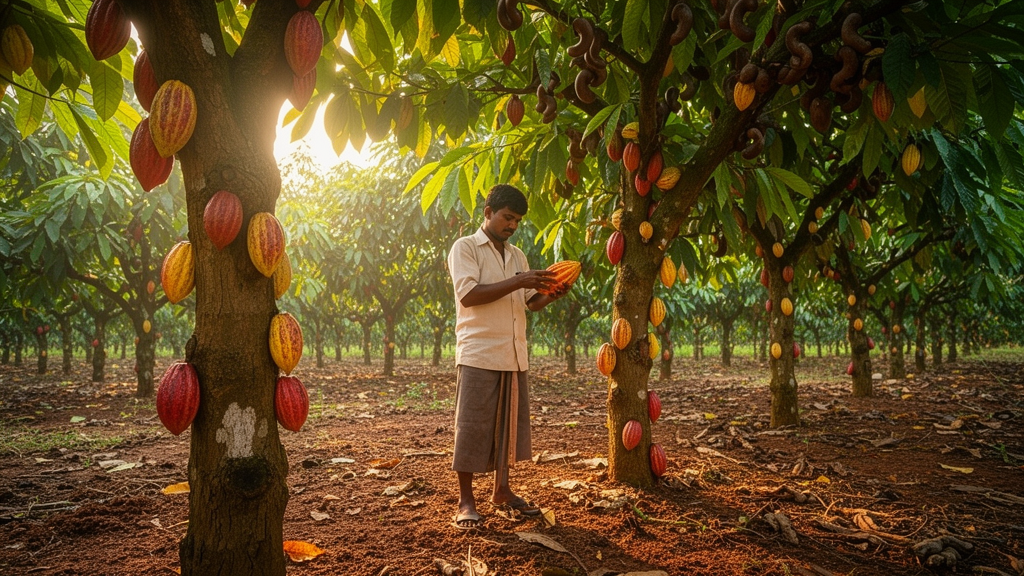
Smallholder farmers in the southern Indian state of Kerala who cultivate cocoa and cashew together on the same land report higher household incomes and better food security than those growing either crop alone, according to a new survey-based study. The research, published in the journal Agriculture & Food Security, surveyed 412 smallholder farmers across five of Kerala’s major cocoa- and cashew-producing districts and applied statistical models to examine how this dual cash-crop system relates to economic and food outcomes. The authors are careful to frame their findings as statistical associations rather than proof of cause and effect, but the pattern they document is consistent across several analytical approaches.
The study focused on Kasaragod, Kannur, Wayanad, Malappuram and Idukki districts, chosen because they represent different points along Kerala’s intercropping spectrum. Idukki produces close to 40 percent of the state’s cocoa and is dominated by cocoa grown under coconut and areca nut shade, while Wayanad and Kannur are expanding cocoa areas, and Kasaragod and Malappuram are major cashew producers where cocoa intercropping is gaining ground for its land-use efficiency. Farmers were selected through multi-stage random sampling, drawing on official farmer lists from local agricultural offices and registered cooperative societies, and households were grouped as cashew monocrop, cocoa monocrop or intercropping farmers to ensure proportional representation.
Food security was measured using a perception-based composite aligned with the four dimensions of the Food and Agriculture Organization’s framework: availability, accessibility, utilization and stability. Each dimension was captured with a single five-point Likert-scale statement, and the four items were averaged into a composite score. The availability item, which asked whether intercropping had reduced staple food production, was reverse coded so that higher values uniformly indicated greater food security. The authors report that the composite showed good internal reliability, with a Cronbach’s alpha of 0.823, but they stress that the score reflects farmers’ perceived food security rather than objective intake-based measures such as the Household Food Insecurity Access Scale.
The analysis began with ordinary least squares regression, treating household income and the food security score as dependent variables and the intercropping ratio, the proportion of land jointly cultivated with cocoa and cashew, as the key independent variable alongside farm size, market access, input costs, cooperative membership and technical training access. Because adoption of intercropping is potentially endogenous, meaning that more progressive or better-resourced farmers may be both likelier to adopt the practice and likelier to enjoy better outcomes, the researchers complemented the regression with propensity score matching. This quasi-experimental technique pairs adopters with comparable non-adopters based on observable characteristics, reducing selection bias from measured factors, though it cannot account for unobserved confounders.
The results pointed in the same direction across methods. In the regression, a higher intercropping ratio was significantly associated with higher annual household income, and cooperative membership and farm size emerged as strong predictors of food security, while greater distance from markets carried a negative coefficient, suggesting that farmers farther from market centres face lower income and weaker food access. The propensity score matching analysis, using nearest neighbour matching with a caliper of 0.05, estimated that intercropping adopters earned about 5,432 rupees more per year and scored roughly 0.36 points higher on the food security composite than matched non-adopters, with post-matching covariate balance diagnostics indicating successful comparability between groups.
Adoption itself was examined with a binary logistic regression focused on institutional, financial and technical determinants. Access to technical training and technical knowledge stood out as the strongest predictors: farmers with training access were 3.45 times more likely to adopt intercropping, and those with stronger technical knowledge 2.96 times more likely. Access to credit was associated with 2.18 times higher odds of adoption and government incentives with 1.46 times higher odds, while high initial investment costs significantly reduced the likelihood of adoption, with an odds ratio of 0.71. Market price stability also supported adoption, indicating that farmers respond to predictable cocoa and cashew prices when deciding whether to diversify their holdings.
Not every expected driver held up under statistical scrutiny. Land tenure security, formal education level and access to financial services showed no significant association with household income or adoption decisions in the models that tested them. The authors suggest that many smallholders in Kerala farm under informal or inherited tenure arrangements yet still intercrop, that hands-on farming experience and extension support may matter more than formal schooling, and that credit in the region is often used for short-term operating expenses rather than the long-term investment that establishing an intercropping system requires. In their reading, collective and institutional mechanisms, particularly cooperative-led training and stable market links, outweigh individual endowments such as land titles or education in shaping adoption.
Farmers’ own perceptions, gathered through Likert-scale items, broadly echoed the quantitative picture. Respondents strongly agreed that intercropping enhances yields, with a mean agreement score of 4.1, and supported its role in soil conservation, pest resistance and reduced reliance on chemical pesticides. Drought intensity and rainfall unpredictability were ranked as the most significant threats to crop success, followed by soil erosion and temperature variability. Income stability received the lowest benefit score, at 3.4, reflecting persistent concern about market volatility, input costs and unstable pricing, a worry that aligns with the study’s finding that market access constraints remain a major limiting factor for intercropping households.
The survey also identified structural barriers that could slow wider adoption. Restricted market access and high initial investment costs were flagged as the principal constraints on scaling up the practice, and roughly half of the surveyed farmers lived within five kilometres of a market while a fifth were more than ten kilometres away, a distance associated with logistical challenges. On the environmental side, the study reports that intercropping was associated with improved soil health, reduced erosion and decreased pesticide reliance, positioning the cocoa-cashew combination as a pathway that pairs economic returns with ecological benefits in a state marked by high population density and fragmented landholdings.
The authors are explicit about the limits of what their data can show. The cross-sectional design captures a single point in time and cannot establish definitive causality, propensity score matching cannot control for unobserved confounders, and the findings are specific to Kerala’s distinct agro-ecological and institutional setting, which may limit generalizability elsewhere. Food security was assessed through perception-based measures rather than validated experiential scales, and the study examined only the cocoa-cashew combination, not broader food-crop intercropping systems. The researchers recommend longitudinal or panel data designs, stronger causal inference techniques such as instrumental variable or difference-in-differences approaches, and comparative studies across regions. On the policy front, they argue that scaling intercropping will require strengthened farmer training programmes, cooperative-based marketing, investment in rural infrastructure and targeted financial incentives designed specifically for intercropping systems rather than generic credit schemes.
Subject of Research: Cocoa-cashew intercropping and its association with household income and food security among smallholder farmers in Kerala, India
Article Title: Cash crops vs. food security? Examining the role of Cocoa-Cashew intercropping in smallholder farming systems
Article References: Chandran MC, S., Chandran, R., Sahib, P. R., & Achuthan, K. (2026). Cash crops vs. food security? Examining the role of Cocoa-Cashew intercropping in smallholder farming systems. Agriculture & Food Security, 15(1), Article 32. https://doi.org/10.1186/s40066-026-00620-0
Image Credits: AI Generated
DOI: 10.1186/s40066-026-00620-0
Keywords: cocoa, cashew, intercropping, smallholder farmers, food security, Kerala, household income, propensity score matching, agricultural adoption, cooperatives, cash crops, India
News Source: Alan Morgan. (October 30, 2026). Cocoa-Cashew Intercropping Linked to Higher Income and Food Security in Kerala. Scienmag.