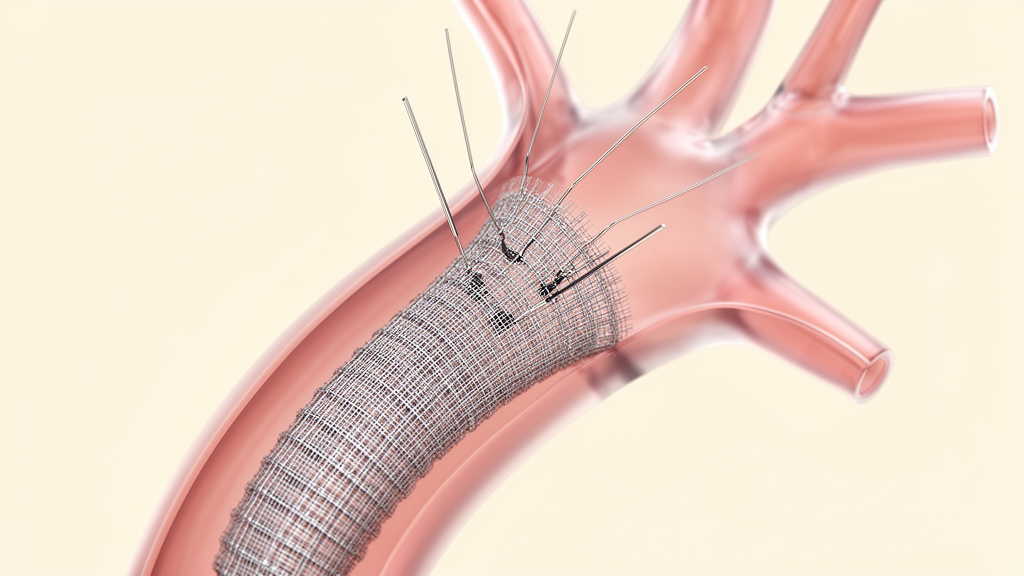
Aortic arch disease has long been one of the most demanding territories in vascular medicine. The traditional answer, total arch replacement, requires opening the chest, stopping the heart, and cooling the body into hypothermic circulatory arrest, a combination that carries substantial mortality and morbidity. A new retrospective study now reports early and midterm results for a fully endovascular alternative that rebuilds all three arch branches from inside the vessels, using needles, guidewires, and stent-grafts rather than a scalpel. In 36 consecutive patients treated between August 2022 and April 2025, the procedure achieved a technical success rate of 94.4%, with no aorta-related deaths during a median follow-up of 19 months.
The technique, described in CVIR Endovascular, is called total endovascular aortic arch repair, or TEAAR, performed via in situ microneedle fenestration with what the authors name the triple (stiff)-sheathed gutter technique. The central problem it solves is cerebral perfusion. When a stent-graft is deployed across the aortic arch in zone 0, it covers the origins of the brachiocephalic artery, the left common carotid artery, and the left subclavian artery, the vessels that feed the brain. Leaving those branches permanently closed is not an option, and temporarily closing them risks ischemic injury to the brain during the minutes needed to fenestrate the graft fabric and reline each branch with a stent.
The team’s answer to that perfusion gap is physically elegant. Before deploying the main stent-graft, the operators placed three 6-Fr, 90-centimeter-long sheaths into the ascending aorta, one via each radial artery and one via a femoral artery, and critically, they left the dilators and the super-stiff Lunderquist guidewires inside them during main graft deployment. Three rigid columns pressing against the conformable stent-graft prevent the fabric from sealing flush against the aortic wall, deliberately inducing a gutter, a crescent of preserved space through which blood continues to flow to the supra-aortic branches while the fenestrations are created. In an in vitro experiment with an aortic arch phantom, computed tomography confirmed the gutter and measured its cross-sectional area at 17.2% of the corresponding aortic area, roughly 1.677 of 9.754 square centimeters.
With cerebral flow maintained through that gutter, the reconstruction proceeded branch by branch. All cases were planned by a multidisciplinary board and performed under general anesthesia by two interventional radiologists with more than two decades of endovascular experience. The bilateral common carotid arteries, the left subclavian artery, and the right brachial artery were punctured in advance. For the brachiocephalic artery and left common carotid artery, a pre-curved 21-G microneedle was advanced through a 6-Fr sheath and rotated until its tip was optimally positioned, then pushed through the fabric of the deployed stent-graft. A guidewire passed into the aorta, the fenestration was sequentially dilated with balloons from 4 to 10 millimeters, and a covered stent was deployed as the first-choice bridging device for each branch.
The left subclavian artery demanded a different geometry. Its takeoff from the arch is sharply angled, so the operators manually pre-curved a 21-G, 15-centimeter trocar needle to match the angle between the branch and the arch, steering it from a left supraclavicular puncture site until its tip sat perpendicular to the graft fabric as confirmed on tangential and axial views. After puncture, a 300-centimeter guidewire was snared from the femoral side, establishing a through-and-through rail from the subclavian artery down to the groin, over which a 10-to-12-millimeter self-expanding covered stent was delivered through a 20-Fr femoral sheath. Only after all branch stents were placed were the three long gutter sheaths removed.
Throughout each case, the team continuously monitored regional cerebral oxygen saturation and invasive mean arterial pressure in both common carotid arteries. The measurements traced the technique’s physiology in real time. After main stent-graft deployment, carotid mean pressure fell from roughly 92 to about 74 millimeters of mercury on both sides, and oxygen saturation dipped slightly, evidence that the gutter was preserving, not eliminating, cerebral flow. After the brachiocephalic fenestration, oxygen saturation rose bilaterally, a consequence of the intracranial anterior circulation cross-connecting the two carotid territories, and pressure recovered on the right. Mean ischemia time for the brachiocephalic artery was 10.5 plus or minus 2.7 minutes, and for the left carotid, 19.5 plus or minus 3.1 minutes.
The clinical results were favorable, though not without complications. Of 36 patients treated for arch aneurysms exceeding 55 millimeters or non-A-non-B dissections involving all three arch branches, 34 procedures met the technical success definition, with the two failures being immediate type Ia endoleaks on the final angiogram that required no intervention and resolved spontaneously during follow-up. Cervical branch reconstruction succeeded in every case. Thirty-day mortality was 2.8%, one patient who died of severe pneumonia despite successful exclusion of the aneurysm. The overall stroke rate was 8.3%: one major stroke from a middle cerebral artery branch occlusion, treated with emergent mechanical thrombectomy with the patient’s modified Rankin Scale improving from 4 to 2 by discharge, and two minor lacunar strokes with full recovery.
During follow-up, three additional deaths occurred, from cerebral hemorrhage at 18 months, liver carcinoma at 24 months, and congestive heart failure at 32 months, bringing the all-cause death rate to 11.1% with no aorta-related deaths. Kaplan-Meier analysis estimated one- and two-year survival at 97.3% plus or minus 2.7% and 85.8% plus or minus 8.1%, respectively. Five patients, 13.9%, required reintervention: three for type Ib endoleaks from distal disease progression treated with additional distal TEVAR, one emergency thrombectomy for the major stroke, and one open surgical repair after retrograde type A aortic dissection appeared at the three-month mark. No branch stent stenosis, obstruction, or fracture was observed, and the cumulative freedom from reintervention was 87.5% plus or minus 5.9% at one year and 83.2% plus or minus 7.0% at two years.
The authors place these numbers in context honestly. Stroke remains the dominant concern after arch TEVAR, with published rates of 9% to 28.6%, and the 8.3% observed here exceeded the 3.7% to 6.0% reported for physician-modified stent-grafts, which involve no cerebral ischemia time and far less manipulation of the supra-aortic vessels. The likely culprit in the major stroke was excessive needle, catheter, and guidewire manipulation within an atherosclerotic arch. The technique also carries a theoretical risk of injuring the ascending aorta with multiple stiff sheaths and guidewires, and type III arches with steep branch angles may raise puncture failure risk. Still, compared with open arch replacement under hypothermic circulatory arrest, and with prior needle-fenestration series reporting success rates of 85.7% to 100%, the results suggest that a deliberately engineered gutter of rigid sheaths can keep blood flowing to the brain while a stent-graft is pierced and rebuilt from within.
Subject of Research: Total endovascular aortic arch repair using in situ microneedle fenestration with a triple-sheathed gutter technique
Article Title: Clinical outcomes of total endovascular aortic arch repair by in situ microneedle fenestration using the triple (stiff)-sheathed gutter technique
Article References: Ye, P., Miao, H., Zeng, Q., Liu, W., Ma, M., & Chen, Y. (2026). Clinical outcomes of total endovascular aortic arch repair by in situ microneedle fenestration using the triple (stiff)-sheathed gutter technique. CVIR Endovascular, 9(1), Article 138. https://doi.org/10.1186/s42155-026-00788-3
Image Credits: AI Generated
DOI: 10.1186/s42155-026-00788-3
Keywords: aortic arch, endovascular repair, stent-graft, in situ fenestration, stroke, endoleak, TEVAR, aortic dissection, cerebral perfusion, interventional radiology, retrospective study, Clinical
News Source: Ophelia Keating. (October 29, 2026). Needle-Fenestrated Stent-Graft Repair of the Aortic Arch Shows Durable Early Results. Scienmag.