


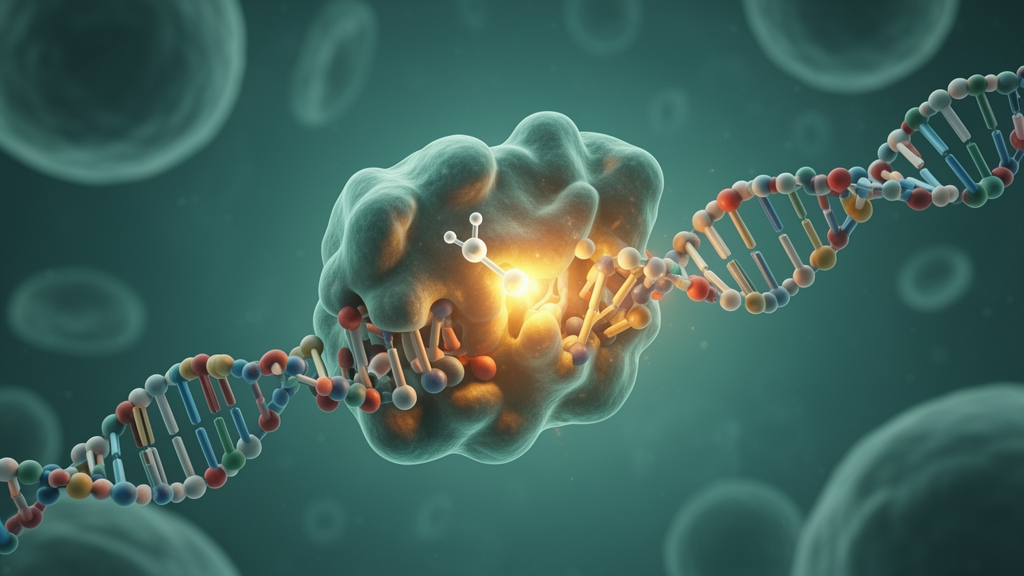
A chemical tag on one of the cell’s core translation factors turns out to be a hidden regulator of which proteins a cancer cell makes, according to a study published in Nature Cell Biology. The modification, dimethylation of the elongation factor eEF1A at lysine 55 (eEF1AK55me2), is installed by the enzyme METTL13, and the new work shows that it does far more than simply speed up protein synthesis in bulk. Instead, it selectively enhances the decoding of a specific subset of codons—the three-letter units of the genetic code—thereby boosting the production of pro-oncogenic proteins, including KRAS, and helping tumours resist KRAS-targeted drugs.
The research team, led by investigators including Shuo Liu, Or Gozani, Pawel K. Mazur and Scott C. Blanchard, combined quantitative proteomics, ribosome profiling and single-molecule fluorescence imaging to dissect the mechanism. Their central question was whether the translation elongation machinery harbours intrinsic mechanisms that selectively modulate codon decoding to shape proteomes—a question that had remained open despite decades of work on translational control in cancer.
To profile newly synthesized proteins, the researchers used a strategy called QuaNCAT, which merges stable isotope labelling with bio-orthogonal amino-acid tagging. In KRASQ61H-mutant T3M4 pancreatic cancer cells, they quantified 2,364 newly synthesized proteins and found that 835 were significantly altered after METTL13 depletion, with 672 downregulated and 163 upregulated. Crucially, these protein changes did not track changes in mRNA abundance: more than 90 percent of the genes whose protein levels shifted showed no significant change in steady-state mRNA. That dissociation pointed to a translational, rather than transcriptional, mechanism.
The codon-level analysis identified twelve codons, termed METTL13-dependent codons (MDCs), that were significantly enriched among the mRNAs encoding downregulated proteins. Eleven of the twelve carry adenine or uracil at the third, or wobble, position of the codon, which produces weaker base pairing with the tRNA anticodon. MDCs also tend to be under-represented in the human transcriptome, and genes containing them show lower predicted adaptation to cellular tRNA pools. Ribosome profiling reinforced the picture: METTL13 depletion increased ribosome-protected fragment signal in proportion to MDC content, and increased relative ribosome occupancy at MDCs compared with synonymous codons encoding the same amino acid—signatures of slower elongation when the methylation mark is absent.
The single-molecule experiments provided the kinetic explanation. Using prism-based total internal reflection fluorescence microscopy, the team purified eEF1A1 from control and METTL13-knockout cells—the knockout-derived protein selectively lacked K55me2 while retaining other known methylations—and watched individual ternary complexes deliver phenylalanine tRNA to surface-tethered ribosomes. Loss of K55me2 increased the apparent binding rate of the ternary complex by roughly 33 percent and reduced its dissociation rate by about 13 percent, indicating that the unmethylated factor forms a more stable, longer-lived initial complex with the ribosome. That codon-independent stabilization would, paradoxically, slow overall protein synthesis by prolonging residence time during initial selection.
The codon-specific effect emerged when the team compared two phenylalanine codons: UUU, an MDC, and UUC, which is not. Loss of K55me2 decreased the overall decoding rate for UUU by about 25 percent but left UUC unaffected. Kinetic modelling of the transition states showed that the unmethylated factor specifically impaired productive initial-selection transitions for UUU, while globally reducing the efficiency of the post-GTP-hydrolysis proofreading step for both codons. The authors infer that K55me2 orders structural elements of eEF1A—the SW-1 motif and the α2 helix—before engagement with the ribosomal GTPase-associated centre, facilitating efficient decoding of wobble-weak codons.
To prove that codon content, not some other property of the affected mRNAs, drives the dependency, the researchers synthetically recoded genes. Replacing all MDCs in MRPS36 and RALA with synonymous codons made their protein levels largely insensitive to METTL13 depletion, while recoding the MIF gene to raise its MDC content from 0.9 to 64.3 percent made it METTL13-dependent. KRAS proved to be a striking natural case: MDCs constitute roughly 30 percent of the KRAS coding sequence, making it one of the most MDC-enriched genes in the human genome. METTL13 knockdown reduced KRAS protein levels across five mutant KRAS cell lines without changing KRAS mRNA, and recoding KRASG12C cDNA rescued both protein abundance and the viability defects caused by METTL13 loss in H2122 lung adenocarcinoma cells.
The therapeutic implications were tested in several mouse models of KRASG12C-driven lung adenocarcinoma. In patient-derived xenografts made resistant to sotorasib, a KRASG12C inhibitor, depletion of METTL13 attenuated tumour growth under continued drug treatment and reduced KRAS protein without altering KRAS mRNA. In syngeneic allografts established from drug-resistant tumours of KP mice, METTL13 knockout alone modestly slowed growth, but its combination with sotorasib produced a markedly stronger effect. Most dramatically, in an autochthonous model (KPCERM) in which METTL13 could be deleted in established tumours, sotorasib alone extended median post-enrolment survival from 25 to 57 days, METTL13 deletion alone extended it to 42 days, and the combination—initiated as resistance emerged—extended it to 96 days, about 3.8-fold over control. Combination therapy also eradicated nearly all tumour nodules, although the few remaining large lesions retained METTL13 expression, suggesting incomplete recombination allowed clonal escape.
Safety signals from earlier work cited in the study support a therapeutic window: tissue-specific METTL13 deletion produced no discernible phenotypes in normal pancreas or lung, germline knockout mice were viable and fertile, and knockout animals had normal blood counts and chemistries. The authors caution, however, that future studies will be needed to assess toxicity more fully. Translational relevance was explored using the KRYSTAL-1 clinical trial of adagrasib: in an exploratory VIPER-based analysis of 68 patients with KRASG12C-mutant lung adenocarcinoma, elevated inferred METTL13 activity correlated with poor response, and in paired biopsies, changes in METTL13 activity distinguished responders from partial and non-responders, with lower activity associated with greater KRAS–MAPK signature suppression after treatment.
The study reframes codon usage bias—long appreciated as a determinant of translation efficiency—as a vulnerability that cancers co-opt through a single methyl mark. Under normal conditions, the authors propose, eEF1AK55me2 buffers against codon-specific disparities in decoding speed; in KRAS-driven tumours with heightened translational demands, it becomes critical for producing MDC-rich oncogenic transcripts. Because METTL13 targeting suppresses KRAS protein abundance and cooperates with KRASG12C inhibitors in cell, xenograft, allograft and autochthonous models, the work suggests that co-targeting METTL13 alongside oncoproteins may counteract resistance—not only in lung adenocarcinoma, but potentially across malignancies where the METTL13–eEF1AK55me2 axis is upregulated and MDC-enriched drivers abound. The findings remain preclinical and inferential in humans, but they identify a molecular mechanism linking the translation machinery’s intrinsic chemistry to the proteomic identity of cancer cells.
Subject of Research: METTL13-mediated eEF1A K55 dimethylation selectively enhances decoding of rare codons to promote oncogenic protein synthesis and KRAS-inhibitor resistance
Article Title: Methylated eEF1A selectively decodes mRNA to shape cancer proteomes
Article References: Liu, S., Cruz-Navarrete, F. A., Hausmann, S., Szkop, K. J., Ikram, S., Brady, R. A., Lu, X., Dong, R., Vu, J., Flores, N. M., Zahn, E., Thompson, J., Garcia, B. A., Larsson, O., Topisirovic, I., Blanchard, S. C., Gozani, O., & Mazur, P. K. (2026). Methylated eEF1A selectively decodes mRNA to shape cancer proteomes. Nature Cell Biology. https://doi.org/10.1038/s41556-026-02085-6
Image Credits: AI Generated
DOI: 10.1038/s41556-026-02085-6
Keywords: METTL13, eEF1A, codon decoding, translation elongation, KRAS, sotorasib, lung adenocarcinoma, protein synthesis, rare codons, drug resistance, methylation, single-molecule FRET
News Source: Nathaniel Bowman. (October 29, 2026). Methylated translation factor speeds decoding of rare codons to drive cancer growth. Scienmag.



