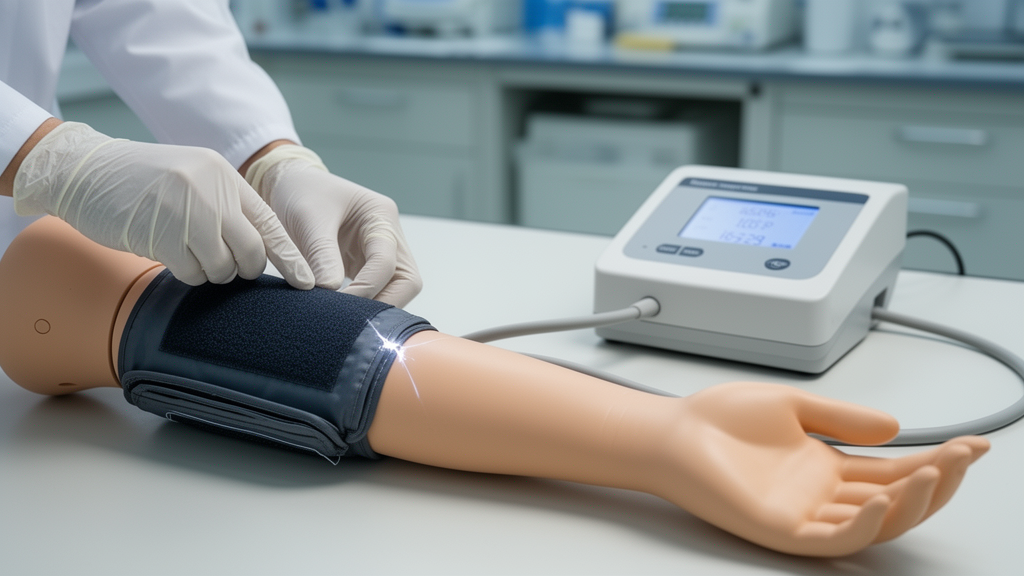
Small pinhole leaks in non-invasive blood pressure (NIBP) cuffs are nearly invisible to the eye, yet they can quietly undermine the reliability of oscillometric blood pressure readings. A new double-blind, randomized-sequence comparative study, published in the Journal of Medical and Biological Engineering, put three inspection strategies to the test against routine clinical practice and found that automated pressure-retention inspection detected simulated pinhole defects far more reliably than simply watching whether a measurement completes successfully.
The prospective study evaluated four inspection methods: a clinical-mimicking inspection based on successful measurement completion or device error messages, a manual pressure-retention inspection, and two automated approaches, Emora Speed and Emora Fine. Ninety-four participants, a mix of healthcare and non-healthcare workers, inspected five cuff conditions: one cuff without a pinhole and four cuffs with simulated pinhole defects. The primary outcome was accuracy, defined as correctly classifying a cuff as normal or abnormal, and the analysis used a generalized linear mixed model to account for repeated measurements within each participant.
The results revealed a striking gap between everyday practice and dedicated leak testing. Across 1,880 inspection trials, accuracy was just 28.3% for clinical-mimicking inspection, meaning that relying on whether a device completes a measurement or flashes an error message missed most defective cuffs. Manual pressure-retention inspection improved accuracy to 56.2%, while the automated methods performed substantially better: 69.1% for Emora Speed and 73.8% for Emora Fine.
Sensitivity told a similar story. Clinical-mimicking inspection detected only 13.8% of the pinhole-bearing cuffs, and manual pressure-retention inspection reached 48.3%. The automated methods identified 61.4% (Emora Speed) and 67.3% (Emora Fine) of defective cuffs. Notably, no false-positive judgments occurred with either automated method, meaning normal cuffs were not incorrectly flagged as defective in these trials.
The authors conclude that clinical-mimicking inspection, which depends on successful measurement completion or device error messages, may be insufficient for detecting simulated pinhole defects in NIBP cuffs. Automated pressure-retention inspection showed higher detection performance and may serve as an adjunctive, cuff-focused screening approach, offering a practical way to catch leaks that would otherwise slip through routine use.
The researchers are careful to frame the technology’s role. Automated pressure-retention inspection should not be considered a replacement for comprehensive NIBP monitor maintenance or calibration, and its effect on blood pressure measurement accuracy remains to be determined. In other words, catching pinholes is one thing; demonstrating that removing them improves the accuracy of blood pressure readings in clinical care is a question for future work.
Subject of Research: Automated pressure-retention inspection for detecting pinhole air leaks in non-invasive blood pressure cuffs
Article Title: Evaluation of Automated Pressure-Retention Inspection for Detecting Air Leaks in Non-Invasive Blood Pressure Cuffs: a Double-Blind Randomized-Sequence Comparative Study
Article References: Imada, H., Toma, R., Hata, S., Katano, M., Nishida, Y., Soga, T., Yoshida, K., Sakaji, I., Motoyama, A., & Hananouchi, T. (2026). Evaluation of Automated Pressure-Retention Inspection for Detecting Air Leaks in Non-Invasive Blood Pressure Cuffs: a Double-Blind Randomized-Sequence Comparative Study. Journal of Medical and Biological Engineering. https://doi.org/10.1007/s40846-026-01060-8
Image Credits: AI Generated
DOI: 10.1007/s40846-026-01060-8
Keywords: blood pressure, NIBP cuffs, air leak detection, pressure-retention inspection, medical device maintenance, oscillometric measurement, diagnostic accuracy, simulated pinholes, healthcare technology, comparative study, Evaluation, Automated
News Source: Ophelia Keating. (October 29, 2026). Automated Pressure-Retention Inspection Outperforms Routine Checks for Finding Hidden Blood Pressure Cuff Leaks. Scienmag.