

• HOME
  • NEWS
  • EXPLORE
    • CAREER
      • Companies
      • Jobs
    • EVENTS
    • iGEM
      • News
      • Team
    • PHOTOS
    • VIDEO
    • WIKI
  • BLOG
  • COMMUNITY
    • FACEBOOK
    • INSTAGRAM
    • TWITTER
Thursday, October 29, 2026
BIOENGINEER.ORG
No Result
View All Result
  • Login
  • HOME
  • NEWS
  • EXPLORE
    • CAREER
      • Companies
      • Jobs
        • Lecturer
        • PhD Studentship
        • Postdoc
        • Research Assistant
    • EVENTS
    • iGEM
      • News
      • Team
    • PHOTOS
    • VIDEO
    • WIKI
  • BLOG
  • COMMUNITY
    • FACEBOOK
    • INSTAGRAM
    • TWITTER
No Result
View All Result
Bioengineer.org
No Result
View All Result
Home NEWS Science News Agriculture

Electronic sensors and GC–MS reveal optimal roasting conditions for white and black sesame seeds

by
October 29, 2026
in Agriculture
Reading Time: 2 mins read
0
Electronic sensors and GC–MS reveal optimal roasting conditions for white and black sesame seeds

Electronic sensors and GC–MS reveal optimal roasting conditions for white and black sesame seeds

Share on FacebookShare on TwitterShare on LinkedinShare on RedditShare on Telegram

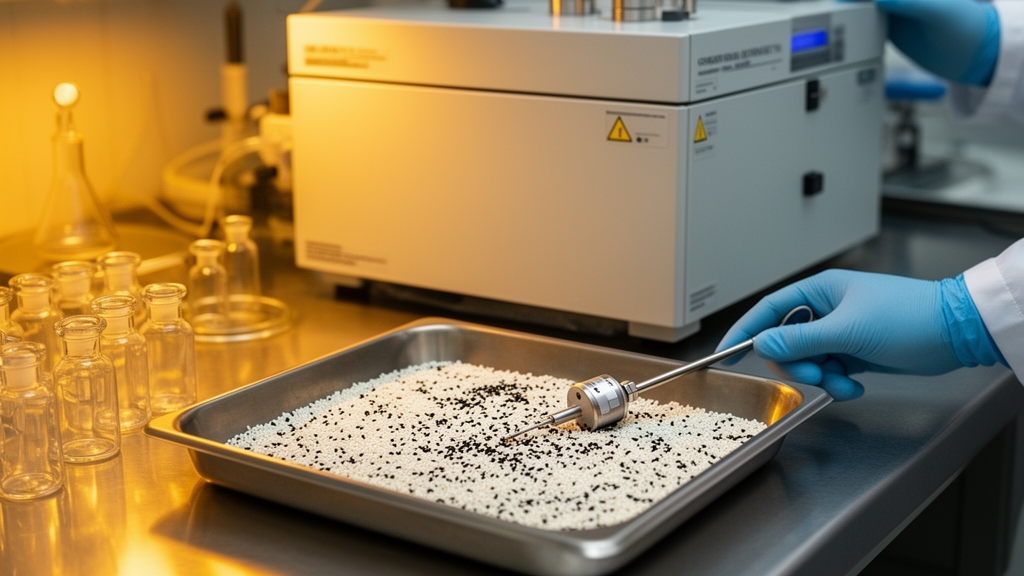
Roasting transforms the flavor of sesame seeds, but pushing the temperature too high can tip the balance from nutty and pleasant to burnt and bitter. A new study in Food Science and Biotechnology set out to find the sweet spot, using electronic sensor systems together with gas chromatography–mass spectrometry and gas chromatography–olfactometry to track how aroma and taste change as white and black sesame seeds are roasted under different conditions.

The research team, led by Hee Sung Moon, Younglan Ban, Se Young Yu, Su Hyun Kim and Eui-Cheol Shin, investigated the chemosensory profiles of both seed types across a range of roasting treatments. The electronic sensor analysis showed that roasting generally reduced perceived sweetness and increased bitterness, a shift that became more pronounced as conditions intensified.

The measured bitterness values illustrate that trend. Black sesame seeds followed the same direction, increasing from 5.1 in the raw sample (BR) to 7.3 in the corresponding high-intensity treatment (BH_20).

Using GC–MS-O analysis, the researchers identified 13 aroma-active compounds in the roasted seeds. The composition of these compounds differed by seed color under high-temperature roasting conditions. White sesame seeds were characterized primarily by pyrazines and heterocyclic compounds, while black sesame seeds were characterized by ketones, sulfur-containing compounds, and furans.

Based on the electronic sensor data, the study identified specific roasting conditions that preserved desirable roasted and nutty-like odors while minimizing burnt-like odors and bitterness. For white sesame seeds, the optimal conditions were 150 degrees Celsius for 20 minutes and 180 degrees Celsius for 10 minutes. For black sesame seeds, 150 degrees Celsius for 10 minutes was identified as optimal.

The authors note that these findings provide insights and practical guidance for color-specific roasting control in sesame processing. Because white and black sesame seeds developed distinct aroma profiles under the same high-temperature conditions, the results suggest that roasting protocols may need to be tailored separately for each seed type rather than applied uniformly.

The study is published as a research article in Food Science and Biotechnology, with the full findings available in the journal’s October 2026 release.

Subject of Research: Optimizing roasting conditions for white and black sesame seeds using electronic sensors and GC–MS-O analysis

Article Title: Optimizing roasting conditions for white and black sesame seeds using electronic sensors and GC–MS/GC-O: minimizing burnt odor and bitterness

Article References: Moon, H. S., Ban, Y., Yu, S. Y., Kim, S. H., & Shin, E.-C. (2026). Optimizing roasting conditions for white and black sesame seeds using electronic sensors and GC–MS/GC-O: minimizing burnt odor and bitterness. Food Science and Biotechnology. https://doi.org/10.1007/s10068-026-02342-2

Image Credits: AI Generated

DOI: 10.1007/s10068-026-02342-2

Keywords: sesame seeds, roasting, electronic sensors, GC-MS, GC-O, aroma-active compounds, pyrazines, bitterness, food science, flavor chemistry, white sesame, black sesame

News Source: Alan Morgan. (October 29, 2026). Electronic sensors and GC–MS reveal optimal roasting conditions for white and black sesame seeds. Scienmag.

Tags: aroma-active compoundsbitternessblack sesameelectronic sensorsflavor chemistryFood scienceGC-MSGC-Opyrazinesroastingsesame seedswhite sesame
Share12Tweet7Share2ShareShareShare1

Related Posts

Trichoderma Fungus Cuts Banana Wilt Damage and Boosts Yields in Lebanon Field Trials

Trichoderma Fungus Cuts Banana Wilt Damage and Boosts Yields in Lebanon Field Trials

October 29, 2026
UK-Grown Beans Reveal Why Household Habits Decide Sustainable Diets

UK-Grown Beans Reveal Why Household Habits Decide Sustainable Diets

October 29, 2026

Plant Shape, Not Robot Skill, Limits Cucumber Harvesting Success

October 29, 2026

Milk Cell Gene Test Reveals Molecular Signatures of High-Yielding Dairy Cows

October 29, 2026

POPULAR NEWS

  • Global Financing Facility falls short on adolescent health funding in three country case studies

    Global Financing Facility falls short on adolescent health funding in three country case studies

    29 shares
    Share 12 Tweet 7
  • Prostate Cancer Detection Rose After MRI Arrived, But a Single-Centre Study Says the Reason Stays Unclear

    29 shares
    Share 12 Tweet 7
  • Midday Sunlight Yields Smaller Copper Nanoparticles With Stronger Antibacterial Activity

    29 shares
    Share 12 Tweet 7
  • Never-Smoker COPD Shows Stronger Lung Function Gains from Salbutamol and Glycopyrronium

    29 shares
    Share 12 Tweet 7

About

We bring you the latest biotechnology news from best research centers and universities around the world. Check our website.

Follow us

Recent News

Global Financing Facility falls short on adolescent health funding in three country case studies

Prostate Cancer Detection Rose After MRI Arrived, But a Single-Centre Study Says the Reason Stays Unclear

Midday Sunlight Yields Smaller Copper Nanoparticles With Stronger Antibacterial Activity

Subscribe to Blog via Email

Enter your email address to subscribe to this blog and receive notifications of new posts by email.

Join 85 other subscribers
  • Contact Us

Bioengineer.org © Copyright 2023 All Rights Reserved.

Welcome Back!

Login to your account below

Forgotten Password?

Retrieve your password

Please enter your username or email address to reset your password.

Log In
No Result
View All Result
  • Homepages
    • Home Page 1
    • Home Page 2
  • News
  • National
  • Business
  • Health
  • Lifestyle
  • Science

Bioengineer.org © Copyright 2023 All Rights Reserved.
