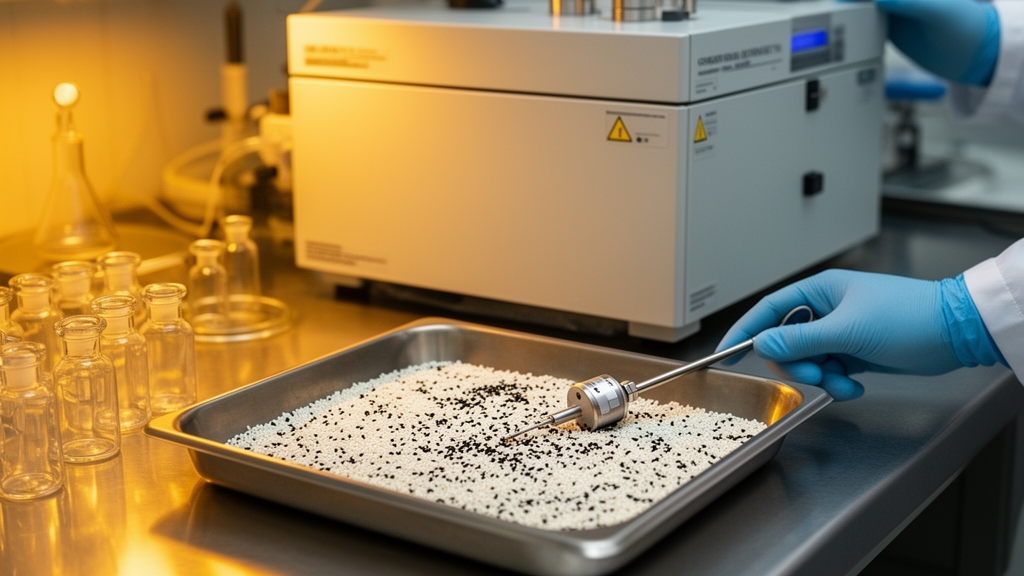
Roasting transforms the flavor of sesame seeds, but pushing the temperature too high can tip the balance from nutty and pleasant to burnt and bitter. A new study in Food Science and Biotechnology set out to find the sweet spot, using electronic sensor systems together with gas chromatography–mass spectrometry and gas chromatography–olfactometry to track how aroma and taste change as white and black sesame seeds are roasted under different conditions.
The research team, led by Hee Sung Moon, Younglan Ban, Se Young Yu, Su Hyun Kim and Eui-Cheol Shin, investigated the chemosensory profiles of both seed types across a range of roasting treatments. The electronic sensor analysis showed that roasting generally reduced perceived sweetness and increased bitterness, a shift that became more pronounced as conditions intensified.
The measured bitterness values illustrate that trend. Black sesame seeds followed the same direction, increasing from 5.1 in the raw sample (BR) to 7.3 in the corresponding high-intensity treatment (BH_20).
Using GC–MS-O analysis, the researchers identified 13 aroma-active compounds in the roasted seeds. The composition of these compounds differed by seed color under high-temperature roasting conditions. White sesame seeds were characterized primarily by pyrazines and heterocyclic compounds, while black sesame seeds were characterized by ketones, sulfur-containing compounds, and furans.
Based on the electronic sensor data, the study identified specific roasting conditions that preserved desirable roasted and nutty-like odors while minimizing burnt-like odors and bitterness. For white sesame seeds, the optimal conditions were 150 degrees Celsius for 20 minutes and 180 degrees Celsius for 10 minutes. For black sesame seeds, 150 degrees Celsius for 10 minutes was identified as optimal.
The authors note that these findings provide insights and practical guidance for color-specific roasting control in sesame processing. Because white and black sesame seeds developed distinct aroma profiles under the same high-temperature conditions, the results suggest that roasting protocols may need to be tailored separately for each seed type rather than applied uniformly.
The study is published as a research article in Food Science and Biotechnology, with the full findings available in the journal’s October 2026 release.
Subject of Research: Optimizing roasting conditions for white and black sesame seeds using electronic sensors and GC–MS-O analysis
Article Title: Optimizing roasting conditions for white and black sesame seeds using electronic sensors and GC–MS/GC-O: minimizing burnt odor and bitterness
Article References: Moon, H. S., Ban, Y., Yu, S. Y., Kim, S. H., & Shin, E.-C. (2026). Optimizing roasting conditions for white and black sesame seeds using electronic sensors and GC–MS/GC-O: minimizing burnt odor and bitterness. Food Science and Biotechnology. https://doi.org/10.1007/s10068-026-02342-2
Image Credits: AI Generated
DOI: 10.1007/s10068-026-02342-2
Keywords: sesame seeds, roasting, electronic sensors, GC-MS, GC-O, aroma-active compounds, pyrazines, bitterness, food science, flavor chemistry, white sesame, black sesame
News Source: Alan Morgan. (October 29, 2026). Electronic sensors and GC–MS reveal optimal roasting conditions for white and black sesame seeds. Scienmag.