


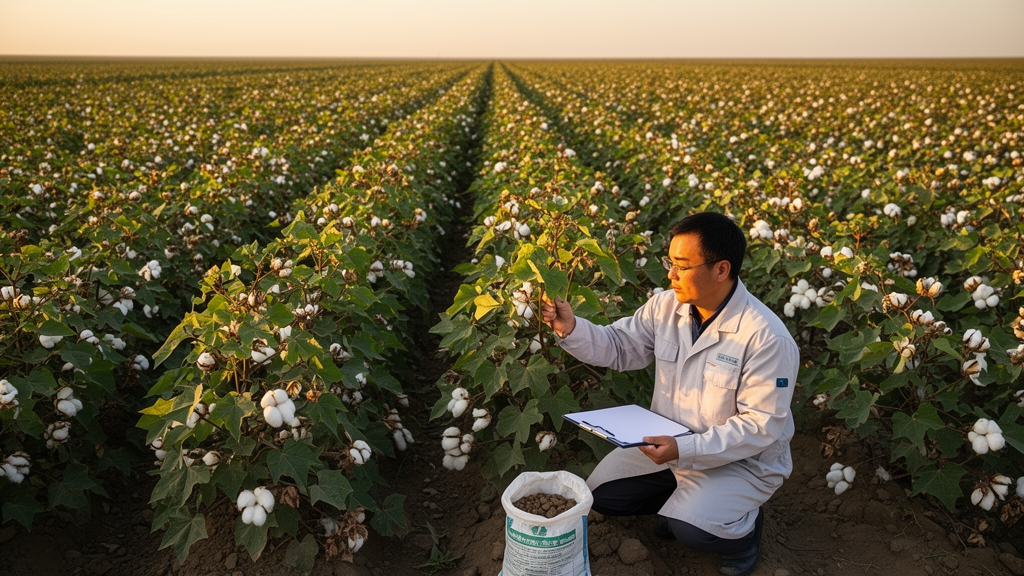
A single-site field experiment in Xinjiang, China, has found that combining organic fertilizer with a composite microbial inoculant substantially improved cotton leaf gas exchange and seed cotton yield under arid drip irrigation. The study, published in BMC Plant Biology, reported that a treatment of 30 tonnes per hectare of organic fertilizer plus 60 kilograms per hectare of microbial inoculant raised the net photosynthetic rate by 58.2 percent, stomatal conductance by 81.6 percent, intercellular CO2 concentration by 39.3 percent and transpiration rate by 58.8 percent relative to untreated control plots.
The same combined treatment produced a mean seed cotton yield of 6,247.89 kilograms per hectare, 24.0 percent higher than the zero-input control. The researchers, led by Zan Yan and Quanjiu Wang, set up 24 independent plots in 2025, crossing two organic fertilizer levels (0 or 30 tonnes per hectare) with four inoculant rates (0, 30, 60 or 90 kilograms per hectare).
Statistically, both organic fertilizer and inoculant rate showed main effects on all four gas-exchange traits measured. However, the interaction between the two inputs was significant only for intercellular CO2 concentration and transpiration rate, not for net photosynthetic rate or stomatal conductance. Seed cotton yield likewise showed main effects of both inputs without a significant interaction, suggesting the two amendments contributed largely independently to yield.
One caveat stands out in the yield data: although the combined 30-tonne-plus-60-kilogram treatment had the highest numerical mean yield, it was not statistically separated from the other organic fertilizer treatments. The authors also note that irrigation water use efficiency shares the same irrigation denominator as yield, a methodological detail relevant to interpreting that metric.
Beyond the field measurements, the team ran exploratory molecular analyses. RNA sequencing identified 156 candidate differentially expressed genes through a reproducible functional screen, of which 147 entered a weighted gene co-expression network. One module, labelled the blue module, was negatively associated with all four gas-exchange traits after adjustment for field block. Yet none of the twelve module-trait associations remained significant after correction for the false discovery rate when treatment was included in the model.
The metabolomic arm of the study was even more restrained. Across seven liquid chromatography-mass spectrometry comparisons, only two molecular features met comparison-specific false-discovery-rate criteria. An exploratory integrated ordination of the multi-omics data was also sensitive to how treatment was modelled. Taken together, the molecular signals should be read as hypotheses for future testing rather than established mechanisms.
The authors are explicit about the limits of their evidence. These are single-year, single-site data showing treatment-associated field and transcriptional responses with limited FDR-controlled metabolomic support. They do not establish a causal molecular mechanism linking the microbial inoculant to photosynthesis or yield, and they do not justify an application-rate recommendation for farmers. Multi-year field trials and independent functional and targeted validation of the candidate genes and metabolites are required before any broader conclusions can be drawn.
If the yield advantage of combined organic and microbial inputs holds up across seasons and locations, the 24 percent gain reported here would be agronomically meaningful, but confirming that will depend on the replicated, multi-year work the authors call for.
The article, published open access on 23 October 2026, was shared early as a peer-reviewed accepted manuscript carrying a permanent DOI, a version the authors note remains subject to final editorial edits. For now, the study stands as a carefully hedged data point: strong field-level gas-exchange and yield responses to organic fertilizer and microbial inoculation in one arid environment, paired with molecular evidence that remains, by the authors’ own assessment, exploratory.
Subject of Research: Field and exploratory omics study of cotton gas-exchange and yield responses to organic fertilizer and composite microbial inoculant in Xinjiang
Article Title: Cotton gas-exchange and yield responses to organic fertilizer and composite microbial inoculant in Xinjiang: a field and exploratory omics study
Article References: Yan, Z., Ma, Z., Ma, Y., Tang, M., Yang, J., Fu, Q., Lin, S., Deng, M., & Wang, Q. (2026). Cotton gas-exchange and yield responses to organic fertilizer and composite microbial inoculant in Xinjiang: a field and exploratory omics study. BMC Plant Biology. https://doi.org/10.1186/s12870-026-10262-w
Image Credits: AI Generated
DOI: 10.1186/s12870-026-10262-w
Keywords: cotton, organic fertilizer, microbial inoculant, gas exchange, seed cotton yield, Xinjiang, drip irrigation, RNA sequencing, metabolomics, co-expression network, photosynthesis, field experiment
News Source: Morgan Morrow. (October 29, 2026). Organic fertilizer and microbial inoculant lift cotton photosynthesis and yield in Xinjiang field trial. Scienmag.



