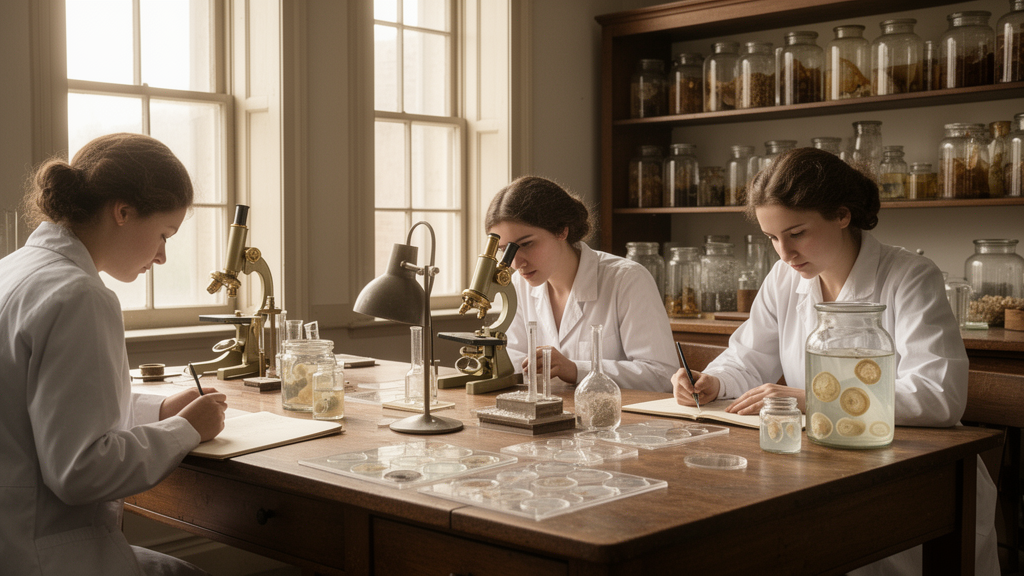
When Wilhelm Roux founded the journal that is today known as Development, Genes and Evolution in 1894 under the name Archiv für Entwicklungsmechanik der Organismen, its pages belonged entirely to men. The founder’s long mission statement in the first issue thanked a list of supporters he addressed as ‘Herren’ — gentlemen — and the publication record of the journal’s first three years consists exclusively of male authors. A new review by Volker Hartenstein, Tamara Franz-Odendaal and Angelika Stollewerk, published in the journal’s volume 234, digs through those early decades and arrives at a strikingly different picture of who actually built the field: women scientists contributed to every research area of developmental mechanics and helped steer its future direction.
The study examined the first 50 years of the journal, from 1894 to 1944, identifying the female authors, their affiliations, mentors and careers, and the topics and organisms they investigated. In total, 203 papers published during that period were written by women. The numbers tell a story of steady growth. Before 1920, women published an average of 2.1 papers per year, and seven years passed with no women-authored papers at all. From 1920 onwards, the average rose to 10.5 papers per year, with only three years — 1935, 1941 and 1943 — lacking women authors. The highest percentage of women-written papers in any year came in 1942, while the largest raw number arrived earlier, in 1927, when 17 papers carried women’s names. The authors speculate that the increase reflects women gaining access to university education and doctoral degrees at the end of the nineteenth and beginning of the twentieth century, since a PhD project usually ends in publication.
The first woman to publish in the journal was the American biologist Harriet Randolph, followed closely by the American embryologist Florence Peebles, both in 1897. Randolph completed her undergraduate studies at Bryn Mawr College in 1889, earned her PhD in Zurich in 1892 on the morphology of tubificid worms, and returned to Bryn Mawr to teach biology until 1913. She was well known for her research on regeneration in earthworms and planaria, work that continues to accrue citations and was cited during her lifetime by leaders of the field including Przibram, Morgan and Driesch. Peebles, a zoology researcher at Bryn Mawr between 1897 and 1919, did much of her work on regeneration and embryology at the Marine Biological Laboratory in Woods Hole, with research stays in Munich, Halle, Bonn, Würzburg and Freiburg. Her 1900 dissertation on regeneration and grafting of hydra appeared in the journal the same year, and her 1897 paper on experimental studies in Hydra was cited 56 times, among others by Driesch and Morgan. Her career spanned three decades and ended as Professor of Biological Sciences at Chapman College in Los Angeles.
A remarkable pattern emerges among these early authors: almost all the women who published in the journal between 1897 and 1909 were students or recent graduates of Bryn Mawr College, an institution founded specifically for women. They were all taught by Thomas H. Morgan, professor there from 1891 to 1904, who — like a handful of other male scientists in leadership positions — supported women entering scientific careers even as conservative, male-dominated institutions erected major obstacles, from exclusion from scientific societies to the near-impossibility of obtaining permanent academic positions. Morgan himself published at least 20 papers in the journal during his Bryn Mawr years, which explains the high proportion of English-language papers in its early decades. Among his students who published there were Nettie M. Stevens, Annah P. Hazen, Alice M. Boring, Helen Dean King, Esther F. Byrnes, Margaret A. Reed and Anne H. Todd.
The standout of Morgan’s laboratory was Nettie M. Stevens, whose work carried consequences far beyond regeneration studies. Stevens studied biology at several universities, including Stanford, over some 20 years with interruptions, and joined Morgan’s lab in 1900 at the age of 39, completing her PhD in 1903 after a prestigious fellowship spent at the Zoological Station in Naples and the University of Würzburg. Her histological training transformed the group’s regeneration work: in her papers, sections of regenerating tissues were treated with standard histological stains and analyzed, allowing far more insightful conclusions than the external observations of earlier studies. In her 1901 paper on Tubularia she correctly identified, as one of the first, the origin and development of the blastema, a structure central to all later regeneration research. Her microscopic expertise also led her to identify the Y chromosome in flies and other insects and link it to the determination of male sex — work that convinced Morgan and others to associate genes with chromosomes and helped launch classical genetics. Despite this excellence, Stevens never secured a permanent academic position; when a professorship was finally offered at age 50, she was too ill with breast cancer to accept, and she died in May 1912.
On the European side, the careers of the first women authors were shadowed by war and, devastatingly, by the Nazi regime. Margarete Zuelzer, the first European woman to publish in the journal, in 1907, was a microbiologist who had been among the first generation of women allowed to study at a German university and one of only six women awarded a PhD in natural sciences at Heidelberg by 1904. She led the protozoa laboratory in Berlin-Dahlem at the Imperial Ministry of Health until April 1933, when the ‘Law for the Restoration of the Professional Civil Services’ cost her the position. She fled to the Netherlands in 1939 and died in 1943 after deportation to the Westerbork Transit Camp. Leonore Brecher, who studied pupal colouration of butterflies with Hans Leo Przibram at the Biologische Versuchsanstalt in Vienna, published over 20 papers, 15 of them in the journal, yet worked as an unpaid research assistant and supported herself through teaching. Her 1923 attempt to habilitate at the University of Vienna was rejected on grounds of ‘lack of personal skills’ — a judgment shaped by her status as a Jewish woman from Eastern Europe. Deprived of research and funding after the Nazis came to power, she was deported in 1942 to the extermination camp Maly Trostinez and killed.
Others escaped or endured. Salome Glücksohn fled Nazi Germany in 1933 after a PhD with Hans Spemann in Freiburg, joined the geneticist Leslie C. Dunn’s lab at Columbia University, co-founded developmental genetics and published over 100 manuscripts — though Columbia denied her a faculty position, and she instead became a Full Professor and later Chair of Genetics at the Albert Einstein College of Medicine. The Norwegian zoologist Kristine Bonnevie, the first woman professor in Norway, published on human fingerprint papillae patterns in the journal and held a full professorship in Oslo thanks to the ‘Lex Bonnevie’, a law granting women the same rights as men to hold professorships. Gudrun Ruud collaborated with Spemann in Berlin on experiments that helped identify the organizer, showing that only the dorsal half of the gastrula could give rise to a complete larva. Laura Kaufmann of Poland habilitated in Experimental Zoology in 1930, joined the Polish resistance Home Army during the occupation, and became a Full Professor at the Marie Curie-Sklodowska University in 1954.
The review categorised women’s research into eight areas: embryology, experimental embryology, physiology, pathology, genetics, ecology, ecological developmental biology and cell biology. Experimental embryology dominated at 36 percent of manuscripts, followed by pathology at 23 percent, with genetics and ecology least represented — genetics accounting for only 3 percent of topics, with just four genetics papers in the 1920s. Within experimental embryology, surgical manipulations such as transplantation and isolation of cells produced 43 papers and regeneration 41. The most common organisms were chordates, at 48 percent of papers, particularly amphibians with 59 papers, followed by arthropods at 19 percent; 33 different phyla were studied overall. Humans appeared in only five publications, and Drosophila in just four, reflecting the era’s split between developmental mechanics and genetics.
The individual contributions often anticipated ideas that later became central. Hedwig Wilhelmi’s experiments in Spemann’s lab showed that reversal of left-right organ symmetry could be created surgically in amphibian embryos, findings the authors note presage by 80 years the modern understanding of how ciliary dynamics activate Lefty and Nodal to set vertebrate asymmetry. Margaret Reed found that muscle, traditionally considered mesodermally derived, developed from ectoderm in the regenerating crustacean limb, implying germ layers are not fixed in fate and supporting the pivotal role of regulation in development. Leonore Brecher demonstrated that it is colour wavelength, not intensity, that drives pupal coloration in butterflies, and that environmental colour information reaches the pupa through the larval eye — a discovery based on simple manipulations of larval eyes that discredited earlier contrary reports. Marguerite Vogt’s transplantation work in the 1940s identified the ring gland as the main endocrine centre in flies, evidence that eventually led others to isolate the hormones ecdysone and juvenile hormone. And the papers of Elena Timofeeff-Ressovsky, co-authored with her husband Nikolai in Berlin between 1926 and 1928, pioneered the concepts of penetrance and expressivity and an early population-genetics study of wild Drosophila from a Berlin trash can — contributions that, written in German and caught in political bias, found no immediate acceptance in the anglophone literature.
Taken together, the analysis shows that while women were certainly underrepresented relative to men, they contributed a significant and more or less continuously rising number of papers from the journal’s beginning, and essentially all the scientific questions and approaches typical of early developmental mechanics can be found among their contributions. Many, partly because of the obstacles to establishing themselves independently, underwent lengthy educations and brought previously acquired skills that opened new paths for the labs they joined. Biographies like those of Stevens, King, Glücksohn and Vogt, the authors conclude, testify to the enormous impact women had in pioneering classical and developmental genetics and molecular biology — approaches that form the foundation of the broad range of problems modern developmental biology addresses today.
Subject of Research: Historical analysis of women authors and their research contributions in the first 50 years of the journal Development, Genes and Evolution
Article Title: Women authors in the first 50 years of DGE-contributions and research topics
Article References: Hartenstein, V., Franz-Odendaal, T., & Stollewerk, A. (2024). Women authors in the first 50 years of DGE-contributions and research topics. Development Genes and Evolution, 234(2), 77-97. https://doi.org/10.1007/s00427-024-00724-2
Image Credits: AI Generated
DOI: 10.1007/s00427-024-00724-2
Keywords: developmental biology, history of science, women in science, Development Genes and Evolution, developmental mechanics, Nettie Stevens, regeneration, genetics, Wilhelm Roux, experimental embryology, Hans Spemann, Thomas Hunt Morgan
News Source: Kennedy Frye. (October 29, 2026). Women Scientists Shaped Developmental Biology From Its Very First Pages. Scienmag.