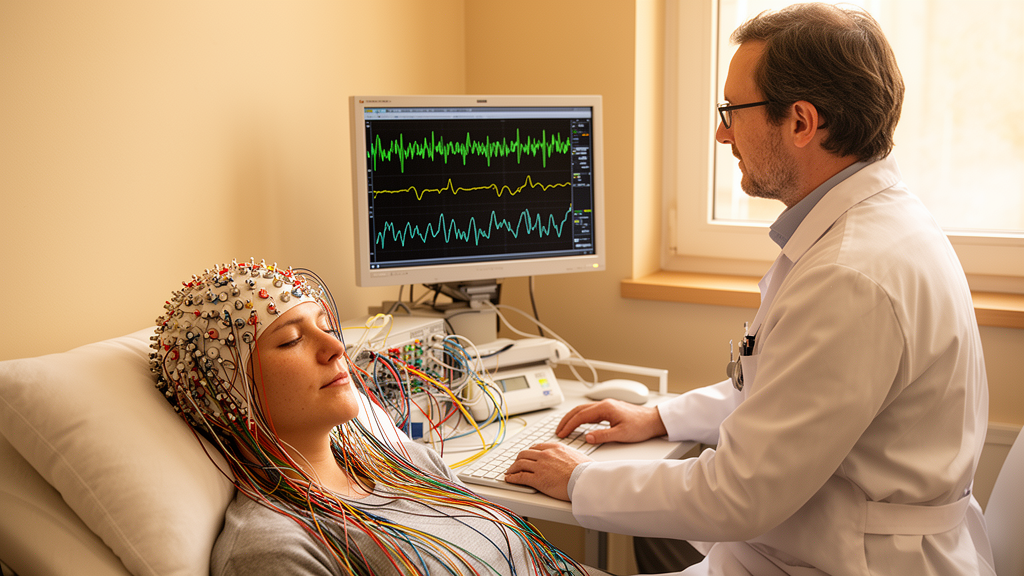
Quantitative electroencephalography, or QEEG, is gaining ground as a way to measure how the brain responds to epilepsy treatment, but a new critical review concludes that the technology is not yet ready to stand alone in clinical decision-making. The review, published in Acta Epileptologica, assessed more than 160 English-language papers on QEEG in epilepsy treatment evaluation published up to March 2026, covering anti-seizure medications, long-term EEG monitoring, neuromodulation, epilepsy surgery, ketogenic diet therapy and artificial intelligence-based models.
Unlike conventional EEG, which relies on visual inspection of brain wave traces by trained specialists, QEEG applies computational and mathematical methods to digital EEG signals. Because each sampling point can be represented numerically, specialized software can perform systematic signal processing, including automatic event detection, frequency-domain transformation and artifact removal. From this foundation, several complementary analytical approaches have emerged: power spectral analysis characterizes the distribution of oscillatory activity across frequency bands, signal complexity measures nonlinear temporal properties and neuronal synchronization, functional connectivity analysis describes statistical dependencies among spatially distributed EEG signals, and network topology metrics capture the global and regional organization of brain networks.
The review’s authors, led by Jingjing Qiu and Yixia Chen with senior author Ying Liu, framed their work as a narrative review rather than a systematic review or meta-analysis. They report that significant differences in patient demographics, EEG acquisition methods, analytical approaches and clinical goals made a thorough systematic synthesis impossible. Instead, the review critically evaluates methodological trends, translational significance and current limitations, distinguishing exploratory findings from those approaching genuine clinical usefulness.
Among the most mature applications is power spectral analysis in anti-seizure medication monitoring. Across treatment studies, spectral results typically reflect shifts in the balance between slow- and fast-frequency activity rather than isolated changes in a single band. Changes in relative band power, power ratios and interhemispheric asymmetry are frequently used to characterize treatment-related EEG modulation linked to seizure control and drug effects. However, the authors caution that reported spectral modulation patterns differ significantly between studies depending on epilepsy type, treatment duration and analytical technique, and are better understood as markers of treatment-related cortical modulation than as drug-specific electrophysiological signatures. They also stress the importance of distinguishing acute pharmacological effects after single-dose or short-term administration from chronic changes that emerge with sustained therapy and long-term network reconfiguration.
A second well-supported domain is the epileptiform activity index, a quantitative measure of interictal epileptiform load. Anti-seizure medication therapy is frequently associated with a decrease in this index, a trend observed in both adult and pediatric populations treated with common drugs such as carbamazepine and valproate. Yet the findings are inconsistent: in certain epilepsy syndromes, notably benign epilepsy with centrotemporal spikes, paradoxical increases in epileptiform activity or persistence of discharges during sleep have been reported after specific therapies, occasionally coinciding with clinical worsening or new seizure types. Definitions of epileptiform events also vary widely between studies, from spike frequency thresholds to the proportion of recording time occupied by discharges, complicating the development of consistent clinical standards. International bodies including the International Federation of Clinical Neurophysiology and the International League Against Epilepsy have begun proposing classification criteria and technical guidelines, but implementation still differs between institutions.
Functional connectivity analysis offers a systems-level view of how epilepsy treatment reshapes brain networks, reflecting the modern understanding of epilepsy as a network disorder. Here the review finds more caution is warranted. Treatment-related connectivity variations show no consistent directional pattern across studies, appearing to depend on epilepsy type, brain state and analytical technique. Notably, increased synchronization, particularly in low-frequency bands, has been observed in both epileptic and non-epileptic conditions, suggesting that connectivity changes may reflect global network states rather than disease-specific mechanisms. The authors conclude that connectivity metrics currently serve an interpretative rather than predictive role, and that their value as stand-alone indicators of treatment response is limited by significant heterogeneity and inconsistent findings.
For neuromodulation, vagus nerve stimulation is the most extensively studied modality. Across studies, VNS is generally associated with reduced cortical synchronization and spectral shifts toward higher frequencies, thought to be mediated in part by neuromodulatory pathways involving the locus coeruleus and dorsal raphe nuclei. Responders have been described as exhibiting lower global synchronization and relative increases in higher-frequency activity, while intracranial EEG studies indicate region-specific reductions in functional connectivity in patients with favorable outcomes. Nevertheless, reported QEEG changes are not entirely consistent, and the review concludes that QEEG captures neurophysiological correlates of VNS effects but lacks specificity and reproducibility as a predictive biomarker. Similar limitations apply to transcranial direct current stimulation, repetitive transcranial magnetic stimulation and deep brain stimulation, where findings derive primarily from small-scale studies with heterogeneous protocols.
Artificial intelligence represents the most exploratory frontier. AI-based models can integrate high-dimensional QEEG features spanning spectral, network and source domains to differentiate responders from non-responders and predict post-intervention outcomes. Yet the review identifies three interconnected problems: no included AI study benchmarked performance against human expert performance or reported inter-rater agreement; reference standards were heterogeneous and often incompletely specified, relying on clinical reporting vulnerable to recall bias and inter-observer variability; and models showed low tolerance for variations in input data quality, with training often performed on manually cleaned EEG segments that may not represent real-world conditions. Most studies were single-center cohorts relying on internal validation only, so apparently favorable performance metrics may overestimate real-world predictive utility.
The review’s overall verdict is task-dependent. QEEG appears most promising for long-term treatment monitoring, where longitudinal spectral power measurements and quantitative epileptiform activity markers demonstrate the greatest stability and reproducibility, particularly when interpreted alongside seizure outcomes and the broader clinical context. Functional connectivity, source-level methods and AI-assisted prediction models remain encouraging but conflicting, limited by methodological variation, small single-center datasets and insufficient external validation. The authors emphasize that QEEG should presently be viewed as a complementary tool whose clinical applicability varies across treatment contexts, not as a universal solution for treatment selection or prognostication, and that future progress depends less on increasingly sophisticated analytics than on standardized acquisition and preprocessing procedures, age- and sex-matched normative datasets, rigorous multicenter validation and smooth integration into clinical workflows.
The authors also acknowledge limitations of the review itself. Formal risk-of-bias assessment was not employed because study designs, patient demographics and analytical frameworks varied too widely, and the synthesis was qualitative rather than fully reproducible. Beyond study-level issues, they highlight technical constraints on QEEG biomarkers generally: EEG features are strongly influenced by age, with pediatric developmental patterns differing markedly from adult ones and aging linked to progressive background slowing; ambient and recording-related factors affect EEG stability; residual muscle and eye movement artifacts can disproportionately affect high-frequency and connectivity metrics; and formal test-retest reliability evaluations remain scarce for many measures. Until these gaps are closed through prospective studies prioritizing practical application, clinical interpretability and repeatability, QEEG’s role in epilepsy care will remain that of a supportive, hypothesis-generating instrument rather than an independent arbiter of treatment success.
Subject of Research: The use of quantitative electroencephalography to evaluate responses to epilepsy treatments
Article Title: The use of quantitative electroencephalography in evaluating epilepsy treatment
Article References: Qiu, J., Chen, Y., Ning, Z., Zhang, B., Shen, B., Zhao, Y., & Liu, Y. (2026). The use of quantitative electroencephalography in evaluating epilepsy treatment. Acta Epileptologica, 8(1), Article 25. https://doi.org/10.1186/s42494-026-00267-1
Image Credits: AI Generated
DOI: 10.1186/s42494-026-00267-1
Keywords: quantitative EEG, epilepsy, anti-seizure medications, functional connectivity, neuromodulation, vagus nerve stimulation, epilepsy surgery, artificial intelligence, power spectral analysis, ketogenic diet, biomarkers, treatment monitoring
News Source: Ophelia Keating. (October 29, 2026). Quantitative EEG Shows Promise for Tracking Epilepsy Treatment, Review Finds. Scienmag.