


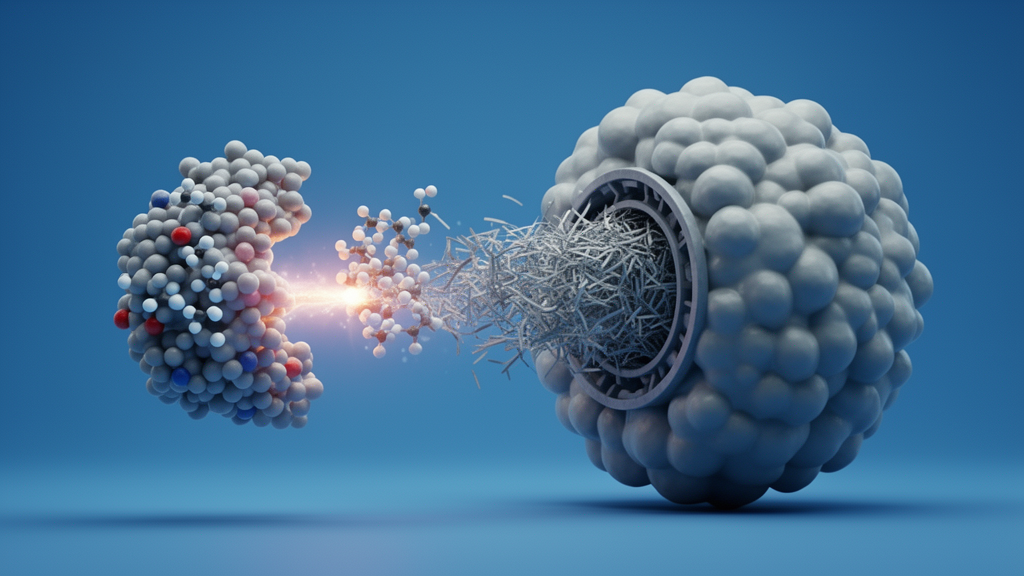
Acquired resistance remains one of the central obstacles to durable treatment in breast cancer, undermining precision therapies that once worked well. A new review published in Breast Cancer Research argues that the answer may lie not in designing better inhibitors, but in destroying the resistance-driving proteins altogether through targeted protein degradation.
The review, authored by Haixia Tang, Caiqin Xiang and colleagues, focuses on proteolysis-targeting chimeras, known as PROTACs. Unlike conventional drugs that bind a target and block it, PROTACs work through event-driven catalytic degradation, eliminating target proteins rather than simply inhibiting them. According to the authors, this degradation-based mechanism offers distinct advantages against binding-pocket mutations, compensatory network rewiring, and proteins that have historically been considered undruggable, including transcription factors and scaffolding proteins.
A key clinical milestone cited in the review is the 2026 U.S. Food and Drug Administration approval of vepdegestrant for estrogen receptor 1-mutant advanced breast cancer. The authors describe this approval as definitive clinical validation of the degradation-based paradigm, demonstrating that a degrader can succeed where occupancy-driven inhibition has faltered.
Beyond surveying the field, the review proposes two complementary translational frameworks intended to guide rational deployment of degraders in the clinic. The first is a clinical-pharmacological classification, labelled Type I through Type III, that aligns specific resistance mechanisms with the particular advantages of different degrader classes.
The second framework is a spatially informed decision matrix that links a target protein’s subcellular localization to the most appropriate degradation platform. Conventional PROTACs are matched to nuclear and cytosolic proteins, lysosome-targeting chimeras are proposed for membrane-associated targets, and engineered exosomes are suggested for addressing extracellular resistance transmission between cells.
The authors also outline a four-step clinical decision framework. It begins with biomarker-guided patient selection using liquid biopsy, followed by technology matching based on target localization. The third step is pharmacodynamic monitoring through serial circulating tumour DNA analysis, and the final step is proactive management of resistance that emerges against the degraders themselves, through E3 ligase switching or rational combination strategies.
The review is candid about the obstacles that remain. Persistent pharmacokinetic challenges and limited diversity among available E3 ligases continue to constrain the field. Nevertheless, the authors point to emerging innovations in delivery technologies and dual-ligase recruitment as developments that hold promise for translating the mechanistic advantages of degradation into durable clinical benefit across all breast cancer subtypes.
As a review article, the work synthesizes existing knowledge and proposes frameworks for future clinical translation rather than reporting new experimental results.
Subject of Research: Targeted protein degradation strategies for overcoming acquired resistance in breast cancer
Article Title: Overcoming acquired resistance in breast cancer: translational strategies for targeted protein degradation of resistance-driving proteins
Article References: Tang, H., Xiang, C., You, G., Luo, C., Zhou, G., Pan, M., Tian, C., Gong, C., Yu, X., & Xia, J. (2026). Overcoming acquired resistance in breast cancer: translational strategies for targeted protein degradation of resistance-driving proteins. Breast Cancer Research. https://doi.org/10.1186/s13058-026-02393-7
Image Credits: AI Generated
DOI: 10.1186/s13058-026-02393-7
Keywords: breast cancer, acquired resistance, PROTACs, vepdegestrant, estrogen receptor, targeted protein degradation, lysosome-targeting chimeras, liquid biopsy, E3 ligase, drug resistance, Overcoming, acquired
News Source: Nathaniel Bowman. (October 29, 2026). Targeted Protein Degraders Offer a New Route Past Breast Cancer Drug Resistance. Scienmag.



