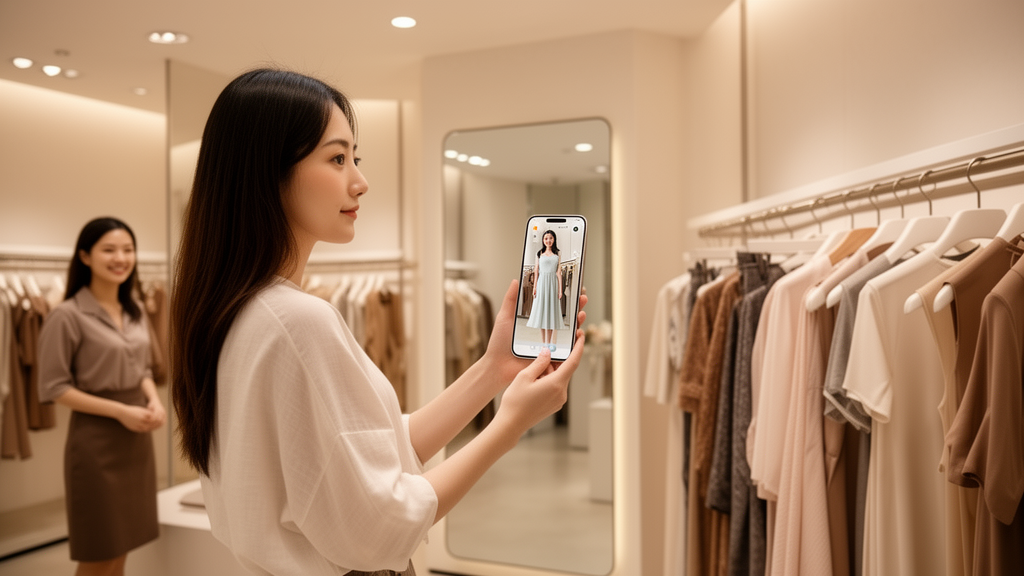
Augmented reality try-on features in online fashion shopping do not drive customer engagement in a single, uniform way, according to a new survey-based study of 865 Chinese consumers. The research, published in the journal Fashion and Textiles, found that four key AR features—realism, interactivity, personalization, and usability—all strengthened shoppers’ psychological immersion, but that this immersion translated into only certain kinds of engagement behavior. Specifically, immersion significantly boosted advocacy, such as recommending brands to others, and co-creation, such as contributing feedback and ideas, while showing no significant direct effect on basic participation behavior during the shopping task itself.
The study, conducted by Peng Chen, Abdullah Al Mamun, Myung-Hwan Chun, Mohammad Nurul Hassan Reza, and Qing Yang, drew on the stimulus–organism–response framework and flow theory to model how technological features become behavioral outcomes. In this structure, AR attributes act as external stimuli, psychological immersion—a state of deep involvement, focused attention, and intrinsic enjoyment—serves as the internal organismic state, and customer engagement behaviors are the responses. The researchers conceptualized engagement as a multidimensional construct with three concurrent dimensions: participation, meaning intentional interactions with brand platforms; advocacy, meaning voluntary promotion of the brand; and co-creation, meaning active contribution of ideas and content that shape products and services.
Data were collected in August 2025 through Wenjuanxing, a widely used Chinese online survey platform. Only respondents with prior experience using AR clothing try-on applications were eligible. The team applied several quality controls: surveys completed in under six minutes, less than half the median pretest time, were removed, an attention-check question was embedded, and the platform’s automated screening excluded entries with abnormal IP addresses, duplicate accounts, or suspicious response patterns. Of 1,007 initial responses, 142 were excluded, leaving 865 valid responses analyzed with partial least squares structural equation modeling, chosen because tests showed the data violated multivariate normality assumptions.
The sample skewed young and educated: 63.4 percent of participants were aged 25 to 34 and 25 percent were 18 to 24, with 81.5 percent holding at least a bachelor’s degree. Gender distribution was nearly balanced at 44.7 percent male and 55.3 percent female. Most respondents were active AR users, with 53.9 percent using try-on functions two to three times per month and 30.6 percent weekly, primarily through e-commerce platforms such as Taobao and JD.com, which accounted for 68.7 percent of usage, followed by social media at 16.5 percent.
The hypothesis testing showed that all four AR features significantly enhanced psychological immersion, though with differing strengths. According to the reported effect sizes, realism (f² = 0.109), personalization (f² = 0.089), and psychological immersion itself exerted the strongest effects in the model, while interactivity and usability generally contributed smaller effects. The model explained 36.7 percent of the variance in psychological immersion, 29.5 percent in participation behavior, 44.0 percent in advocacy behavior, and 38.2 percent in co-creation behavior. The authors characterized these values as reflecting moderate to substantial explanatory power.
The pattern of direct effects on engagement varied by feature and outcome. Interactivity, personalization, and usability significantly influenced participation, but realism did not. All four features significantly influenced advocacy. For co-creation, realism, interactivity, and personalization were significant while usability was not. The authors interpret the non-significant realism-to-participation path as evidence that realism functions mainly as a credibility and evaluation cue rather than a direct trigger of task-oriented action, particularly once realistic AR representations become a normalized feature of the shopping environment.
The mediation results were central to the study’s argument. Psychological immersion significantly mediated the paths from all four AR features to advocacy and co-creation behavior, but the indirect effects on participation were not significant. The direct effect of immersion on participation was likewise insignificant, which the authors attribute to a state-action distinction: participation during AR try-on shopping is largely instrumental and utility-driven, whereas immersion energizes higher-order responses that extend beyond task completion. In practical terms, immersive experiences appear to translate technological features into expressive, value-extending behaviors—recommending or co-creating with a brand—rather than basic task participation.
Perhaps the most surprising finding concerned self-regulatory focus, the study’s proposed moderator. Prevention focus significantly and negatively moderated the relationship between immersion and co-creation, indicating that risk-averse individuals are less likely to convert immersive experiences into creative engagement. More counterintuitively, promotion focus also showed significant negative interaction effects: the positive influence of immersion on participation and advocacy became weaker as promotion focus increased. The authors explain this paradox through regulatory fit theory, arguing that immersive AR creates a motivational misfit for promotion-focused consumers by redirecting attention inward toward absorbed experience rather than outward toward the gain-oriented action characteristic of that mindset.
For retailers, the authors draw several implications. Interactivity and realism show stronger and more consistent relationships with higher-order engagement, suggesting investment in dynamic interaction design and perceptual fidelity when the goal is brand endorsement or creative involvement. Usability, by contrast, behaves as a hygiene factor: once ease of use is ensured, further investment alone is unlikely to yield proportional engagement gains. Immersion should be managed as an experiential performance indicator rather than assumed to automatically produce all engagement outcomes, and AR design for prevention-focused consumers should emphasize accuracy cues, risk reduction, and decision-support functions such as precise size visualization.
The authors caution that the findings rest on a cross-sectional survey, which restricts causal inference, and on self-reported measures that may introduce response bias. The sample was predominantly young, consistent with actual AR usage patterns but limiting generalizability to older populations, and the analysis did not control for factors such as AR usage frequency, fashion involvement, or spending level. China’s digitally mature infrastructure, collectivist cultural orientation, and high mobile commerce adoption may have amplified the observed pathways in ways that may not replicate in nascent AR markets or individualist cultural contexts. The authors call for replication across culturally diverse settings, comparative studies across product categories such as apparel, cosmetics, and footwear, and cross-modal comparisons between augmented, virtual, and mixed reality environments.
Subject of Research: How augmented reality features influence customer engagement behavior in online fashion retail through psychological immersion and self-regulatory focus
Article Title: From immersion to engagement: unpacking the mechanisms of augmented reality in online fashion retail
Article References: Chen, P., Al Mamun, A., Chun, M.-H., Reza, M. N. H., & Yang, Q. (2026). From immersion to engagement: unpacking the mechanisms of augmented reality in online fashion retail. Fashion and Textiles, 13(1), Article 33. https://doi.org/10.1186/s40691-026-00482-x
Image Credits: AI Generated
DOI: 10.1186/s40691-026-00482-x
Keywords: augmented reality, online fashion retail, customer engagement, psychological immersion, virtual try-on, co-creation, brand advocacy, flow theory, self-regulatory focus, PLS-SEM, consumer survey, China
News Source: Denise Maddox. (October 29, 2026). Augmented Reality in Fashion Retail Boosts Brand Advocacy and Co-Creation Through Psychological Immersion, Chinese Survey Finds. Scienmag.