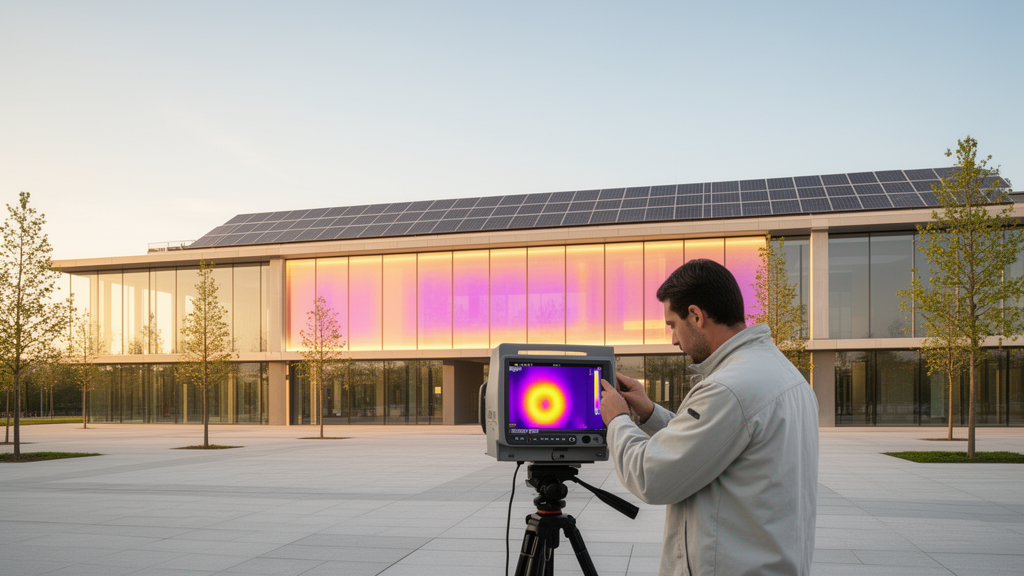
Buildings consumed 32% of global energy and emitted 34% of carbon dioxide in 2023, while indoor air pollution caused more than 3.2 million premature deaths worldwide in 2020. Those two figures frame the motivation behind a new theoretical framework published in the journal Carbon Neutrality, in which researchers propose what they call analytical building thermology: a way of treating the design of walls, air-conditioning processes, and heat-work cycles not as a sequence of separate calculations, but as a single optimization problem solved with the mathematics of variational mechanics.
The core idea borrows from a surprising corner of physics. In the 1630s, Galileo posed the brachistochrone problem, asking for the path of least time for a frictionless particle sliding between two points. The infinite number of possible paths defeated ordinary calculus, but the calculus of variations, later systematized by Lagrange, solves it directly by extremizing a quantity over all candidate paths. The same logic underlies the principle of least action, the foundation of analytical mechanics. The authors ask whether this inverse, function-seeking style of reasoning can be transplanted into the thermal domain of buildings, where the unknown is often not a number but an entire function, such as the ideal temperature-dependent thermal conductivity of a wall.
The framework differs from traditional building thermology in three declared respects. First, it is holistic rather than reductionist, considering the coupled interactions among climate, envelope, and HVAC systems rather than analyzing components in isolation. Second, it rests on the least action principle rather than the second law of thermodynamics, which the authors argue extends its reach to non-equilibrium systems with multiple coupled variables such as temperature, humidity, and pollutant concentrations. Third, it employs inverse-problem and functional analysis, mapping from functions to numbers, instead of the forward-problem, number-to-number analysis of conventional heat transfer calculations. In practice, the quantity to be minimized, energy consumption or carbon emissions, is treated as an action variable, constraints such as thermal comfort are handled with Lagrange multipliers, and the Euler-Lagrange equations yield the unknown optimal function.
The authors acknowledge that traditional approaches have genuine strengths and specific blind spots. Heat and mass transfer theory can analyze a given process but cannot identify the optimal one under complex conditions; engineering thermodynamics, including entropy and exergy analysis, can optimize quasi-static heat-work conversion but not nonequilibrium coupled processes; and entransy theory applies to pure heat or mass transfer but not to coupled conversion. The new framework is presented as a complement aimed at these gaps rather than a replacement for established tools.
The first demonstration revisits classical heat engine cycles. Without invoking the second law of thermodynamics, using only the first law and the ideal gas law, the framework recovers the Otto, Diesel, Brayton, and Rankine cycles as maximum-efficiency configurations under their respective engineering constraints. In numerical simulations with typical working fluid properties and parameters such as a maximum temperature of 1800 K and pressures from 0.1 to 5.0 megapascals, the efficiency peaks precisely where the classical cycles place their adiabatic and constant-volume or constant-pressure processes. For the steam Rankine cycle, where the ideal gas assumption fails, the optimization using actual steam properties and a dryness limit to prevent turbine corrosion still converged on isobaric heat addition with adiabatic compression and expansion. Within this framework, the authors note, the second law becomes, to some extent, a derivable result rather than an axiom.
The second case study turns to the building envelope. Conventional walls have constant specific heat capacity and thermal conductivity, so they cannot exploit the daily swings of outdoor temperature and solar radiation. The researchers formulated the annual heating and cooling electricity consumption of a room as a functional of the wall’s variable thermal properties and solved the resulting nonlinear optimization with a particle swarm algorithm, using Chinese meteorological data and a comfort constraint of 18 to 26 degrees Celsius. The optimal specific heat of interior walls resembles a square wave, peaking near the upper boundary of the comfort zone to absorb solar heat in winter days and cool night air in summer nights, while the optimal thermal conductivity of the exterior wall behaves like a step function, high when outdoor conditions are favorable and minimal when they are harsh.
The modeled savings are striking but come with caveats the authors themselves emphasize. Compared with an actual wall of reinforced concrete and polystyrene board, the ideal variable specific heat achieved 91% energy savings, equivalent to a carbon reduction of 10.5 kilograms of CO2 per square meter per year using Beijing’s emission factor, while the ideal variable thermal conductivity achieved 28% savings, or 3.26 kilograms of CO2 per square meter per year. These are theoretical potentials for idealized property functions, not performance figures for buildable materials. Practical variable-property technologies such as phase change materials and heat pipes carry higher cost and embodied carbon, and the authors state that whether they outperform conventional materials over a full lifecycle requires further evaluation.
The third line of work addresses dehumidification, an often-overlooked energy burden. The condensing dehumidification air conditioner, invented by Willis Carrier in 1902, handles the 20% to 40% latent heat load by cooling air to about 7 degrees Celsius and then reheating it, causing cooling and heating to offset each other and wasting high-grade energy. The authors instead analyze liquid desiccant systems, in which moisture moves from process air to regeneration air through a circulating salt solution, driven not by temperature difference but by chemical potential difference. By analogy with the Carnot cycle, they construct an ideal mass-work cycle of two constant-chemical-potential mass transfer processes and two variable processes with zero net Gibbs free energy input, with efficiency given by one minus the ratio of low to high chemical potential. Consistency between the derived energy consumption and the humidity partial derivative of moist air humidity exergy supports the internal coherence of the construction.
Constrained by real lithium bromide solution properties and a heat-pump-driven counterflow system, the ideal case with infinite heat and mass transfer area yields a coefficient of performance of 41.4, a thermodynamic perfectness of 67% relative to the moist air exergy COP of 61.5. Under practical conditions with finite transfer areas and the electricity consumption of fans and pumps, the COP falls to 4.09, a perfectness of 6.65%. The analysis attributes the losses not only to parameter mismatches and the single heat pump but also to configurational losses: temperature changes during vapor absorption and desorption shift the solution’s chemical potential, preventing the constant-potential transfer the ideal cycle assumes.
The authors position the framework as a theoretical foundation for intelligent, low-carbon buildings, potentially guiding self-adjusting materials, dynamic windows, and coordinated control of walls, HVAC, fresh air units, and air purifiers. For now, its demonstrations are idealized numerical case studies rather than validated prototypes, and the gap between a 91% modeled saving and a manufacturable wall remains wide. But the underlying proposition, that the mathematics that finds the swiftest falling path can also find the least-energy path for a building’s climate, gives engineers a new and unusually general question to ask of every component: not how well does it perform, but what would the theoretically best version of it look like.
Subject of Research: A variational framework for optimizing heat, mass, and work processes in low-carbon building design
Article Title: Analytical building thermology: framework, methodology and applications
Article References: Ji, P., Xie, Y., Xia, J., Wei, J., Little, J. C., & Zhang, Y. (2026). Analytical building thermology: framework, methodology and applications. Carbon Neutrality, 5(1), Article 23. https://doi.org/10.1007/s43979-026-00177-8
Image Credits: AI Generated
DOI: 10.1007/s43979-026-00177-8
Keywords: building thermology, least action principle, calculus of variations, energy efficiency, carbon emissions, variable thermal properties, dehumidification, heat engine cycles, HVAC optimization, building envelope, Analytical, building
News Source: Sloane Callahan. (October 29, 2026). New Thermology Framework Seeks Minimum-Energy Paths for Low-Carbon Buildings. Scienmag.