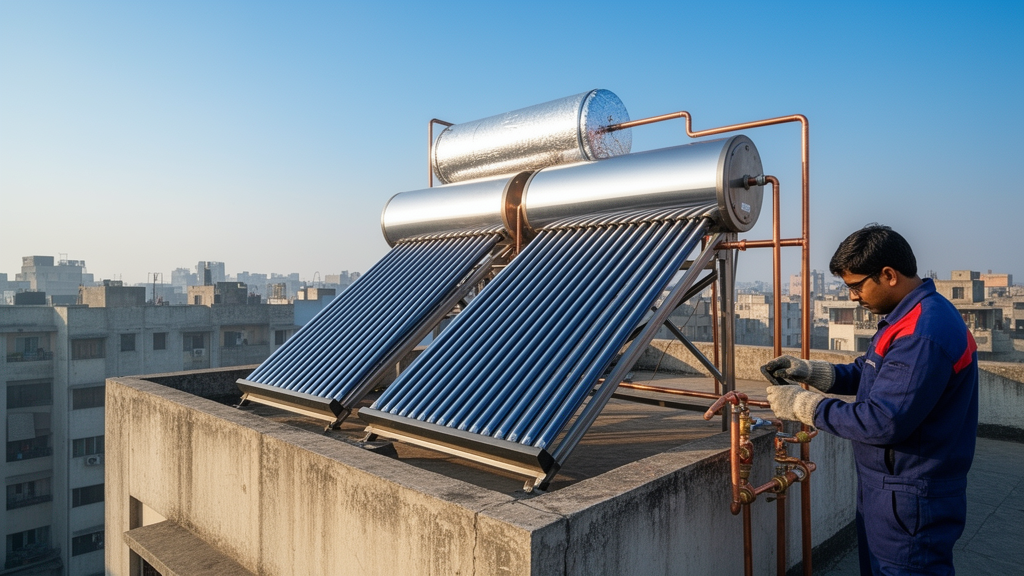
Engineers in Maharashtra have built and tested a solar water heater that combines two different collector technologies in a single rooftop unit, and their seasonal measurements show the combined system reaching efficiencies of 74 to 80 percent under winter conditions — above the roughly 62 percent ceiling reported for optimised hybrid flat-plate and evacuated-tube configurations in the most comprehensive recent review of the field. The prototype, described in the journal Discover Energy, was designed not by engineering intuition alone but through Quality Function Deployment, a structured method that translates what customers say they want into measurable engineering specifications before any design decision is frozen.
The dual absorber solar water heater, or DASWH, integrates a flat plate collector and an evacuated tube collector feeding one shared storage tank. Flat plate collectors, made of an aluminium enclosure with a glass top housing an absorber plate and copper tube risers, are favoured for their cost-effectiveness but suffer radiative losses, with reported efficiencies of roughly 50 to 70 percent and outlet temperatures between 50 and 70 degrees Celsius. Evacuated tube collectors use concentric borosilicate glass tubes with a vacuum between them to suppress both convective and radiative heat loss, achieving reported efficiencies of 60 to 80 percent and temperatures of 70 to 85 degrees Celsius, though the fragile glass tubes raise maintenance concerns. By pairing the two, the new system captures complementary portions of the incoming sunlight.
The physics behind the gain lies in how each collector interacts with solar radiation. The flat plate leg, with its large flat aperture, is most effective at intercepting the direct beam component at low to moderate incidence angles early and late in the day. The evacuated tube’s cylindrical geometry continues to intercept diffuse and off-normal radiation relatively efficiently through most of the day. Because both legs feed a single shared tank, the hotter of the two thermosyphon loops — typically the evacuated tube side, owing to its lower heat-loss coefficient — augments circulation drawn from the cooler flat plate leg, raising the mixed outlet temperature above what either leg would achieve independently. This is the physical basis for the combined system’s efficiency exceeding the simple average of its two individual legs.
The experimental work was carried out at Vidyavardhini’s College of Engineering and Technology in Vasai, Maharashtra, at coordinates 19.3919 degrees north, 72.8397 degrees east. The evacuated tube section operates as a non-pressurised system installed at a 30-degree inclination, driven by the thermosyphon effect: solar heating creates a temperature gradient that induces buoyancy forces, circulating heated fluid naturally from the collector tubes to the storage tank without any pump. During the day, cold water enters the storage tank’s inner cylinder, while the flat plate collector absorbs diffused solar radiation and transfers the captured heat to the evacuated tube header through a high-conductivity fluid via a built-in heat exchanger. The designers report that this arrangement can maintain hot water for two to three days during non-solar periods.
The seasonal trials compared flat-plate-only, evacuated-tube-only and combined configurations at the same time steps on the same days. In the December 2023 winter trial, flat plate efficiency ranged from 57 to 71 percent, evacuated tube efficiency from 63 to 77 percent, and the combined system from 74 to 80 percent, peaking at 15:00. Under optimal operating conditions the flat plate setup attained a maximum water temperature of 65 degrees Celsius with a peak thermal efficiency of 75 percent, while global solar radiation varied between 400 and 950 watts per square metre through the day. Shading experiments that reduced the effective collector area to three and then two square metres cut maximum temperatures to 65 and 45 degrees Celsius respectively, but thermal efficiency remained largely unaffected by the reduced area.
The monsoon told a different story. In a June 2024 trial, flat plate efficiency fell to a range of 40 to 50 percent, evacuated tube efficiency to 40 to 45 percent, and the combined system to 40 to 53 percent. The site’s own weather record explains the narrowing advantage: wind speeds peak at 5.5 metres per second in June, monsoon relative humidity reaches up to 90 percent, and available sunshine drops from eight to nine hours per day in summer to only three to five hours during the monsoon. The reduced direct-beam fraction and higher cloud cover weaken the complementary-capture mechanism on which the dual design depends, a genuine operating-envelope constraint rather than a fixable defect, according to the authors, who recommend further wind- and cloud-resolved analysis.
The design process itself offers a case study in customer-driven engineering. Researchers conducted one-to-one interviews that yielded eighteen essential requirements, alongside eight material-quality parameters, seven performance parameters and nine innovation-related parameters. Twenty-six respondents, recruited through purposive sampling targeting residential users and prospective buyers in Maharashtra, Gujarat, Tamil Nadu and Andhra Pradesh, scored each customer need on a one-to-five importance scale. Three domain experts in materials engineering and renewable-energy applications helped translate those needs into design measures using the standard House of Quality relationship matrix on a nine-three-one scale, with a roof matrix identifying trade-offs such as footprint reduction set against absorber area. The top three customer-weighted priorities proved to be robust exterior design, safety measures and a wide operational temperature range, with modularisation strongly linked to IoT-based sensors, form design and copper collectors.
The authors are candid about the study’s limits. The survey sample of 26 and the expert panel of three are modest by the standards of large-scale consumer research, and formal internal-consistency reliability statistics such as Cronbach’s alpha were not computed because the raw item-level response data were unavailable. The efficiency uncertainty analysis, applying the Kline and McClintock propagation method with instrument uncertainties of roughly 1.3 percent for flow rate and 5.0 percent for irradiance, yields a combined relative uncertainty of about 5.7 percent, corresponding to an absolute band of roughly plus or minus 4.6 percentage points on the peak winter efficiency of 80.8 percent — an illustrative calculation the authors say should be repeated for each individual data point. A techno-economic assessment in the paper is explicitly literature-benchmarked and indicative, relying on a willingness-to-pay proxy rather than actual fabrication costs, and payback estimates for comparable Indian installations typically fall in the three to 4.5 year range depending on location and system type.
Additional constraints concern durability and context. The mild-steel support frame faces corrosion risk in the humid coastal environment unless adequately coated, the borosilicate tubes remain mechanically fragile during installation and transport, and tube scaling, sealant degradation and instrument recalibration are expected maintenance needs outside the scope of the short single-season trials. Among tube diameters tested — 48, 54 and 72 millimetres — the 48 millimetre tube demonstrated the highest efficiency in hot water generation, while the 72 millimetre tube exhibited a thermal stagnation region at its lower end that reduced overall performance, a problem to which larger diameters are generally prone. The system also depends on the thermosyphon effect, which may not activate under overcast conditions, occasionally leaving users with inadequate hot water.
The broader context is India’s push to promote domestic solar water heaters as part of its sustainable development strategy, where replacing conventional geysers offers a cost-effective route to climate mitigation. A standard 100-litre solar water heater requires about 1.2 square metres of installation space, making spatial limitations a real barrier in densely populated cities — precisely the constraint the dual-absorber design targets by boosting heating capacity without demanding more roof area. Adoption patterns across Indian states show that municipal or state-level mandates, as in Pune, Rajkot and the earlier Vijayawada requirement, sharply accelerate uptake, while their absence or withdrawal correlates with weaker penetration even where local supply chains are strong. The authors frame this work as an initial phase: future priorities include a larger, psychometrically validated QFD sample, a techno-economic assessment grounded in actual fabrication cost, optimisation of inter-collector spacing, wind-effects analysis, and feasibility studies on nanofluids as working media, alongside integration with other renewable energy sources.
Subject of Research: Design and seasonal performance testing of a dual-absorber solar water heater developed using Quality Function Deployment in India
Article Title: A sustainable solar water heating using integration of quality function deployment
Article References: Mane, S. R., Aswalekar, U., Kale, R., & Gawande, S. H. (2026). A sustainable solar water heating using integration of quality function deployment. Discover Energy, 6(1), Article 72. https://doi.org/10.1007/s43937-026-00198-5
Image Credits: AI Generated
DOI: 10.1007/s43937-026-00198-5
Keywords: solar water heater, dual absorber, Quality Function Deployment, flat plate collector, evacuated tube collector, thermosyphon, thermal efficiency, India, renewable energy, seasonal performance, House of Quality, monsoon
News Source: Denise Maddox. (October 29, 2026). Dual-Absorber Solar Water Heater Tops 74% Winter Efficiency in Indian Trial. Scienmag.