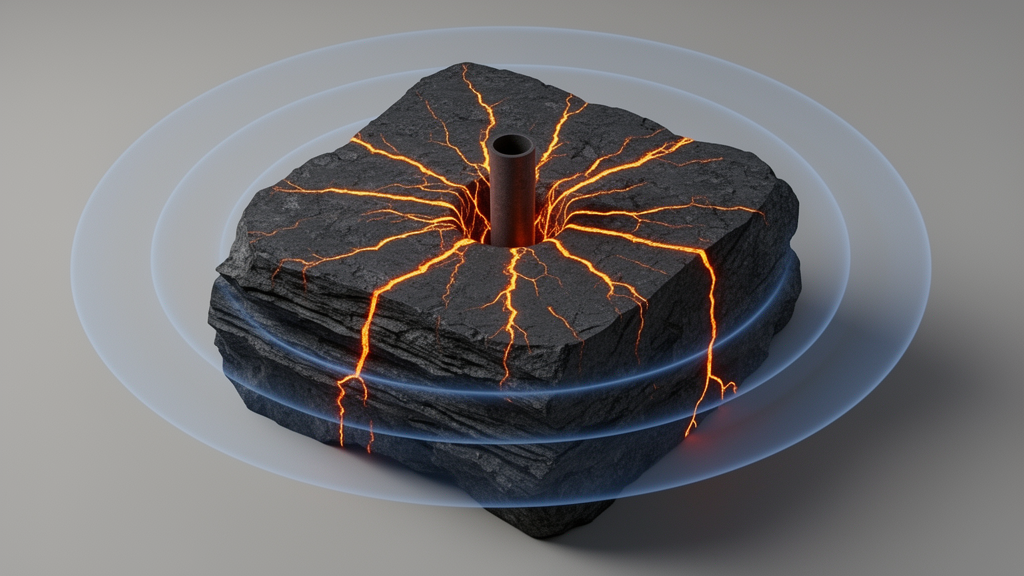
Blasting in coal mines is a delicate balancing act. Detonate too many boreholes at once and most of the explosive energy is wasted crushing rock in one narrow zone; space the holes too far apart and the stress waves never meet, leaving large, awkward fragments behind. A new numerical study published in Frontiers in Materials uses the LS-DYNA simulation code to map how in situ stress, delay timing between detonations, and borehole spacing control the way cracks form, grow, and ultimately determine fragment size in coal masses. The work, led by Jianjian Zhao and colleagues at institutions including Zhongyuan University of Technology and Tongji University, also proposes a practical method for estimating fragment size distribution directly from simulated damage fields.
The researchers chose the Riedel–Hiermaier–Thoma, or RHT, constitutive model to represent the coal. LS-DYNA offers three damage models for rock dynamics—the Holmquist–Johnson–Cook model, the Johnson–Holmquist model, and the RHT model—and all three capture strain-rate effects, shear-compression failure, and tensile failure in brittle geomaterials. The RHT model, however, pairs the Mie–Gruneisen equation of state with a more comprehensive description of pressure-dependent yielding, strain hardening, and damage softening, which the authors argue makes it better suited to reproducing the full sequence of stress-wave propagation, crack initiation, and crack growth during blasting.
The RHT framework describes material response in three distinct stages. In the elastic stage, plastic strain begins to accumulate but no damage occurs. In the strain-hardening stage, stress rises between the elastic limit surface and the ultimate failure surface as accumulated equivalent plastic strain grows. Only when the equivalent stress exceeds the failure strength limit does the damage softening stage begin; there, the model uses the ratio of accumulated plastic strain to ultimate failure strain as the damage variable, and residual friction between fractured fragments allows the material to sustain some shear force even after failure. Porous compaction is handled by the p-alpha equation of state, in which pore collapse progresses from an elastic crushing phase at a defined pressure to complete compaction, while the explosive itself is described by the Jones–Wilkins–Lee equation of state with parameters including a density of 1,000 kilograms per cubic meter, an initial internal energy of 8 gigapascals, and a detonation velocity of 4,000 meters per second.
To initialize the in situ stress field realistically, the team used a two-step procedure. An implicit analysis first computed static stresses and strains in the model using SOLID 185 elements under boundary stresses or body forces. Those converged stress and strain data were then transferred into an explicit RHT simulation model with SOLID 164 elements, a non-reflecting boundary, and a stress boundary, and the explicit solver ran the blasting process itself. The computational domain was a three-dimensional slab 4,000 by 4,000 by 2 millimeters, treated as plane strain in the x-y plane, with 2-millimeter elements, displacement restraint in the z direction, and non-reflecting boundaries on the x-y plane edges to absorb stress waves. The explosive charge sat at the center as a circle with a 30-millimeter radius, and the model contained 3,991,575 rock material elements alongside 128 explosive elements.
Before exploring multi-hole scenarios, the single-borehole model was verified against experimental results. The simulated fracture pattern showed a crush zone and radial cracks broadly similar to the experiment, although the simulated radial cracks appeared as straight lines because the modeled material is more homogeneous than real rock. The authors are candid about this limitation: the RHT simulation can indicate trends and laws of the blasting process, including crack length under various explosive conditions, but it cannot reproduce the exact crack path, and experimental size restrictions meant only part of the radial crack was visible in the comparison sketch. They also note that rock heterogeneity and the presence of a free surface, both excluded from the model, significantly affect crack growth and fragmentation and remain topics for future work.
The single-hole baseline run revealed the timeline of fragmentation. A crush zone with a radius roughly ten times the hole radius formed within 0.3 milliseconds. Between 0.3 and 0.6 milliseconds, radial cracks generated by the blasting stress waves extended to a radius of approximately 0.5 meters. From 0.6 to 3.0 milliseconds, tension failure at the crack tips drove further radial growth, and the final crack length reached approximately 1.5 meters. This crack radius became the reference length against which all subsequent hole-spacing decisions were judged.
The first systematic variable was biaxial isobaric in situ stress, tested at 0, 10, 20, 30, and 40 megapascals. The trend was unambiguous: crack growth is progressively restrained as isobaric stress increases. With 10 megapascals of in situ stress, the maximum crack length fell from about 1.5 meters to 1.2 meters, while crack density showed no significant change. At 30 to 40 megapascals, crack growth was depressed significantly. Notably, in these biaxial isobaric models the cracks kept growing along the radial direction; the authors flag that the influence of unequal horizontal and vertical stresses—different lateral pressure coefficients—needs further investigation, since real underground coal masses typically experience anisotropic stress states that can steer cracks along the maximum principal stress direction.
Delay timing between two boreholes proved to be the second decisive factor. When the two holes detonated simultaneously, stress waves superposed in the zone between them, generating excessive cracks there and producing small fragments, while few cracks formed elsewhere because most of the blasting energy was exhausted in the middle zone. The authors note this pattern suits pre-splitting and controlled blasting but is not recommended for ore block blasting, which generally requires uniformly sized fragments. With a 1-millisecond delay, the weak stress wave of the first hole superposed with the strong waves of the second, creating a slightly fragmented block in the overlap zone, and the second hole’s waves deflected the still-growing radial cracks of the first into new directions—evidence that blasting energy was still being consumed in the superposition zone rather than in productive fragmentation. At a 2-millisecond delay, the connected crack zone between the holes increased markedly, indicating that radial cracks in the first hole had grown fully before the second wave arrived, so more energy went into generating new cracks. The 3-millisecond model differed only slightly from the 2-millisecond case, since cracks in the single-hole model had already stopped growing by 3 milliseconds. The team concluded that avoiding stress-wave superposition improves the efficiency of blasting energy in crack generation and adopted the 3-millisecond delay for all subsequent multi-hole simulations.
Hole spacing completed the parameter study. At 1-meter spacing, stress waves impacted a smaller zone, producing smaller fragments and even crush zones at some stress-wave intersection points. At 1.5 meters, fragment size and the fragmented zone both expanded, suggesting engineers can tune spacing to meet a target fragment size. At 2.0 meters, the stress waves of adjacent holes could no longer promote crack growth from the first hole, and no crack network formed between the two holes—consistent with the single-hole crack radius of roughly 1.5 meters. Under the study’s parameters, 1.5-meter spacing was selected for the multi-hole optimization stage.
For the multi-hole models, motivated by stratiform ore deposits where triangular and rectangular hole layouts are common, the team built three configurations with 1.5-meter horizontal spacing, 1.0-meter vertical spacing, and 3-millisecond delays: a three-hole triangle layout, a four-hole rectangle, and a rectangle with an empty hole at its center to test whether a free face could guide crack growth. In the triangle model, a large crack network formed after the first two holes initiated, and after the third hole fired the network developed fully, fragmenting the solid among the three holes, with the largest fragments roughly 0.2 to 0.3 meters. Fragment size in the triangle model was small and uniform, whereas the rectangle model left several larger voids at its center because the vertical hole distance differed from the horizontal distance, producing slight nonuniformity in the two directions. The empty hole did guide crack growth between holes but suppressed crack growth in other directions, which the authors found adverse to fragment generation.
The final contribution is a quantitative fragment evaluation method built on a damage threshold. Damage in the RHT model is defined as accumulated plastic strain relative to ultimate failure strain, ranging from 0 for intact material to 1 for fully damaged. Building on prior work that used a damage level of 0.6 as the limit for fully crushed rock, the team applied a damage threshold of 0.8 to identify cracks: mesh cells with damage below 0.8 were colored white and those at or above 0.8 black, isolated white blocks fully enclosed by black mesh were counted as fragments, and the ratio of each fragment to the whole analyzed zone was plotted as a fragment-versus-accumulated-area scatter plot. Fitting that scatter with the Rosin–Rammler–Bennett formula, whose parameters include an average fragment size, produced good agreement for the triangle model, and the fitted equation was then applied to all three models. The fragment size distributions of the triangle and rectangle models differed only slightly, and the model with the central empty hole showed a similar small-fragment distribution, but its proportion of large fragments with areas above 0.1 square meters rose significantly to 16 percent, compared with 5 percent in the other layouts.
The authors stress the boundaries of what these simulations can claim. Computer capability limited the model size, so only a three-hole configuration could be used to characterize fragment distribution, even though real blasting operations detonate many more holes, and crack distribution may change as the number of adjacent firing holes increases. The 3-millisecond optimal delay is specific to the model parameters used here; because the RHT model contains many parameters that can generate varied rock properties, the authors emphasize that experimental verification is necessary before applying the method to new materials, and a fresh parameter verification must be conducted whenever the material changes. Within those limits, the study offers mining engineers a structured workflow—verify a single-hole model against experiment, select delay times that avoid stress-wave superposition, keep hole spacing within the single-hole crack radius, and read fragment outcomes directly from damage-threshold maps—that could sharpen blasting design in deep underground excavation, where accounting for in situ stress is essential for predicting rock damage and optimizing fragmentation efficiency.
Subject of Research: Numerical simulation of blasting-induced crack growth and fragmentation in coal masses using the RHT model
Article Title: Analysis of multi-hole blasting-induced fracture and fragmentation in coal masses
Article References: Zhao, J., Ding, P., Ta, B., Zhou, M., Zhao, H., & Zhou, C. (2026). Analysis of multi-hole blasting-induced fracture and fragmentation in coal masses. Frontiers in Materials, 13, Article 1951341. https://doi.org/10.3389/fmats.2026.1951341
Image Credits: AI Generated
DOI: 10.3389/fmats.2026.1951341
Keywords: blasting, coal masses, numerical simulation, RHT model, LS-DYNA, crack propagation, fragment size, delay initiation, borehole spacing, in situ stress, damage threshold, mining engineering
News Source: Denise Maddox. (October 29, 2026). Simulations Reveal How Stress and Delay Timing Shape Coal Blasting Fractures. Scienmag.