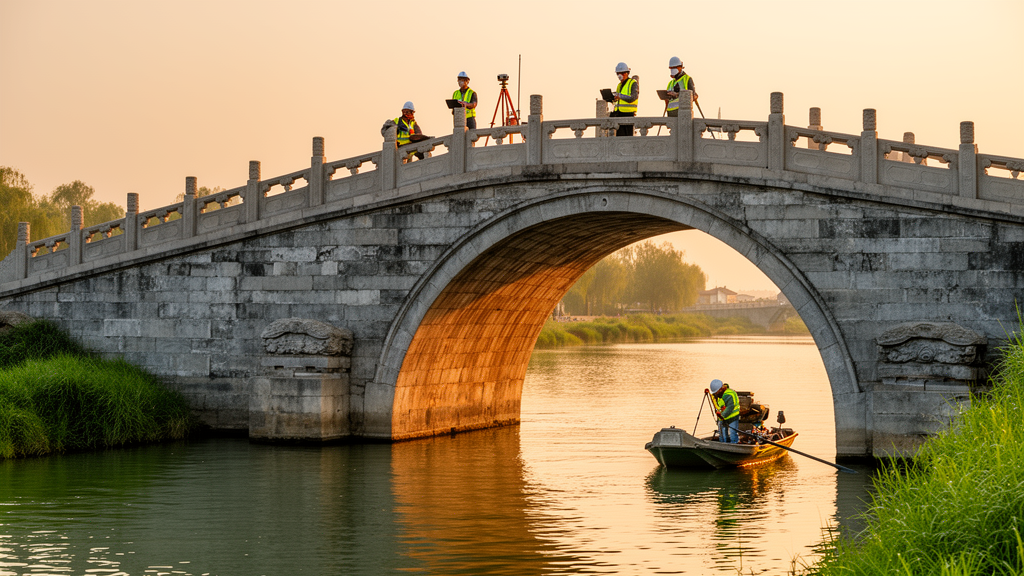
Engineers in China have put a newly developed technical standard for assessing the safety of ancient masonry arch bridges through its first documented field trial, applying it to the Yong’an Bridge in Zherong County, Fujian Province. The bridge, a single-span semicircular stone arch crossing Yushan Creek in Xikou Village, is recognised as one of the largest extant single-span stone arch bridges in East China, with a net span of 23.76 metres. The pilot study, published in the journal Built Heritage, reports that the bridge remains generally stable under current static loading and typical hydrological conditions, although localised cracking and material loss were identified, and the surrounding environment emerged as the principal long-term threat.
The work stems from a broader concern about China’s ancient stone arch bridges, which are numerous and constitute a highly representative part of the country’s bridge engineering heritage. According to the researchers, these structures increasingly face multifaceted, multi-hazard challenges arising from both climate change and intensified human activity. Existing structural assessment systems for aged bridges, they argue, predominantly focus on physical damage to the bridge body or on hazards from a single source, making it difficult to identify and evaluate safety risks when several factors act together. The study was carried out under China’s National Key R&D Program on key technologies and demonstration for risk assessment and hidden danger investigation of bridge cultural heritage.
From that programme, a drafting group produced the Technical Standard for Hidden Danger Investigation of Ancient Masonry Arch Bridges, designated T/NAIC 004 (2025). The standard’s central innovation is an assessment framework the authors call B–E–F: Bridge Body, Disaster-prone Environment, and Disaster-causing Factors. Rather than treating structural defects, environmental exposure, and external actions as independent variables, the framework evaluates their coupled interactions. The B dimension covers a bridge’s intrinsic resistance, including material mechanical properties, mortar joint degradation, arch ring integrity, and geometric stability. The E dimension characterises the environment that incubates and accelerates hidden hazards, such as riverbed morphology, hydrological conditions, geological stability, and long-term moisture exposure. The F dimension captures external triggering forces, including extreme rainfall, hydrodynamic impact, flood-induced scour, and seismic actions.
The framework’s logic rests on the intersections among the three dimensions. The overlap of bridge body and environment represents the vulnerability state of the system, since moisture infiltration, salt crystallisation, leaching, and foundation scour progressively reduce the resistance of masonry materials. The overlap of bridge body and triggering factors describes how existing defects determine the structure’s instantaneous response to hydraulic impact, dynamic vibration, or concentrated flood pressure. The overlap of environment and factors captures how conditions such as channel constriction, sediment accumulation, or unstable riverbanks can amplify hazard effects by increasing local flow velocity and scour depth during floods. The three-way intersection serves as the comprehensive criterion for safety classification, reflecting the premise that catastrophic failures typically result from synergistic interactions rather than isolated causes.
To turn this conceptual model into numbers, the standard builds on the Analytic Hierarchy Process, a multi-criteria decision-making method introduced by Thomas Saaty in 1980. The overall safety evaluation forms the target layer, the three B–E–F dimensions form the criterion layer, and individual deterioration indicators, environmental parameters, and hazard-triggering variables form the indicator layer. Weight coefficients were fixed during the standard’s compilation by an expert working group drawn from bridge engineering, heritage conservation, structural health monitoring, and hydrology. Each expert independently assigned relative importance on a one-to-nine scale, pairwise comparison matrices were constructed, and weights were derived from the principal eigenvalue problem. Matrices passed a consistency ratio test only when the ratio fell below 0.10, and the passing results were aggregated by mean and normalised into the final weight vector, which is reproduced in the paper’s appendix.
The field investigation itself combined a suite of non-destructive and minimally invasive techniques. UAV-based photogrammetry and 3D laser scanning produced high-density point clouds for geometric reconstruction, allowing quantitative checks of arch alignment, springer displacements, and deformation. Rebound testing and ultrasonic non-destructive testing assessed masonry integrity and mortar degradation, while accelerometer-based ambient vibration testing identified modal frequencies used to calibrate a finite element model of the bridge. Hydrometric monitoring with flow meters and a densitometer accurate to 0.1 kilograms per cubic metre quantified flow velocity and water density, and endoscopic inspection was used to examine underwater foundation conditions and scour-related features not accessible to visual inspection. Historical repair records, regional meteorological data, long-term rainfall sequences, and flood-frequency information completed the environmental baseline.
The results paint a picture of a structurally sound but environmentally exposed monument. The comprehensive hazard score came to 75.42 on the standard’s weighted scale. The bridge body dimension scored 67.62, indicating that the primary load-bearing system and global structural integrity remain generally stable; point cloud analysis found no significant deformation accumulation, and endoscopic inspection confirmed no severe foundation exposure, excessive scour cavities, or major instability. The disaster-causing factors dimension scored 93.33, suggesting current external triggering forces remain within an acceptable range under normal conditions. The disaster-prone environment dimension, by contrast, scored only 63.63, reflecting the humid subtropical climate, frequent seasonal rainfall, and flood susceptibility of the Fujian site, which were rated at the lower end of the scale. Cracks in the masonry received a poor rating, and material loss a moderate one, indicating localised deterioration despite overall stability.
The authors highlight the value of coupling different detection methods rather than relying on any single measurement. Flow-velocity readings alone indicate only the external hydraulic intensity at the site, but combined with endoscopic views of the underwater foundations, they allowed the team to verify directly whether hydraulic conditions had produced scour-induced instability. Similarly, modal identification from vibration sensing did more than characterise dynamic response: it calibrated the finite element model, improving the reliability of bearing-capacity interpretation. A one-at-a-time sensitivity analysis, in which each weight was perturbed by plus or minus twenty percent while remaining weights were renormalised, showed the composite score fluctuating only between 73.49 and 77.35, which the authors take as evidence that the hazard classification is resilient to weight uncertainty.
The team is transparent about the limits of the exercise. Several of the authors sit on the technical-drafting group that developed T/NAIC 004, and the paper explicitly avoids claiming that the standard outperforms alternatives. The framework was evaluated on a single bridge under static loading and typical environmental scenarios; performance under extreme events such as severe flooding or seismic loads was beyond the scope of the field inspection and is addressed in parallel numerical work. The authors call for multi-case benchmarking by independent external teams across diverse bridge typologies and geographical settings, and for systematic tracking of operational costs, equipment requirements, and person-hours compared with conventional inspection methods. For now, the pilot provides a scientific basis for the targeted reinforcement and conservation of Yong’an Bridge itself, and a demonstrative reference for preventive conservation of masonry heritage in multi-hazard environments.
Subject of Research: Pilot application of a multi-hazard hidden danger investigation standard to an ancient masonry arch bridge in China
Article Title: Pilot application of technical standards for hidden danger investigation of ancient masonry arch bridges: a pilot study of Yong’an Bridge
Article References: Han, J., Shen, Y., Li, Y., Chen, Y., & Dai, S. (2026). Pilot application of technical standards for hidden danger investigation of ancient masonry arch bridges: a pilot study of Yong’an Bridge. Built Heritage, 10(1), Article 65. https://doi.org/10.1186/s43238-026-00318-z
Image Credits: AI Generated
DOI: 10.1186/s43238-026-00318-z
Keywords: masonry arch bridges, heritage conservation, structural health monitoring, B–E–F framework, T/NAIC 004 standard, Yong'an Bridge, non-destructive testing, 3D laser scanning, flood scour, Analytic Hierarchy Process, finite element calibration, preventive conservation
News Source: Denise Maddox. (October 29, 2026). Ancient Chinese Stone Arch Bridge Tested as Pilot for New Multi-Hazard Safety Standard. Scienmag.