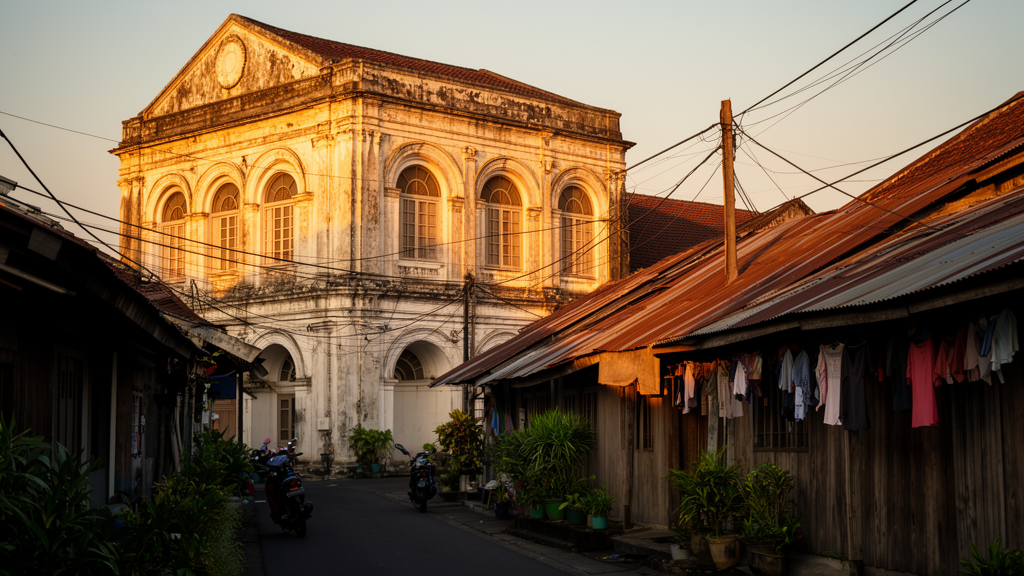
A new open-access study in the journal City and Built Environment argues that these two components should be read together as a single hybrid heritage, because each one is needed to understand the city’s historical memory and identity.
The research, conducted by Mauricio Jhonatan Clavijo del Carpio and Tanti Satriana Rosary Nasution, is an interpretative, case-based analysis rather than a statistical or causal study. It examines three colonial areas of Surabaya: Kota Lama, the old town along the Kalimas River; Tunjungan, the historic commercial corridor; and Darmo, the early twentieth-century residential expansion to the south. The authors selected these areas because they contain the highest concentrations of colonial-era buildings and their modern reinterpretations, and because each combines colonial architecture with adjacent kampungs.
Colonial heritage remains visible in the city’s main streets, in monumental white buildings that served as VOC headquarters from the seventeenth century onward. As the city grew, new areas such as Kota Lama and Tunjungan emerged, and between 1900 and 1950 the southern suburbs, including Darmo and nearby Tegalsari and Sawahan, developed with wide streets and two-story houses with gardens, reflecting European suburban ideals supported by the Decentralization Ordinance of 1905.
Methodologically, the study draws on Aldo Rossi’s Theory of the Urban Artifact, which holds that a city’s memory is shaped by monuments and enduring architectural features recognized by the people who inhabit and use its collective spaces. The authors used historical maps from J.R. van Diessen’s 2004 book Soerabaja to define the study areas from the late 1800s until 1945, then documented the current state of the areas on site with photographs and geographic information system mapping in QGIS. The survey covered ten major streets, including Jl. Rajawali, Jl. Kembang Jepun, and Jl. Karet in Kota Lama; Jl. Tunjungan, Jl. Songoyudan, and Jl. Pahlawan in Tunjungan; and Jl. Diponegoro and Jl. Raya Surabaya-Malang in Darmo.
The fieldwork identified 179 buildings across the three areas. Of these, 89 are heritage colonial buildings and 32 are infill buildings, contemporary structures constructed from the 1970s to the present that imitate colonial style using Dutch architectural elements such as those catalogued in prior research on recurrent Dutch colonial facades. Kota Lama contains the largest concentration of both historical and adapted examples, followed by Tunjungan and Darmo. Alongside the building survey, the team identified the kampungs behind the main corridors: Kampung Krembangan Selatan, Kampung Nyamplungan, and Kampung Bongkaran in Kota Lama; Kampung Peneleh and Kampung Genteng in Tunjungan; and Kampung Grudo and Kampung Dinoyo in Darmo. Urban characteristics of the kampungs, including their extension, number of houses, and maximum number of floors, were drawn from the Central Statistics Agency of Surabaya as of 2024.
The interpretative findings center on a persistent spatial hierarchy. In Kota Lama, the first Dutch settlement and a fortified walled city, monumental colonial buildings line the main corridors while kampungs were relegated to the edges of the former fort. The kampungs historically housed workers and service personnel employed by the colonial establishments, and the authors observe that this relationship can still be seen today, with many kampung residents working in service or small businesses in the area while people working in the colonial buildings reside in other districts. In Tunjungan, which by 1900 had become the cultural and financial center of Surabaya, colonial department stores, hotels, and cafes shaped a commercial boulevard whose service workers and labor force came from the kampungs hidden behind the facades. In Darmo, opulent detached mansions surrounded by greenery stood in contrast to the compact, community-oriented kampung settlements on the area’s edges.
The study also documents how kampung communities have adapted and reused colonial remnants over time. In Genteng, residents have transformed old colonial structures into benches, foundations, and other urban furniture, and the alleys function as community infrastructure where locals conduct surveillance, children play, and street vendors support the local economy. In Kampung Peneleh, the authors describe a local dining business that serves as a venue for historical recollection and heritage advocacy, which they interpret as a community-led effort to have kampungs recognized as living heritage. In Kampung Nyamplungan and Kampung Bongkaran, locally adapted businesses operated by families from combined residential and business facilities reflect, in the authors’ interpretation, a resilient, community-oriented memory in contrast to the rigid institutional image of the main streets.
At the conceptual level, the authors argue that colonial heritage and kampungs coexist in the same urban space as complementary rather than competing elements, forming a hybrid heritage of two different societies that shared one space and depended on each other. They frame the persistence of this pattern through Rossi’s concept of the Urban Artifact: even as heritage buildings have faced decay and demolition and kampungs have adapted to modern needs, the memory persists dynamically through the daily lives of locals who reuse old structures and transform urban space for contemporary uses. The paper connects this to broader critical heritage debates, including the aesthetics of authority that continues to valorize colonial imagery, and notes that even current heritage initiatives prioritize colonial buildings, allocating most of the budget to restoring colonial facades, while infill buildings replicate colonial designs.
A central conclusion concerns heritage management. The analysis found that Surabaya lacks a comprehensive heritage management approach that includes both components, and that current initiatives have mainly consisted of the revitalization and restoration of colonial buildings, with little attention paid to the problems of kampungs. The authors argue that future heritage initiatives must contemplate both colonial infrastructure and kampungs, that most kampung issues can be solved at the community level, and that authorities should work alongside residents as part of the city’s living heritage. They also note that kampung residents themselves refer to their neighborhoods using well-known urban landmarks, such as saying they live near the Majapahit or behind the Siola, illustrating how colonial monuments function as reference points that connect directly to the kampungs.
The authors are explicit about the study’s limitations. It is a case-based interpretive analysis framed by the historical uniqueness of Surabaya’s colonial history, and the pattern of coexistence between colonial heritage and kampungs varies according to each city’s historical process, making the results difficult to generalize to other contexts. However, because kampungs also exist in other Indonesian colonial cities such as Semarang, Bandung, Malang, and old Jakarta, the authors suggest that future research could examine the relationship between the two heritage components in those cities according to their historical relevance. Within its scope, the study positions itself as an interpretative framework for rethinking heritage in Surabaya as a hybridity, with implications for urban heritage management, postcolonial studies, and critical heritage studies.
Subject of Research: An interpretative urban heritage analysis of colonial architecture and kampungs in Surabaya, Indonesia
Article Title: Colonial heritage and kampungs as hybrid heritage in Surabaya, Indonesia: an interpretative analysis
Article References: Clavijo del Carpio, M. J., & Nasution, T. S. R. (2026). Colonial heritage and kampungs as hybrid heritage in Surabaya, Indonesia: an interpretative analysis. City and Built Environment, 4(1), Article 15. https://doi.org/10.1007/s44213-026-00081-y
Image Credits: AI Generated
DOI: 10.1007/s44213-026-00081-y
Keywords: Surabaya, urban heritage, kampungs, colonial architecture, Indonesia, Aldo Rossi, Urban Artifact, heritage management, postcolonial studies, Kota Lama, Tunjungan, Darmo
News Source: Denise Maddox. (October 28, 2026). Colonial buildings and kampungs together form Surabaya’s hybrid urban heritage, study finds. Scienmag.