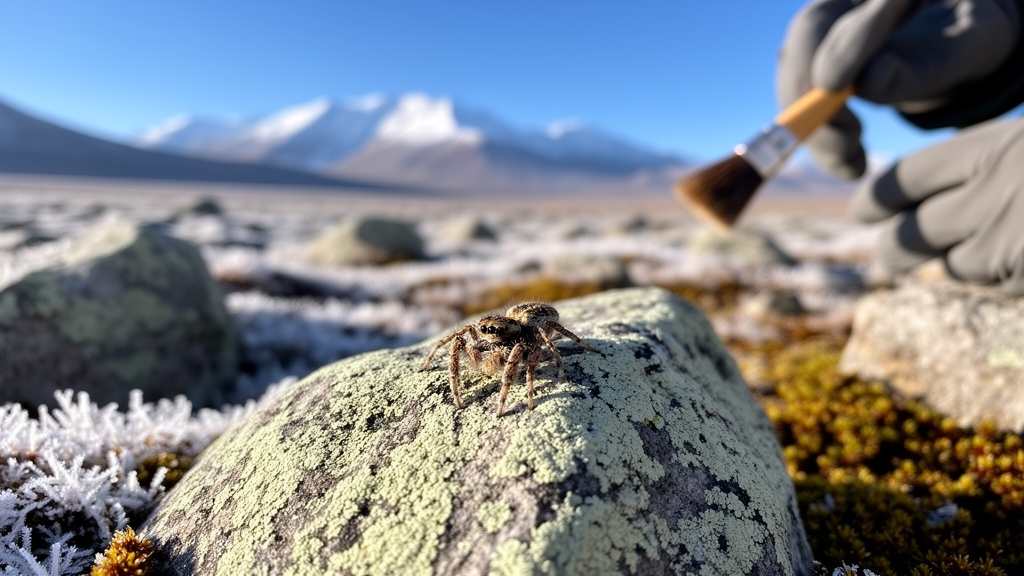
Two previously unknown species of sheet-web weaving spiders have been described from the Tibetan Plateau, collected at elevations of roughly 3,910 and 4,492 meters above sea level in Xizang Autonomous Region, China. The species, named Poeciloneta duinanensis and Poeciloneta jidingensis, belong to the dwarf spider family Linyphiidae and were identified from specimens gathered in 2018 by sieving leaf litter in grassland habitats. Both sexes of each species are described in the study, which raises the number of Poeciloneta species recorded from China from three to five and underscores how incompletely the spider fauna of the eastern Himalayas remains documented.
The genus Poeciloneta currently comprises 14 species with a predominantly Holarctic distribution, occurring widely across the Nearctic and Palaearctic regions. In North America it is represented in Canada and the United States, including Alaska, with one species, P. variegata, extending more broadly beyond the region. Across the Palaearctic the genus stretches from Europe and European Russia eastward through Middle Siberia to the Russian Far East, and southward to Georgia, Iran, Kazakhstan, and Kyrgyzstan. Before the new work, East Asian representatives included just three Chinese species: P. variegata in northern and western China, including Qinghai, Xinjiang, and Xizang, and two species described from the Tibetan Plateau in 2008, P. xizangensis and P. ancora, both known from high-elevation habitats around Lhasa at approximately 3,655 meters.
Poeciloneta species occupy diverse habitats ranging from lowland vegetation to high-elevation mountains, turning up under stones, among mosses and grasses, and in leaf litter in moist habitats and spruce forests. That wide ecological and elevational range reflects considerable adaptability across the genus’s extensive distribution. The two new species, from Yadong and Sajia counties in Xizang, extend the known Chinese distribution of the genus further and point to the potential for undiscovered diversity in a region that has seen relatively little sampling.
The specimens behind the new descriptions were collected by sieving leaf litter and preserved in 75 percent ethanol. For study, the left male pedipalps were dissected and photographed, while female epigynes were cleared in a trypsin solution before examination. Researchers examined and measured the specimens using a Leica M205A stereomicroscope equipped with a Leica DFC450 camera, and took habitus and genitalia photographs with a CCD camera mounted on an Olympus BX53 compound microscope. Compound focus images were generated with Helicon Focus software, eye sizes were measured at maximum dorsal diameter, and all measurements are reported in millimeters. The material is deposited at the School of Life Sciences, Southwest University, Chongqing, and the morphological terminology follows the framework established by Saaristo and Tanasevitch in 1996.
Poeciloneta duinanensis takes its name from its type locality, Duinan Township in Yadong County, where the holotype male was collected on 10 July 2018 in grassland and along walls at the water’s edge, at 4,492 meters above sea level, at coordinates 27°58.555’N, 89°14.576’E. Paratypes include one male and thirteen females from the same site. The species is known only from this locality. The male measures 2.43 millimeters in total length, with a yellowish brown carapace 1.19 millimeters long and 0.87 millimeters wide, a slightly elevated cephalic region, and an opisthosoma bearing a greenish dorsal pattern with white patches on the sides. The female is larger at 3.26 millimeters, with a brown carapace 1.54 millimeters long. Both sexes show a tibial spine formula of 2-2-2-2, and the position of the trichobothrium on the first metatarsus is 0.26 in the male and 0.23 in the female.
The male of P. duinanensis resembles P. ancora, P. jidingensis, and P. xizangensis in having a similar distal arm of the paracymbium and a lamella characteristica with several branches, but it can be distinguished by the tip of the LC2 branch, which carries three teeth, compared with seven teeth in P. jidingensis and a bifurcated tip in both P. ancora and P. xizangensis. It also lacks the lateral projection tooth on LC2 that is present in P. jidingensis, and the tip of its embolus proper is bifurcated, unlike the unbifurcated tips of the related species. In the female, the posterior median plate is strongly depressed at the center with a rounded lateral margin, whereas P. jidingensis has a trapezoid plate and P. xizangensis has a plate that is only slightly depressed at the center with an angular lateral margin. The epigyne of the new species features a proscapus 1.5 times wider than long, an ear-shaped lateral lobe, a stretcher with a rounded end, and tubular, slightly curved spermathecae pointing downward.
Poeciloneta jidingensis, whose name also derives from its type locality, was collected in Jiding Town, Sajia County, in grassland along farmland at 3,910 meters above sea level, at 29°12.571’N, 88°22.267’E, on 13 July 2018. The type series comprises a holotype male and one male and nineteen female paratypes. The male again measures 2.43 millimeters in total length, with a yellowish brown carapace 1.28 millimeters long and 0.98 millimeters wide, while the female measures 2.72 millimeters with a carapace 1.25 millimeters long. The male’s trichobothrium position on metatarsus I is 0.24, and the female’s is 0.21. The species is likewise known only from its type locality. Its male pedipalp differs from that of P. duinanensis in the seven-toothed LC2 tip, the presence of a lateral projection tooth, and an embolus proper that is slightly curved with a pointed, unbifurcated tip; its lamella characteristica’s distal branch bears two long branches with two median teeth apically, and the thumb is inconspicuous rather than sheet-like.
The female of P. jidingensis shares a similar proscape with the other Xizang species but is separated by its trapezoidal posterior median plate, a globular rather than ear-shaped lateral lobe, and strongly curved spermathecae, in contrast to the slightly curved spermathecae of P. duinanensis. These genital characters are central to linyphiid taxonomy, and the study provides photographs of both genital structures and somatic features for each species, together with a distribution map of Poeciloneta species in China. The genus as a whole is diagnosed by a very long, narrow lamella characteristica that splits into several parallel, spine-shaped branches, and its females are distinguished by a proscape and spinulated metatarsi, setting it apart from the closely resembling genus Lepthyphantes.
That close relationship has long been recognized. Poeciloneta and Lepthyphantes have been regarded as closely related lineages within a morphologically cohesive Linyphiinae, and Tanasevitch in 1989 even suggested treating Poeciloneta as a subgenus of Lepthyphantes. Poeciloneta is nonetheless distinguished by unarmed metatarsi each bearing a distal trichobothrium, the absence of tibial lateral spines, the multibranched lamella characteristica, and, in females, the pseudoscape together with spinulated metatarsi. The two new species conform fully to the generic diagnosis: the males possess the characteristic multibranched lamella characteristica and the females exhibit the typical proscape. By expanding morphological variation within the genus, particularly in the configuration of the lamella characteristica, without altering its core diagnosis, the discoveries reinforce the stability and diagnostic value of these characters at the generic level.
The findings carry broader implications for biodiversity documentation on the Tibetan Plateau. Collected at 4,492 and 3,910 meters respectively, the two species add to evidence of the genus’s occurrence in high-elevation habitats in the region, though each is currently known only from its type locality, leaving its geographic range, elevational limits, and habitat requirements unknown. The authors note that further sampling across localities, elevations, and habitat types is needed to assess the distributions of these spiders and to determine whether additional species remain undocumented, and that integrating such collections with morphological and molecular analyses would help clarify species boundaries and evolutionary relationships within the genus.
Subject of Research: Taxonomic description of two new Poeciloneta spider species from high elevations in Xizang, China
Article Title: Two new species of Poeciloneta Kulczyński, 1894 ( Araneae , Linyphiidae ) from Xizang, China
Article References: Xu, Y.-Q., Irfan, M., & Zhang, Z.-S. (2026). Two new species of Poeciloneta Kulczyński, 1894 (Araneae, Linyphiidae) from Xizang, China. ZooKeys, 1296, 63-75. https://doi.org/10.3897/zookeys.1296.205589
Image Credits: AI Generated
DOI: 10.3897/zookeys.1296.205589
Keywords: Poeciloneta, Linyphiidae, spider taxonomy, new species, Tibetan Plateau, Xizang, China, high elevation, morphology, biodiversity, eastern Himalayas, arachnology
News Source: Margaret Porter. (October 29, 2026). Two New Dwarf Spiders Discovered at High Elevations on the Tibetan Plateau. Scienmag.