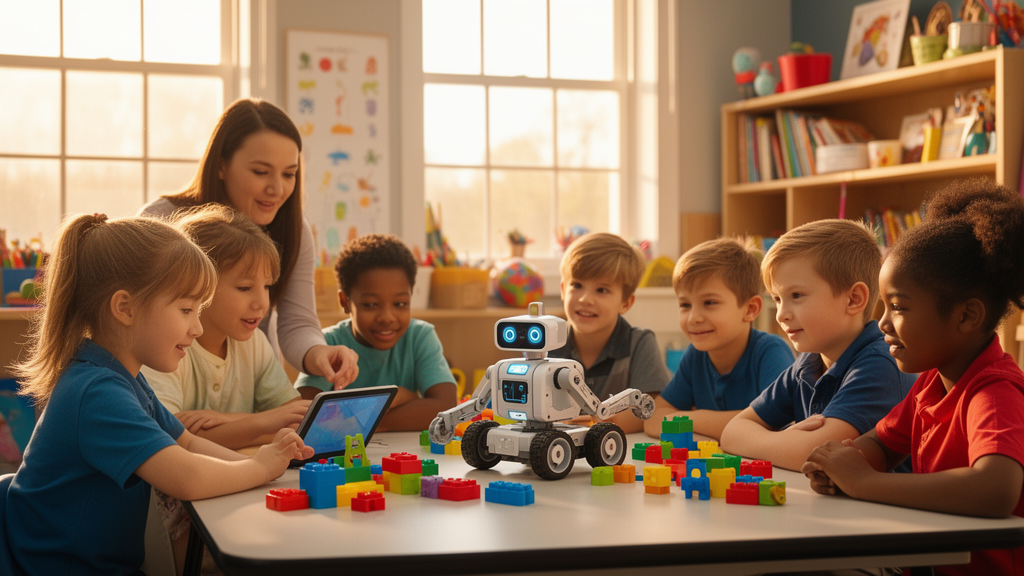
Educational robotics programs delivered outside the regular school day appear to be associated with positive changes in children’s learning, but the strength of that evidence is far weaker than the enthusiasm surrounding the field suggests. That is the central conclusion of a systematic review published on 28 July 2026 in the journal AI, Brain and Child, which examined what actually happens when primary school-aged children build and program robots in after-school programs, extracurricular clubs, holiday camps, and enrichment courses.
The review’s authors set out to fill a specific gap. Educational robotics, in which children construct, program, and interact with physical robotic systems, has become a widely adopted pedagogical resource in primary education, yet most existing evidence comes from formal classrooms or from reviews focused on a single robotic platform such as LEGO WeDo. Extended education, by contrast, occupies a non-formal space: it is intentional and organized but operates outside formal schooling, typically with greater flexibility, voluntary participation, and reduced emphasis on grading. These features, the authors argue, may be especially compatible with robotics activities that demand exploration, iteration, debugging, and peer collaboration, but it remained unclear which outcomes such programs achieve when delivered beyond regular instruction.
To answer that question, the team searched ERIC, JSTOR, Web of Science, and Google Scholar between November 6 and November 25, 2025, supplemented by backward and forward citation searching that added 213 records. From 477 initial records, fifteen studies survived screening: ten from database searches and five from citation chasing. The studies came primarily from the United States, China, Spain, and Türkiye, with single studies from Argentina, Bahrain, and Oman. Sample sizes ranged from 15 to 862 participants, with a median of just 38 and a total reported sample of 1,563. LEGO-based systems dominated the interventions, appearing in nine studies, alongside Fischertechnik kits, KAZI EV5 robots, Robotics Dream kits, and social robots. Intervention duration ranged from a three-day camp to a 31-week course, with most studies reporting total exposure between 10 and 24 hours.
A distinctive methodological contribution of the review was its tiered approach to effect sizes. Because statistical reporting across educational robotics studies is notoriously uneven, the researchers extracted a standardized effect size, Cohen’s d, wherever the reported statistics allowed, and classified every estimate into three convertibility tiers. Tier 1 estimates could be derived directly from reported statistics without assumptions; Tier 2 estimates required at least one parameter assumption, such as an assumed pre-post correlation; and Tier 3 results could not be defensibly converted at all and were synthesized narratively. Following the Synthesis Without Meta-Analysis guideline, the team displayed the convertible estimates in descriptive forest plots without pooled summary effects, explicitly because the available effect sizes represented different estimands, including within-group pre-post change, between-group post-test contrasts, and controlled difference-in-differences, which address partly different questions and should not be averaged together.
Cognitive and academic outcomes formed the largest and most consistent domain, drawing on nine studies with convertible estimates plus two more contributing narrative evidence. For computational thinking, the four plotted estimates were all positive but varied wildly in magnitude. A single-group study by Baek and colleagues reported a large pre-post gain of d = 1.21, while Khodabandelou and Alhoqani reported an extraordinarily large gain of d = 4.50 on a short multiple-choice concept test with only 35 children. By contrast, the largest computational thinking sample, a study by Shang and colleagues with 133 participants, found a small but statistically significant total effect of d = 0.22, with subscale effects ranging from nearly zero for critical thinking to 0.23 for a creativity subscale. The only adjusted between-group computational thinking contrast, from a cross-sectional study by Merino-Armero and colleagues, was moderate at d = 0.58, but it was based on years of prior after-school robotics attendance rather than random assignment, making it associational rather than causal.
Other cognitive findings followed a similar pattern of promising but fragile signals. Spatial ability showed possible benefits, particularly for spatial visualization and perspective taking, but the controlled difference-in-differences estimates from a Spanish study by Julià and Antolí had confidence intervals spanning zero for most subconstructs. Self-perceived STEM skills and problem-solving appraisal showed large gains, but both came from a single uncontrolled study by Kılıçkıran and Korkmaz. A study by Barker and Ansorge reported a very large between-group difference on a researcher-developed science and technology achievement test, d = 4.01, which the review authors explicitly flagged as unstable because it came from a small posttest-only comparison. Two further studies, by Qu and Fok and by Ragusa and Leung, reported statistically significant gains in computational thinking and in robotics design and coding knowledge, but their statistics could not be converted into comparable standardized effects.
The socio-emotional and motivational picture was considerably less encouraging. All five studies with convertible estimates in this domain used uncontrolled within-group pre-post designs. Self-efficacy effects were small and clustered near zero: Shang and colleagues found a small positive effect on STEM self-efficacy of d = 0.20, while Newton and colleagues found effects ranging from essentially zero for videogaming self-efficacy to a small negative effect for using computers to solve problems. STEM-attitude effects were inconsistent, ranging from negative or null estimates in some studies to large positive estimates in others, with the largest effects, d = 1.35 for total STEM attitude, reported by the single uncontrolled study of Kılıçkıran and Korkmaz. Three additional studies contributed only narrative evidence, including one finding that children’s pre-post change in STEM interest was statistically non-significant despite a slight increase in means. The review concludes that motivational benefits should not be assumed simply because children participate in robotics activities.
Creativity-related outcomes rested on a single study. Jamali reported large within-group pre-post gains on the Creativity Assessment Packet among 15 gifted primary-school students, with a total creative thinking effect of d = 1.17 and large effects for fluency, flexibility, elaboration, and abstract mindset, though originality’s confidence interval included zero. With no controlled comparison and no replication, the review authors characterized these findings as preliminary and hypothesis-generating rather than evidence of a reliable domain-level effect.
A risk-of-bias assessment helps explain why the largest effects clustered where they did. Across 90 domain-level judgments, 40 percent were rated low risk, 56.7 percent some concerns, and 3.3 percent high risk, and no study was judged low risk across all six domains. The weakest domain was baseline equivalence and confounding, where thirteen studies drew some concerns and one was rated high risk, reflecting the predominance of single-group pretest-posttest designs in which observed change cannot be separated from maturation, repeated testing, or selection effects. The review found a systematic gradient: the largest effects came from uncontrolled within-group comparisons and researcher-developed measures, whereas the few controlled estimates were smaller, imprecise, or mixed in direction. The authors note that such designs are useful for early evidence-building but cannot support causal claims, and that the risk-of-bias profile helps explain, rather than merely accompany, the observed effect-size pattern.
The review also acknowledges its own limitations, including the omission of Scopus, the small number of studies, the reliance of many outcome subconstructs on single studies, and the exclusion of grey literature. All included studies were published in English despite eligibility for German and Chinese. The authors did not compare extended-education programs with formal classroom instruction, so no conclusions can be drawn about whether the out-of-school context itself adds value. Their bottom line is measured: educational robotics in extended education appears broadly associated with positive change, and the consistently positive direction of effects is encouraging for practitioners, but the size and causal status of these effects remain to be established. The next stage of research, they argue, should move beyond single-group demonstrations toward better-controlled, better-measured, and more fully reported studies, including follow-up assessments and direct comparisons between extended-education and classroom settings.
Subject of Research: The effects of educational robotics programs in extended education on primary school children's learning and developmental outcomes
Article Title: Effects of educational robotics in extended education on primary school-aged children’s learning and developmental outcomes: a systematic review
Article References: Xiang, S., Koch, H., Lilla, N., Nieuwenboom, J. W., & Schüpbach, M. (2026). Effects of educational robotics in extended education on primary school-aged children’s learning and developmental outcomes: a systematic review. AI, Brain and Child, 2(1), Article 15. https://doi.org/10.1007/s44436-026-00039-1
Image Credits: AI Generated
DOI: 10.1007/s44436-026-00039-1
Keywords: educational robotics, extended education, after-school programs, primary school children, systematic review, computational thinking, STEM attitudes, self-efficacy, creativity, effect sizes, research methodology, Effects
News Source: Denise Maddox. (October 28, 2026). Educational Robotics After School Shows Promise, But Evidence Remains Shaky, Review Finds. Scienmag.