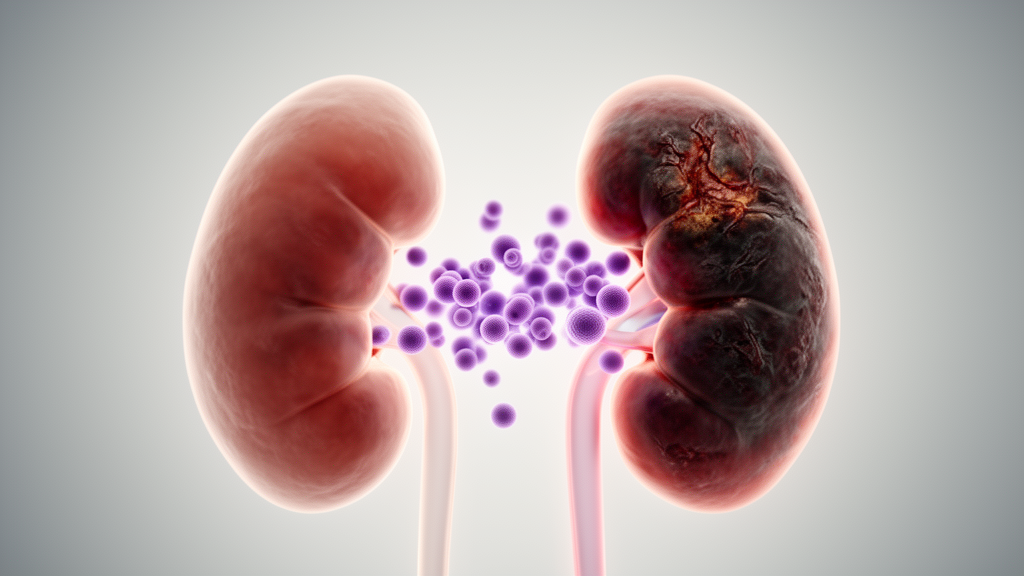
Patients newly diagnosed with multiple myeloma whose kidneys are already moderately to severely impaired at the time of diagnosis face a substantially higher long-term risk of progressing to end-stage kidney disease, according to a retrospective cohort study published in BMC Nephrology. The finding, reported by Cui Li, Qun Xia, Bo Zhang and Yanli Xu, suggests that a single measurement of kidney function taken at diagnosis carries prognostic information that persists well beyond the early treatment period.
Renal impairment is a common and serious complication of multiple myeloma, affecting an estimated 20 to 50 percent of patients at the time of diagnosis. What remained uncertain, the authors write, is whether the severity of baseline kidney function retains its predictive value for long-term kidney failure once patients begin myeloma-directed therapy.
To address this question, the researchers conducted a single-center retrospective cohort study of 100 patients with newly diagnosed multiple myeloma and renal impairment, diagnosed between 2010 and 2018. The primary endpoint was progression to end-stage kidney disease, analyzed with a Fine–Gray subdistribution hazards model that treated death as a competing event, so that patients who died before developing kidney failure were accounted for appropriately rather than simply censored. Overall survival was assessed as a secondary endpoint.
Over a median follow-up of 21.05 months, nine patients progressed to end-stage kidney disease. The five-year cumulative incidence of kidney failure differed significantly across strata of baseline kidney function, as assessed by Gray’s test (p = 0.014). In the group with an estimated glomerular filtration rate of 15 to 29 mL/min/1.73 m² at diagnosis, the five-year cumulative incidence reached approximately 26 percent, whereas no kidney failure events occurred among patients with preserved renal function.
In the multivariable Fine–Gray model, a baseline eGFR of 15 to 29 mL/min/1.73 m² remained independently associated with progression to end-stage kidney disease, with a subdistribution hazard ratio of 4.02 (95 percent confidence interval, 1.12 to 14.49; p = 0.033). This means that, after accounting for the competing risk of death, patients in this moderately severe impairment category had roughly a fourfold higher rate of kidney failure than the reference group.
The study also explored whether achieving a renal response after treatment altered these outcomes. This exploratory analysis was restricted to the 29 patients whose baseline eGFR was below 50 mL/min/1.73 m². A minor renal response or better was achieved by 51.7 percent of these patients, with similar rates across the compared groups (50 percent versus 53.3 percent; p = 0.858). Notably, achieving such a response was associated with improved overall survival (p = 0.007), but it was not associated with renal survival, the endpoint reflecting freedom from kidney failure (p = 0.81).
The authors conclude that baseline renal function severity, particularly an eGFR of 15 to 29 mL/min/1.73 m², predicts long-term end-stage kidney disease risk in patients with newly diagnosed multiple myeloma and renal impairment. At the same time, they emphasize that whether renal response modifies the kidney failure risk associated with baseline impairment remains unresolved, and they call for larger prospective cohorts using prespecified landmark or time-dependent response analyses to settle the question.
Several limitations deserve emphasis. The study was retrospective and single-center, involving only 100 patients, of whom just nine reached the primary endpoint; the confidence interval around the hazard ratio is wide, reflecting limited statistical precision. The renal response analysis was exploratory and confined to a small subgroup of 29 patients. The findings therefore should be viewed as hypothesis-generating rather than definitive, and the reported associations do not establish that altering kidney function at diagnosis would change outcomes.
The article was published open access on 23 October 2026 and is being shared as an early, peer-reviewed, accepted version that carries a permanent DOI and remains citable; it is subject to further edits before the final version of record appears.
Subject of Research: The relationship between baseline renal function severity and long-term end-stage kidney disease risk in newly diagnosed multiple myeloma with renal impairment.
Article Title: Baseline renal function severity predicts long-term end-stage kidney disease risk in newly diagnosed multiple myeloma with renal impairment
Article References: Li, C., Xia, Q., Zhang, B., & Xu, Y. (2026). Baseline renal function severity predicts long-term end-stage kidney disease risk in newly diagnosed multiple myeloma with renal impairment. BMC Nephrology. https://doi.org/10.1186/s12882-026-05450-7
Image Credits: AI Generated
DOI: 10.1186/s12882-026-05450-7
Keywords: multiple myeloma, end-stage kidney disease, renal impairment, estimated glomerular filtration rate, Fine–Gray subdistribution hazards model, renal response, overall survival, retrospective cohort study, BMC Nephrology, kidney failure, competing risk analysis, light-chain nephropathy
News Source: Jerry Hayes. (October 28, 2026). Severe Baseline Kidney Impairment Predicts Long-Term Kidney Failure Risk in Myeloma. Scienmag.