


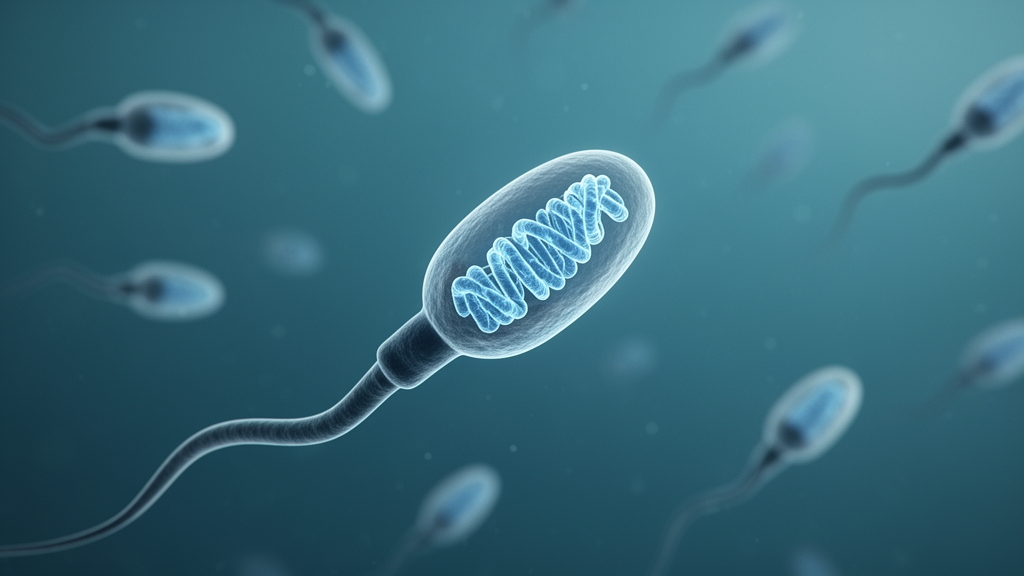
Men whose semen looks almost normal on standard testing may still carry a molecular warning sign in their sperm, according to a new case-control study published in the Egyptian Journal of Medical Human Genetics. Researchers in India measured the messenger RNA levels of two sperm-specific proteins, protamine 1 and protamine 2, in 279 men with fertility problems and 32 fertile controls, and found that the ratio between the two transcripts was significantly elevated in every infertile subgroup examined, including men classified as normozoospermic. The ratio showed moderate ability to distinguish infertile men from fertile controls, with an area under the receiver operating characteristic curve of 0.74, a sensitivity of 67.38 percent and a specificity of 78.12 percent at a cutoff of 1.29. The authors suggest this transcript ratio could serve as a supplementary molecular marker alongside conventional semen analysis, rather than a standalone diagnostic test.
Protamines are small, positively charged proteins made exclusively in the testis that replace somatic-cell histones during the late stages of spermiogenesis. This histone-to-protamine exchange produces the highly compact chromatin architecture characteristic of mature spermatozoa and protects the paternal genome that will be delivered to the egg. When the balance between protamine 1 and protamine 2 is disturbed, chromatin condensation can be incomplete, a state that has been linked in previous research to sperm DNA fragmentation, male subfertility and impaired embryonic development. Earlier studies have also reported reduced protamine 2 expression among infertile men, and alterations in the PRM1 to PRM2 ratio have been proposed as a contributor to infertility. The authors of the new study set out to quantify protamine transcript levels and their ratio in the germ cells of men with borderline infertility, a population in which standard semen profiling often fails to identify a clear cause.
The case-control study was carried out at the Centre for Research and Innovation in Molecular Diagnostics at inDNA Life Sciences Private Limited in Bhubaneswar, Odisha, in association with the Department of Biotechnology at KIIT Deemed to be University. The participants were men aged between 20 and 44, comprising 279 men seeking evaluation for reproductive issues and 32 men with proven fertility drawn from the general population. The researchers collected medical histories and information on urogenital, endocrine and surgical factors, and excluded individuals with obstructive azoospermia, varicocele, testicular torsion, urogenital infections, congenital absence of the vas deferens, cryptorchidism, endocrine disorders, confirmed genetic abnormalities, autoimmune conditions and comorbidities such as diabetes, dyslipidaemia, cancer or cardiovascular disease. Written informed consent was obtained from every participant, and the protocol was approved by the Independent Ethics Committee of inDNA Life Sciences.
Semen samples were collected after three to five days of abstinence and analysed according to the sixth edition of the World Health Organization laboratory guidelines, with participants classified by microscopic parameters including sperm count, motility and morphology as well as macroscopic features such as volume, pH and viscosity. The infertile cohort spanned a wide range of phenotypes: normozoospermic, asthenozoospermic, teratozoospermic, oligospermic, oligoasthenozoospermic, oligoteratozoospermic, oligoasthenospermic, asthenoteratozoospermic and oligoasthenoteratozoospermic men. The comparative semen profiling showed a significant reduction in semen volume in the normozoospermic, oligoasthenoteratozoospermic and oligoasthenospermic groups, marked reductions in sperm count across all oligo- and asthenic groups, profound motility impairment in the oligoasthenozoospermic, oligoasthenoteratozoospermic and asthenoteratozoospermic groups, and morphological impairment in the teratozoospermic, oligoasthenoteratozoospermic and asthenoteratozoospermic groups. The oligoasthenoteratozoospermic subgroup showed the most severe multi-parameter impairment, while the normozoospermic group’s parameters remained unchanged compared with controls.
To measure protamine transcripts, the team purified spermatozoa by two-layer density gradient centrifugation followed by three washes, confirmed the absence of leukocytes and epithelial cells microscopically, and extracted total RNA using a commercial kit with DNase treatment to remove residual genomic DNA. RNA purity and concentration were verified by spectrophotometry and fluorometry, and complementary DNA was synthesised for quantitative reverse transcription polymerase chain reaction targeting PRM1 and PRM2, with beta-globin as the housekeeping gene. Beta-globin showed low within-group variability, with coefficients of variation between 1.23 and 9.18 percent, and most groups fell below 5 percent. Statistical comparisons were performed on delta Ct values using unpaired two-tailed Student’s t-tests, while fold changes were calculated with the comparative delta-delta Ct method solely for biological interpretation, and the PRM1 to PRM2 transcript ratio was derived from the ratio of the two relative expression values.
The expression results revealed a consistent pattern of downregulation across nearly all infertile subgroups. In asthenozoospermic men, PRM1 showed the largest mean delta Ct difference of any group at 9.96, corresponding to an approximate 0.001-fold expression change relative to controls, and PRM2 showed a mean difference of 8.44, an approximate 0.002-fold change, both with p values below 0.0001 and large effect sizes. Teratozoospermic men showed a PRM1 mean difference of 8.79 and PRM2 difference of 6.57, oligoasthenoteratozoospermic men 7.86 and 6.46, asthenoteratozoospermic men 6.74 and 5.63, oligospermic men 6.72 and 4.58, oligoasthenozoospermic men 6.15 and 4.02, oligoasthenospermic men 5.76 and 3.96, and oligoteratozoospermic men 6.26 and 4.34, all statistically significant and all indicating substantial downregulation of both transcripts. Volcano plot analysis confirmed that the most pronounced PRM1 downregulation occurred in the asthenozoospermic and teratozoospermic groups, while PRM1 expression in the normozoospermic group clustered near baseline.
The normozoospermic subgroup stood out with a distinctly different pattern. PRM1 expression in these men did not differ significantly from controls, with a mean delta Ct difference of 1.02, a p value of 0.0754 and a small effect size, corresponding to an approximate 0.49-fold change. PRM2, however, was significantly different, with a mean delta Ct difference of minus 1.12, a p value of 0.0157 and an approximate 2.18-fold expression change, indicating significant upregulation of PRM2 in men whose semen parameters were otherwise normal. The authors note that this finding suggests apparently normal semen parameters can coexist with altered protamine transcript equilibrium, and that the biological and clinical significance of elevated PRM2 expression in this subgroup requires further investigation. They also caution that transcript-level findings alone cannot establish impaired chromatin condensation, and that direct evaluation of protamine protein abundance, chromatin compaction and sperm DNA integrity will be needed to clarify the functional consequences.
When the two transcripts were combined into a ratio, the PRM1 to PRM2 mRNA transcript ratio was significantly elevated in every infertile category compared with the fertile controls, whose mean ratio was 1.155. Normozoospermic men averaged 1.486, asthenozoospermic men 2.754, teratozoospermic men 2.518, oligospermic men 2.481, oligoteratozoospermic men 2.051, asthenoteratozoospermic men 3.198, oligoasthenoteratozoospermic men 2.451, oligoasthenospermic men 3.076 and oligoasthenozoospermic men 2.295, with p values ranging from 0.0186 to below 0.0001. The most prominent elevations appeared in the asthenozoospermic, oligoasthenoteratozoospermic and asthenoteratozoospermic subgroups, and the authors note that interpretation of the smaller subgroups is limited by sample size. Receiver operating characteristic analysis of the ratio yielded an area under the curve of 0.74, with an optimal threshold of 1.29 determined by Youden’s index delivering 67.38 percent sensitivity and 78.12 percent specificity. The authors conclude that this corresponds to moderate discriminatory performance, insufficient for the ratio to serve as an independent diagnostic marker but potentially valuable as a supplementary biomarker when combined with conventional semen analysis for the evaluation and risk stratification of male infertility.
The study has several limitations acknowledged by the authors. Chromatin structure parameters were not quantified, protamine regulation may be affected at the post-transcriptional level, and the use of a single reference gene, beta-globin, for normalisation is a methodological constraint that validation with multiple stable reference genes would improve. The authors call for further research incorporating chromatin dispersion assays, chromomycin A3 staining and proteomic validation, along with longitudinal follow-up in larger independent cohorts, to determine whether PRM1 to PRM2 ratio assessment can predict fertility problems and to validate its clinical significance. Data from the study will be shared with the journal’s editors upon request but not with other researchers, for patient confidentiality reasons. Within those constraints, the findings add to a growing body of evidence that protamine homeostasis is a key molecular characteristic of male infertility, and that molecular assessment of ejaculated spermatozoa may one day reveal fertility risks that conventional semen analysis leaves undetected.
Subject of Research: Protamine 1 and 2 mRNA expression and transcript ratio in the spermatozoa of men with borderline infertility
Article Title: Role of protamine 1 and protamine 2 in spermatozoa of men with borderline infertility
Article References: Patel, S. K. J. K., Raj, R., Tandia, A., Devada, K., & Banerjee, B. (2026). Role of protamine 1 and protamine 2 in spermatozoa of men with borderline infertility. Egyptian Journal of Medical Human Genetics, 27(1), Article 83. https://doi.org/10.1186/s43042-026-00912-x
Image Credits: AI Generated
DOI: 10.1186/s43042-026-00912-x
Keywords: male infertility, protamine 1, protamine 2, PRM1/PRM2 ratio, spermatozoa, mRNA expression, qRT-PCR, semen analysis, chromatin condensation, biomarker, ROC analysis, case-control study
News Source: Juliet Wilcox. (October 28, 2026). Sperm Protamine Gene Imbalance Emerges as Molecular Signature of Male Infertility. Scienmag.



