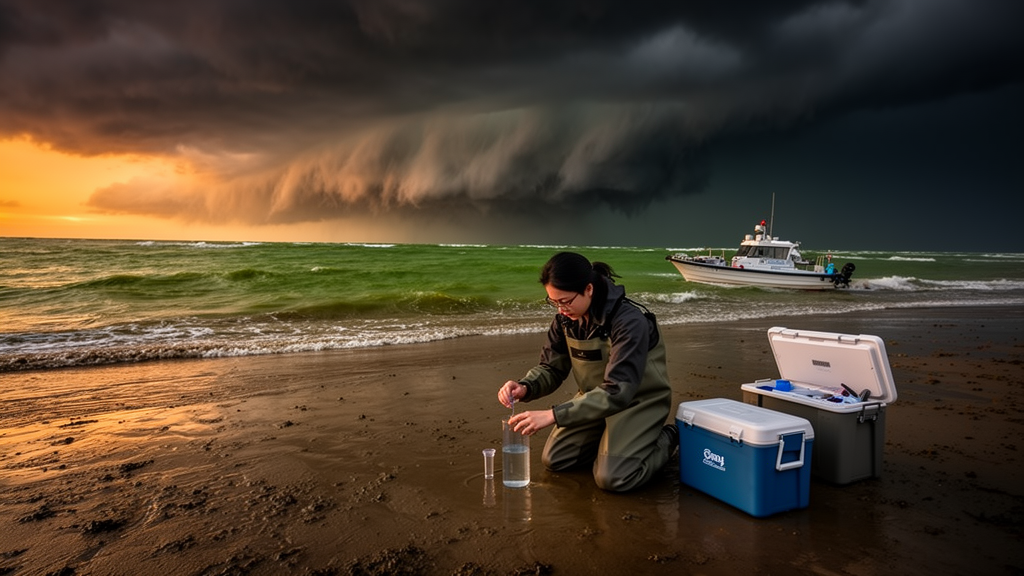
A six-year study of fungal plankton in the Yellow Sea has found that the community’s composition and structure were highly sensitive to environmental disturbances, with sharp declines in diversity and network connectivity during periods of extreme climate events. The research, published in Environmental Microbiome, analyzed seawater samples collected from 2017 to 2022 within the Yellow Sea Cold Water Mass (YSCWM) and adjacent surface waters in the northern and southern Yellow Sea during summer, using fungal ITS2 amplicon sequencing.
The study identified three major disturbances during the sampling period: a record-breaking marine heatwave in 2018, typhoon Lekima in 2019, and local cyclones in 2020. According to the researchers, these events likely decimated dominant fungal taxa and significantly decreased diversity. The period of environmental fluctuation coincided with the proliferation of several fungal genera, including Aspergillus, Alternaria, Cladosporium, Rhodotorula, Acremonium, Malassezia, and Fusarium.
By examining the mechanisms behind community turnover, the team found that dispersal limitation and drift were the main driving processes shaping the mycoplankton communities. The authors report that an increase in seawater temperature and phosphate concentration might lead to a significant decline in fungal diversity, though these are associations drawn from the observational dataset rather than demonstrated causal effects.
In particular, minor taxa appear to persist there under stress, suggesting the cold water mass may serve as a refuge for fungal diversity during disturbance periods. The authors suggest this role could be important for ecosystem sustainability under changing climate conditions, although the study is limited to summer sampling in the Yellow Sea and to DNA-based amplicon data, which document the presence of fungal lineages without directly measuring their activity or ecological function.
Understanding the mechanisms underlying marine fungal community turnover is critical to predicting how communities respond to climate disturbances, the authors note in their background. Yet, before this work, the interannual stability of mycoplankton community composition, structure, and network organization in the Yellow Sea remained poorly understood. The new dataset covers three regions of the sea at different depths, allowing comparisons between the cold water mass and the northern and southern surface waters over multiple summers.
The findings underscore the susceptibility of Yellow Sea fungal communities to drastic oceanic events, the researchers conclude. The work also highlights the potential role of the Yellow Sea Cold Water Mass as a biodiversity reservoir under changing climate conditions, a hypothesis the authors propose based on the persistence of minor taxa within that water body during the disturbance period.
The article was published as an open access paper on 15 October 2026, and the version shared at publication is a peer-reviewed accepted manuscript that remains subject to further editorial edits before the final version of record.
Subject of Research: Interannual dynamics of mycoplankton communities in the Yellow Sea under climate disturbances
Article Title: Interannual dynamics and assembly mechanisms of mycoplankton community amid climate disturbances in the Yellow Sea
Article References: Dossou, S. S. K., Wang, L., Burgaud, G., Li, Q., Wang, M., & Li, W. (2026). Interannual dynamics and assembly mechanisms of mycoplankton community amid climate disturbances in the Yellow Sea. Environmental Microbiome. https://doi.org/10.1186/s40793-026-00975-8
Image Credits: AI Generated
DOI: 10.1186/s40793-026-00975-8
Keywords: mycoplankton, marine fungi, Yellow Sea, Yellow Sea Cold Water Mass, marine heatwave, typhoon Lekima, ITS2 amplicon sequencing, fungal diversity, community assembly, dispersal limitation, phosphate, seawater temperature
News Source: Morgan Morrow. (October 28, 2026). Marine heatwaves and typhoons reshaped Yellow Sea fungal communities, study finds. Scienmag.