


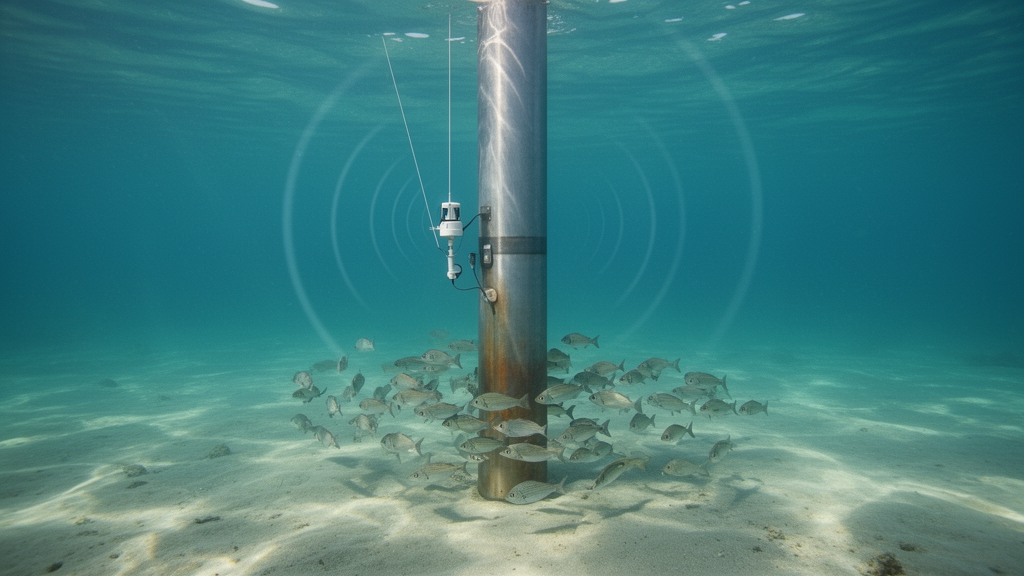
Large steel foundations of offshore wind turbines can block acoustic signals from fish tags, but a new study finds that receivers sitting in those shadow zones still do valuable work, and it offers concrete guidance on how many receivers are enough when monitoring fish around wind farms.
Acoustic telemetry is increasingly used to track how fish respond to offshore wind infrastructure, including through regulatory monitoring programs, yet practical guidance on designing receiver arrays at wind farm sites has been lacking. A team led by Brendan J. Runde and Ryan M. Tharp set out to fill that gap by systematically quantifying how acoustic shadowing affects both raw detection success and positioning performance.
The researchers deployed a dense array of acoustic receivers around an offshore wind monopile foundation and evaluated its performance using stationary reference transmitters at known locations. Because large monopiles can obstruct line-of-sight transmission paths, they created calculated acoustic shadow zones and tested how receivers inside those zones performed compared with unobstructed units.
The shadowing effect was real but moderate. An obstructed receiver contributed approximately 19 percent less than unobstructed receivers at similar distances. Despite that suppression, the receiver positioned in the calculated shadow zone still contributed to 70 to 74 percent of positions and improved positioning precision when it was included in minimal arrays.
Array size mattered in a nonlinear way. Configurations with six or more receivers successfully calculated more than 90 percent of positions relative to a baseline ten-receiver array, and for a reference transmitter within 15 meters of the foundation, median horizontal positioning error was less than 2 meters. Performance degraded nonlinearly below five receivers, meaning that trimming an array from six to four receivers costs more accuracy than the raw receiver count might suggest.
Geometry proved just as important as receiver count. One three-receiver configuration completely failed to position a transmitter located 241 meters from the monopile, even though the same configuration successfully positioned a transmitter near the foundation. That failure demonstrates that geometric coverage becomes critical at the edge of an array, and the authors conclude that receivers should be placed on all sides of monopiles to maintain positioning capability.
From these results, the study distills context-dependent design guidelines. For time-difference-of-arrival positioning studies, such as those using virtual positioning systems, six receivers represent a practical minimum for high-quality positioning of structure-associated fish. For broad-scale movement studies focused on presence or absence, two receivers per turbine may suffice, while three to four receivers are recommended when individual detections are valuable, for example when sensor-equipped transmitters are used.
The authors caution that these guidelines should be scaled to site-specific detection ranges determined through range testing, since acoustic conditions vary among sites. The work, published open access in Animal Biotelemetry, provides evidence-based recommendations for researchers designing acoustic telemetry arrays at offshore wind installations, where both regulatory requirements and fish behavior around foundations make reliable detection a growing concern.
Subject of Research: How acoustic shadowing by offshore wind monopile foundations affects acoustic telemetry receiver array design and fish positioning performance.
Article Title: Acoustic shadows and array performance at offshore wind monopile foundations: quantifying trade-offs for telemetry array design
Article References: Runde, B. J., & Tharp, R. M. (2026). Acoustic shadows and array performance at offshore wind monopile foundations: quantifying trade-offs for telemetry array design. Animal Biotelemetry. https://doi.org/10.1186/s40317-026-00502-z
Image Credits: AI Generated
DOI: 10.1186/s40317-026-00502-z
Keywords: acoustic telemetry, offshore wind energy, monopile foundations, acoustic shadowing, receiver array design, fish tracking, TDOA positioning, virtual positioning system, detection efficiency, marine monitoring, Acoustic, shadows
News Source: Faith Mcneil. (October 28, 2026). Monopile acoustic shadows cut receiver detections but still aid fish tracking. Scienmag.



