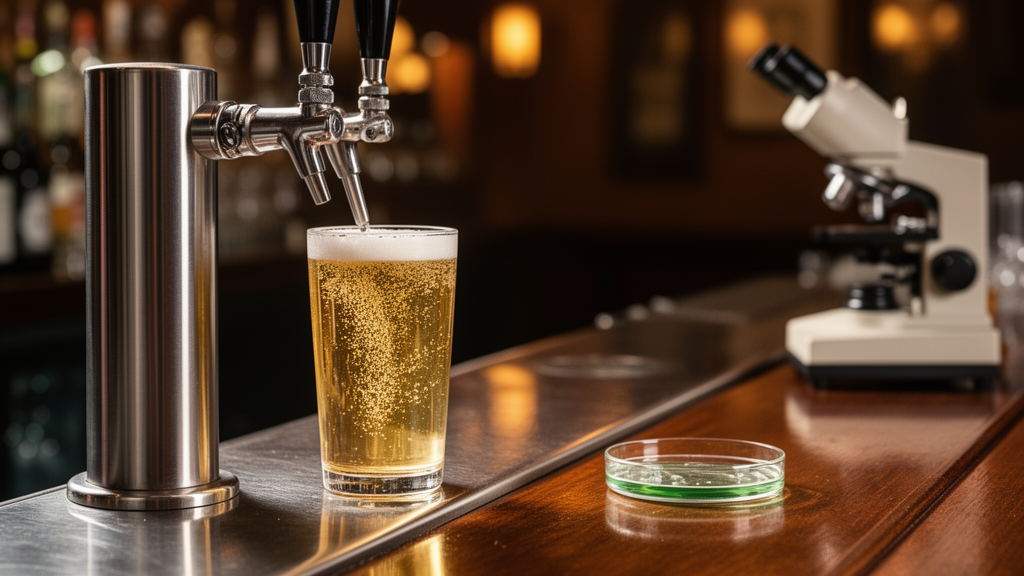
Draught no- and low-alcohol beers are turning out to be far more microbially lively than their packaged cousins, and the biggest influence on what grows in them is not the beer itself but the pub that pours it. In the first study to apply third-generation sequencing to these products, researchers at the University of Nottingham profiled the microbial communities living in commercially dispensed no- and low-alcohol beers and found that the venue accounted for the overwhelming majority of the variation in community structure. The work, published in Frontiers in Microbiology, underscores how vulnerable these increasingly popular drinks are to spoilage once they leave the brewery and pass through long-draw dispense systems managed by individual publicans.
The team collected more than 50 samples representing 20 different no- and low-alcohol beers across 12 public houses in Nottingham, United Kingdom, over three months from January to April 2025. The products spanned seven styles, including lager, India pale ale, pale ale, pilsner, amber ale, radler and wheat beer, from 17 brands, with labelled alcohol contents ranging from 0.0 to 0.5 percent ABV. In total, 49 samples were analysed, and sequencing of bacterial 16S rRNA genes and fungal internal transcribed spacer regions on Oxford Nanopore Technologies’ PromethION platform revealed seven phyla, 87 genera and 207 species across the set.
Three genera dominated the community: Acetobacter, Brettanomyces and Saccharomyces. Each was consistently present in more than 70 percent of the draught samples, earning them the status of core microbiome members. All three are well-recognised beer spoilage organisms, and their species-level identities reinforced the concern. Brettanomyces bruxellensis was the single most abundant species across all samples, in line with its reputation as the yeast most frequently encountered in standard beer spoilage. Brettanomyces anomalus was also widespread, and Saccharomyces-dominated samples contained both S. cerevisiae and S. uvarum.
The acetic acid bacteria told perhaps the most intriguing story. Across the samples, the researchers detected 28 species of Acetobacter, nine of Gluconobacter and two of Gluconoacetobacter. The two most abundant Acetobacter species, A. oryzoeni and A. sicerae, found in 20 and 18 samples respectively, had not previously been associated with beer at all. A. oryzoeni has been isolated from Korean rice wine vinegar and palm wine fermentations, while A. sicerae has been linked to cider contamination and spoiled kefir made with sugar syrups. Both can metabolise fructose, sorbitol and glycerol, an adaptation to sugar-rich niches that may give them a selective advantage in no- and low-alcohol beers, where residual fermentable sugars can remain because of arrested fermentation or post-production sugar syrup additions.
Lactic acid bacteria added to the spoilage picture. Levilactobacillus brevis, the basionym of the former Lactobacillus brevis, and Secundolactobacillus paracollinoides were among the most abundant species detected. Lactic acid bacteria are considered the most significant Gram-positive spoilage agents in brewing, believed to account for 60 to 70 percent of all reported beer spoilage cases. L. brevis in particular resists the antimicrobial hop compounds that suppress most microbes, thanks to plasmid-borne resistance genes such as horA, horC and hitA, and it readily forms biofilms that persist in brewery environments. As heterofermenters, these bacteria produce acetic acid, ethanol, diacetyl and carbon dioxide alongside lactic acid, driving acidification, turbidity, buttery off-flavours and gushing in the finished product.
Notably, no pathogenic microorganisms, including Escherichia coli and Salmonella species, were detected in any sample. That finding is consistent with a separate study that reported no detection of these organisms across 90 draught non-alcoholic beer samples. The threat identified here is to quality rather than safety: microbial contamination manifests as sensory defects ranging from subtle flavour changes to pronounced alterations in flavour, aroma and appearance.
The decisive role of the venue emerged from the diversity analyses. Alpha diversity metrics, including observed richness, Shannon and Simpson indices, showed only moderate and statistically insignificant differences between accounts. But beta diversity, measured with Bray-Curtis dissimilarity and visualised through principal coordinates analysis, told a different story: samples clustered primarily by the account from which they were poured. A permutational analysis of variance confirmed that the sampled account explained 72.6 percent of the variance in microbial community composition, with a p-value of 0.01. Ethanol content, beer style and production method, whether the beer was made by physical alcohol removal or biological restriction, did not significantly explain community structure when tested individually.
Paired samples made the point vividly. The same lager product collected from two different accounts, labelled L1A and L1B, and the same amber ale collected from two venues, A17A and A17B, showed clearly different microbial profiles despite being identical beers, with the differences driven by shifts in the relative abundances of Acetobacter, Gluconobacter and Levilactobacillus. Some accounts, such as accounts 3 and 7, yielded samples that clustered tightly together, while others, including accounts 1, 4 and 6, were more dispersed, suggesting greater within-venue variability that may reflect differences in product throughput or the use of different taps and lines within the same premises. Account 4 showed the highest richness of unique taxa but also the greatest variability among its samples, whereas accounts 5, 8 and 10 hosted the simplest communities.
The authors caution that the sequencing results reflect the community after a forcing treatment rather than the beer as poured. Samples were incubated statically at 30 degrees Celsius for 96 hours with loosened caps to encourage gas exchange, a standard procedure designed to promote the growth of any microorganisms capable of multiplying in beer. This favours organisms that thrive under those specific conditions, which differ from a dispense system in temperature, oxygen availability and the absence of flow. The researchers also note that direct sequencing cannot distinguish viable from non-viable cells, so future work combining culture-based techniques, viability assays or quantitative PCR would be needed to establish both community composition and functional potential. The account-level patterns are likewise indirect: the authors suggest they likely reflect microbial reservoirs, including biofilms in beer lines, taps and other contact surfaces, but direct sampling of multiple locations within each site over time would be required to confirm this.
Why draught no- and low-alcohol beer is so susceptible comes down to chemistry and plumbing. Standard beer is inherently hostile to microbes, with hop bitter acids of roughly 17 to 55 ppm iso-alpha acids, a pH of about 3.9 to 4.4, low oxygen below 0.1 ppm, carbonation of 2 to 2.5 volumes and 4 to 8 percent ethanol all acting as barriers. Removing or reducing ethanol while leaving more fermentable sugar behind weakens that antimicrobial system. Meanwhile, packaged beers are typically commercially sterile, with microbial loads below 1 CFU per litre, because breweries control contamination through closed vessels, cleaning-in-place systems, wort boiling, filtration, sterile filling and pasteurisation. Draught systems, by contrast, are often maintained by individual proprietors, and long-draw lines offer opportunities for oxygen ingress, temperature fluctuation and beer residues that encourage biofilm formation. Biofilms resist routine cleaning and periodically slough organisms into the beer as it passes through. Previous work by the same group found that more than half of no- and low-alcohol beers sampled on draught were of unacceptable quality due to microbial growth. The authors argue that strict hygiene control focused on draught lines, taps, keg couplers and nozzles is essential, especially when dispensing microbiologically sensitive no- and low-alcohol beverages, and that tailored cleaning protocols and consistent hygiene maintenance are likely to be critical to protecting product quality as consumer demand for these drinks on draught continues to grow.
Subject of Research: The microbial communities of draught-dispensed no- and low-alcohol beers and the role of the dispensing venue in shaping them
Article Title: The microbiome of draught no- and low-alcohol beer
Article References: Roselli, G. E., Smart, K. A., Crow, M., & Powell, C. D. (2026). The microbiome of draught no- and low-alcohol beer. Frontiers in Microbiology, 17, Article 1966818. https://doi.org/10.3389/fmicb.2026.1966818
Image Credits: AI Generated
DOI: 10.3389/fmicb.2026.1966818
Keywords: draught beer, no- and low-alcohol beer, food microbiology, nanopore sequencing, microbiome, beer spoilage, biofilms, Acetobacter, Brettanomyces, Saccharomyces, lactic acid bacteria, hygiene
News Source: Morgan Morrow. (October 28, 2026). Venue, not beer, shapes the microbes lurking in draught no-alcohol beer. Scienmag.