


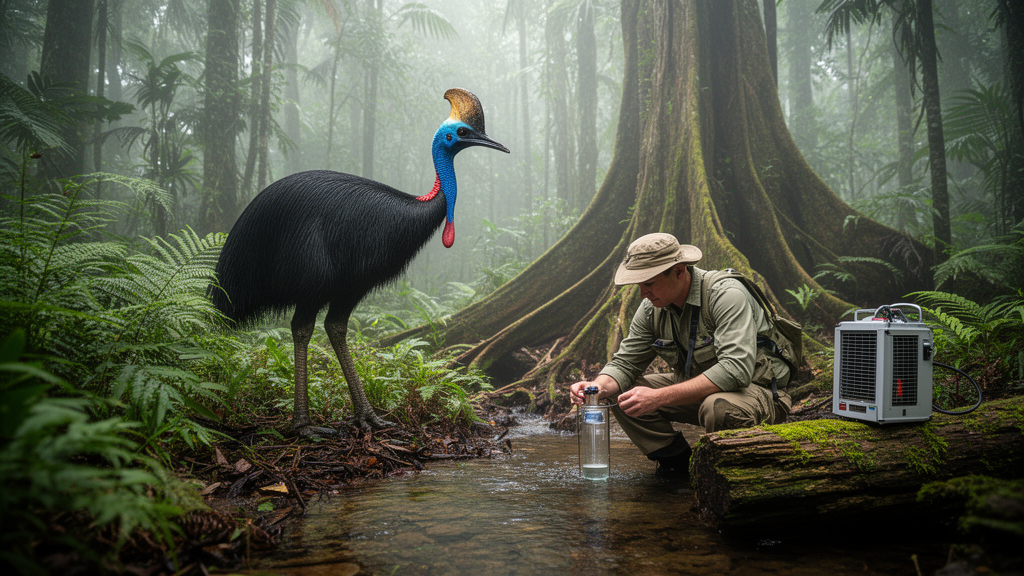
One of Australia’s most difficult birds to find has just become considerably easier to detect, thanks to DNA floating in the air and drifting in the water. Researchers have developed and validated a genetic test that picks up traces of the southern cassowary, Australia’s heaviest flightless bird, from both air and water samples, and they have shown it works not only in captive enclosures but also in open rainforest where the birds roam free.
The southern cassowary is a striking and ecologically vital animal. Growing to 1.8 metres tall and weighing up to 80 kilograms, it is Australia’s only cassowary species and the country’s only large-bodied frugivore, capable of dispersing large quantities of seeded fruits over significant distances, thereby shaping the composition and structure of tropical rainforests. It occupies the wet tropics of far north Queensland and two disjunct populations in Cape York, and it also occurs in Indonesia and Papua New Guinea. Despite its size, brightly coloured neck and prominent casque, the bird is famously cryptic, and the dense, structurally complex habitats it favours make traditional surveys slow and unreliable.
Those detection difficulties matter for conservation. In Australia the southern cassowary is listed as endangered, and it faces climate-driven habitat loss, fragmentation and road mortality. Vehicle strikes accounted for 39 of 53 recorded deaths in the wet tropics population between 2023 and 2025, according to unpublished data from the Queensland Department of the Environment, Tourism, Science and Innovation. Historic clearing and degradation of rainforest for sugar cane plantations, cattle grazing and urbanisation across the Australian wet tropics bioregion, which covers 8944 square kilometres, have reduced lowland rainforest habitat substantially. While the wet tropics population appears stable, far less is known about the status of the remote Cape York population, including the severity of threats there and possible connectivity between populations.
Environmental DNA surveys detect species from trace amounts of genetic material shed into the environment through sloughed cells, faeces or urine. Although eDNA applications in avian monitoring lag behind those for other taxa, the approach has proven effective for elusive or low-density birds. The research team reasoned that cassowaries might be particularly suitable targets: the birds spend time in and around water, including upland streams and estuarine foraging areas, and as large-bodied animals that preen and fluff their feathers, they can release substantial amounts of skin cells into the air, making airborne DNA available for capture.
The assay itself was built on the mitochondrial cytochrome b gene. The researchers collated all readily available sequence records for the southern cassowary and its closest Australian relative, the emu, then sequenced 56 additional cassowary tissue samples collected opportunistically, mostly from vehicle strikes or deceased individuals across the wet tropics between July 2018 and July 2022. All 56 newly sequenced samples shared an identical sequence, representing a previously unreported haplotype. Within an internal region of roughly 307 base pairs, mean pairwise variation among cassowary sequences was 0.5 percent, while variation between cassowary and emu averaged 12.3 percent, providing ample genetic separation on which to anchor a diagnostic test.
The resulting TaqMan assay, designated C.cas_CytB, targets a 116-base-pair region of cytochrome b and was designed to match all known southern cassowary sequences while incorporating seven mismatches to the emu: two in the forward primer, one in the reverse primer and four in the probe. In silico screening predicted no cross-amplification for co-occurring Australian taxa, including the emu, and laboratory testing amplified every southern cassowary sample while failing to amplify emu samples, as expected. The assay proved extremely sensitive, detecting DNA concentrations as low as two copies per reaction, and reliably detecting 200 copies per reaction with 95 percent detection. The authors report that the assay has been validated to Level 4, described as substantial, on the Thalinger et al. scale of eDNA assay validation.
Validation proceeded in two stages. In captive settings, cassowary DNA was detected in one of three air samples taken at the Garners Beach Cassowary Rehabilitation Facility and in all five water samples taken from a small drinking pond at Hartley’s Crocodile Adventures, with all control samples performing as expected. In the field, around Mission Beach in far north Queensland, trail cameras confirmed cassowary presence at all three air sampling sites before or during sampling. Airborne cassowary DNA was detected at two of the three field sites, on day three at site T and on the single sampling day at site A, while no DNA was detected at site B or at a negative control site in the Cairns central business district. Water sampling performed even better: cassowary DNA was detected at five of six field sites, and Sanger sequencing confirmed the target species in every positive amplification.
Detection rates were higher in captivity than in the field, a pattern the authors attribute to the confined spaces and close proximity of birds to samplers. Air samples yielded a positive proportion of 0.33 in captivity compared with 0.11 in the field, while water samples yielded 1.00 in captivity versus 0.33 in the field. The authors also note that their sampling coincided with heavy rainfall towards the end of the wet season, and that warm, humid tropical conditions are likely to have accelerated DNA degradation in both air and water samples. They suggest that dry-season sampling, along with quantifying the effects of seasonality and abiotic factors, will further refine the technique. Possible improvements include larger sample volumes, longer air sampler battery life or solar power, and even lures that draw birds toward sampling sites, though lures can cause non-random movement of individuals through the landscape.
Importantly, the primer and probe regions show no sequence variation among available southern cassowary samples from Australia and Papua New Guinea, suggesting the assay is likely applicable across the species’ broader Indo-Pacific range, though further testing outside Australia is needed to confirm that intraspecific variation does not introduce performance-reducing mismatches. The target region also shows no variation with available dwarf or northern cassowary sequences, meaning all three cassowary species can be detected, while internal sequence variation among cassowary species within the 116-base-pair target allows Sanger sequencing to distinguish species where they co-occur.
The study’s authors position the work as a contribution to growing evidence that airborne DNA can detect terrestrial vertebrates, extending the application to a large-bodied, mobile bird and demonstrating detection in semi-natural and open field settings rather than only small, enclosed or highly controlled environments. They caution that the sensitivity and variability of air and water eDNA sampling in more remote habitats, particularly where cassowaries occur at low density near the limits of their range, remain to be quantified. For now, the approach is best suited as a first-pass detection tool to identify presence, which could be used to prioritise areas for targeted management or more intensive follow-up surveys. For a keystone frugivore whose movements underpin rainforest regeneration, an easier, non-invasive way to confirm where the birds persist could carry real weight for conservation planning in Australia’s fast-changing tropical forests.
Subject of Research: Environmental DNA detection of the southern cassowary using air and water sampling
Article Title: Air and Water Environmental DNA Enable Detection of a Large Terrestrial Bird: A Case Study of the Southern Cassowary (Casuarius casuarius)
Article References: Hill, P., Booth, S., Guymer, D., Matthews, A., Perera, D., Brien, M., & Furlan, E. (2026). Air and Water Environmental DNA Enable Detection of a Large Terrestrial Bird: A Case Study of the Southern Cassowary ( Casuarius casuarius ). Ecology and Evolution, 16(10), Article e74578. https://doi.org/10.1002/ece3.74578
Image Credits: AI Generated
DOI: 10.1002/ece3.74578
Keywords: environmental DNA, southern cassowary, airborne eDNA, water eDNA, qPCR assay, cytochrome b, Queensland, rainforest monitoring, endangered species, wildlife detection, conservation, Mission Beach
News Source: Margaret Porter. (October 28, 2026). Airborne and Water DNA Reveal Elusive Southern Cassowary in Queensland Rainforests. Scienmag.



