• HOME
  • NEWS
  • EXPLORE
    • CAREER
      • Companies
      • Jobs
    • EVENTS
    • iGEM
      • News
      • Team
    • PHOTOS
    • VIDEO
    • WIKI
  • BLOG
  • COMMUNITY
    • FACEBOOK
    • INSTAGRAM
    • TWITTER
Thursday, October 29, 2026
BIOENGINEER.ORG
No Result
View All Result
  • Login
  • HOME
  • NEWS
  • EXPLORE
    • CAREER
      • Companies
      • Jobs
        • Lecturer
        • PhD Studentship
        • Postdoc
        • Research Assistant
    • EVENTS
    • iGEM
      • News
      • Team
    • PHOTOS
    • VIDEO
    • WIKI
  • BLOG
  • COMMUNITY
    • FACEBOOK
    • INSTAGRAM
    • TWITTER
No Result
View All Result
Bioengineer.org
No Result
View All Result
Home NEWS Science News Biology

Optimized Fermentation Boosts Streptococcus suis Biomass for Inactivated Vaccine Testing

by
October 28, 2026
in Biology
Reading Time: 2 mins read
0
Optimized Fermentation Boosts Streptococcus suis Biomass for Inactivated Vaccine Testing

Optimized Fermentation Boosts Streptococcus suis Biomass for Inactivated Vaccine Testing

Share on FacebookShare on TwitterShare on LinkedinShare on RedditShare on Telegram

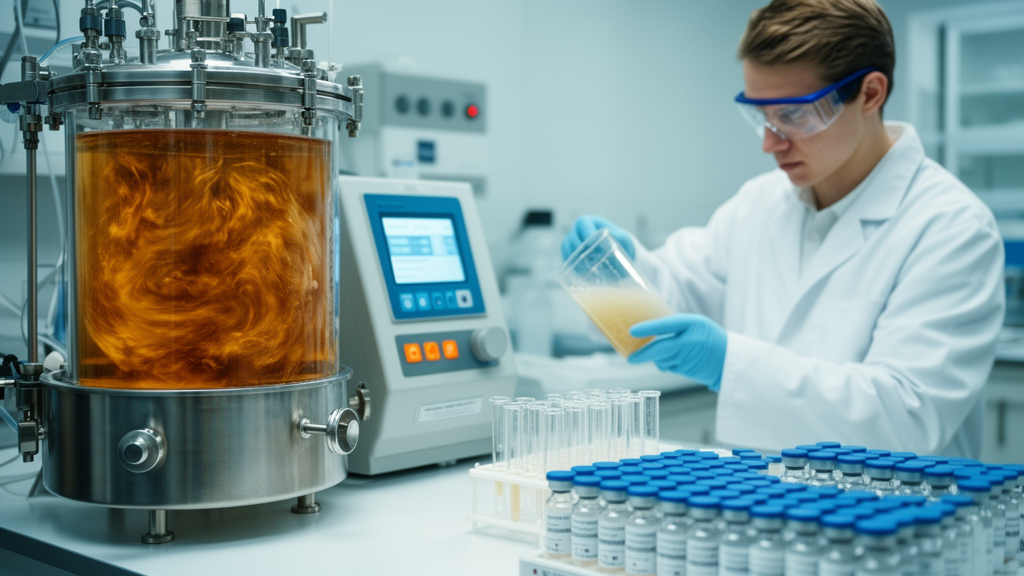
Researchers have developed a scalable fermentation process for growing Streptococcus suis serotype 31, a clinically important swine pathogen, and used it to produce an inactivated vaccine candidate that showed protective activity in a mouse challenge model. The study, published in BMC Biotechnology, addresses a persistent problem in veterinary vaccine manufacturing: conventional culture methods often yield insufficient bacterial biomass, while aggressive high-density fermentation can perturb the physiological features that determine vaccine quality.

The team used a Response Surface Methodology (RSM) guided strategy that combined single-factor screening with Box-Behnken modeling to optimize the culture microenvironment. This statistical approach identified glucose, organic nitrogen and newborn bovine serum as the dominant growth variables affecting SS31 cultivation.

The optimized formulation contained 2.19 g/L glucose, 43.8 g/L organic nitrogen and 5.89% serum. When the process was scaled to a 14-L bioreactor with residual sugar controlled at 1–3 g/L and pH maintained at 7.2, it achieved 1.51 × 10¹⁰ CFU/mL, approximately seven-fold higher than shake-flask cultivation.

The researchers also examined how the culture medium influenced the bacterium’s virulence-associated phenotype. The LD₅₀ estimate was 2.50 × 10⁶ CFU/mouse for SS31 cultured in the optimized medium, compared with 2.14 × 10⁷ CFU/mouse for SS31 cultured in Martin medium, indicating a difference in virulence-associated phenotype under the experimental conditions. The authors note that these estimates do not demonstrate the conservation or enhancement of vaccine antigens.

Four vaccine formulations were tested in the study. The aluminum-adjuvanted vaccine containing 3 × 10⁹ pre-inactivation CFU equivalents/mL yielded the highest observed survival, protecting 10 of 10 mice after challenge with 2 LD₅₀ of the pathogen.

Organ bacterial-load and histopathological findings were evaluated descriptively, providing supporting observations alongside the survival data rather than formal statistical comparisons.

According to the authors, the findings demonstrate the technical feasibility of the SS31 cultivation process at the 14-L scale and support further evaluation of the resulting inactivated vaccine against S. suis. The work represents an early-stage proof of process scalability rather than a validated commercial vaccine protocol.

The study is published as an open-access article in BMC Biotechnology, with the version shared carrying a permanent DOI and subject to further edits before the final Version of Record.

Subject of Research: Fermentation optimization and inactivated vaccine development for Streptococcus suis serotype 31

Article Title: High-density fermentation of Streptococcus suis serotype 31 for inactivated vaccine production

Article References: Liu, L., Zhou, T., Cui, J., Han, S., Hu, J., Gao, J., & Liu, Z. (2026). High-density fermentation of Streptococcus suis serotype 31 for inactivated vaccine production. BMC Biotechnology. https://doi.org/10.1186/s12896-026-01241-y

Image Credits: AI Generated

DOI: 10.1186/s12896-026-01241-y

Keywords: Streptococcus suis, serotype 31, high-density fermentation, inactivated vaccine, Response Surface Methodology, bioreactor, biomass, LD50, aluminum adjuvant, swine pathogen, vaccine development, Box-Behnken design

News Source: Kristina Jarvis. (October 28, 2026). Optimized Fermentation Boosts Streptococcus suis Biomass for Inactivated Vaccine Testing. Scienmag.

Tags: aluminum adjuvantbiomassbioreactorBox–Behnken designhigh-density fermentationinactivated vaccineLD50response surface methodologyserotype 31Streptococcus suisswine pathogenVaccine development
Share12Tweet7Share2ShareShareShare1

Related Posts

Drift metrics predict how synthetic clinical text fails on real patient notes

Drift metrics predict how synthetic clinical text fails on real patient notes

October 29, 2026
Computational screen of 407,270 natural compounds yields four predicted dengue polymerase inhibitors

Computational screen of 407,270 natural compounds yields four predicted dengue polymerase inhibitors

October 29, 2026

DNA Barcodes Reveal a New Bean Clam Species Hidden in Kuwait’s Intertidal Waters

October 29, 2026

Wildfires and Logging Leave Lasting Scars on Patagonia’s Southern Beech Forests

October 29, 2026

POPULAR NEWS

  • Optical Hydrogen Sensor Built on Planar Lightwave Circuit Detects Leaks Without Electricity

    Optical Hydrogen Sensor Built on Planar Lightwave Circuit Detects Leaks Without Electricity

    29 shares
    Share 12 Tweet 7
  • L-Arginine Supplementation Boosts Amino Acid Digestibility in Heat-Stressed Pigs

    29 shares
    Share 12 Tweet 7
  • U-Net Variants Compared for Automated Lung Tumor Segmentation on CT Scans

    29 shares
    Share 12 Tweet 7
  • Flowing Water Weakens Layered Sandstone More Than Still Water, Study Finds

    29 shares
    Share 12 Tweet 7

About

We bring you the latest biotechnology news from best research centers and universities around the world. Check our website.

Follow us

Recent News

Biochar turns green roofs into five-year methane sinks, field study finds

Nigeria’s digital health records promise stalls at unreliable power and costly infrastructure

Ultra-Low-Dose Tin-Filtered CT Slashes Radiation in PET/CT Without Losing Accuracy

Subscribe to Blog via Email

Enter your email address to subscribe to this blog and receive notifications of new posts by email.

Join 85 other subscribers
  • Contact Us

Bioengineer.org © Copyright 2023 All Rights Reserved.

Welcome Back!

Login to your account below

Forgotten Password?

Retrieve your password

Please enter your username or email address to reset your password.

Log In
No Result
View All Result
  • Homepages
    • Home Page 1
    • Home Page 2
  • News
  • National
  • Business
  • Health
  • Lifestyle
  • Science

Bioengineer.org © Copyright 2023 All Rights Reserved.