Oxygen is a stubborn bottleneck in industrial fermentation. When the yeast Komagataella phaffii is grown to very high cell densities to produce recombinant proteins, its appetite for oxygen can outstrip what the bioreactor can deliver, because oxygen dissolves poorly in aqueous culture media. A new study now reports a multiscale solution that combines a dynamic headspace-pressure control strategy with computational fluid dynamics (CFD)-guided redesign of an industrial-scale agitation system, published in the journal Bioresources and Bioprocessing.
The conventional remedies for oxygen limitation carry well-known drawbacks. Cranking up agitation speed generates shear stress that can compromise cell viability, while pushing aeration rates harder invites impeller flooding and excessive foaming. Enriching the air with pure oxygen is often ruled out by cost. Raising the pressure in the headspace above the broth offers an alternative route: according to Henry’s law, elevating the partial pressure of oxygen increases its saturation concentration in the liquid, strengthening the driving force for mass transfer without intensifying hydrodynamic shear. Previous studies had shown that elevated pressure can support high-cell-density K. phaffii cultivation, but pressure was typically applied as a fixed operating condition rather than as a stage-dependent variable that tracks the cells’ changing oxygen demand.
In the new study, the researchers first mapped the engineering landscape of oxygen transfer at the 5-liter scale using response surface methodology. A Box-Behnken design varied agitation speed from 500 to 900 rpm, aeration from 1.5 to 2.5 vvm, and headspace gauge pressure from 0.5 to 1.5 bar, with the volumetric oxygen transfer coefficient (kLa) as the response. All measurements were performed in pure water at 30 degrees Celsius using the dynamic gassing-out method, providing a standardized engineering basis rather than direct estimates of kLa in fermentation broth. Notably, pressure outranked aeration within the studied range, and significant interactions emerged between agitation and pressure and between pressure and aeration.
The model’s stationary point sat at approximately 775 rpm, 2.09 vvm, and 1.12 bar, predicting a kLa of about 201.5 per hour. For the subsequent fermentation work, the team selected 700 rpm, 2.0 vvm, and 1.0 bar as a practical operating point, where independent validation experiments yielded 190.5 plus or minus 3.2 per hour against a predicted 192.9 per hour, a relative error of roughly 1.2 percent.
The heart of the study was a comparison of three headspace-pressure strategies during actual K. phaffii fermentation, all run with identical feeding, agitation, and aeration profiles so that pressure was the only intentionally varied oxygen-transfer variable. The control group held pressure constant at 0.5 bar, the typical industrial slight overpressure. A second group maintained constant high pressure throughout. The third applied a two-stage dynamic pressure (TSP) strategy: conventional 0.5 bar during cell growth and early methanol induction, then a gradual increase to 1.0 bar in the mid-to-late induction phase, when oxygen consumption rises with intensified methanol metabolism.
The results were striking. Under the control condition, dissolved oxygen fell below 20 percent during induction even after agitation and aeration reached their maximum limits of 700 rpm and 2.0 vvm, and the oxygen uptake rate (OUR) declined about 19 percent from its peak of 153.66 plus or minus 4.90 mmol/L/h. Both pressure-enhanced strategies reversed this pattern. Peak OUR reached 182.59 plus or minus 3.31 mmol/L/h under constant high pressure and 179.93 plus or minus 3.78 under TSP, increases of 18.8 and 17.1 percent over the control. Final dry cell weight rose from 108.15 plus or minus 1.15 g/L in the control to 125.25 plus or minus 0.91 g/L under high pressure and 120.25 plus or minus 1.04 g/L under TSP, gains of 15.8 and 11.2 percent. Maximum xylanase activity climbed from 177.95 plus or minus 2.04 KU/mL to 216.80 plus or minus 2.06 and 213.23 plus or minus 2.10 KU/mL, increases of 21.8 and 19.8 percent. The TSP condition also showed the lowest acetate accumulation, 1.16 g/L, a 45.5 percent reduction relative to the control, and statistical analysis confirmed significant improvements over the control for both pressure strategies, with no significant difference between them in peak OUR, maximum xylanase activity, or overall productivity.
Because TSP applies elevated pressure only when oxygen demand actually rises, it shortens the duration of high-pressure operation while showing no significant difference from constant high pressure in peak OUR, maximum xylanase activity, acetate accumulation, or overall productivity, although dry cell weight was significantly higher under constant high pressure. The researchers caution, however, that elevated-pressure operation demands pressure-rated equipment and reliable control systems, may increase gas-compression costs, and can affect carbon dioxide stripping and dissolved CO2 accumulation in strain- and process-dependent ways. These constraints, they argue, must be weighed alongside the oxygen-transfer benefits when scaling pressure-based strategies.
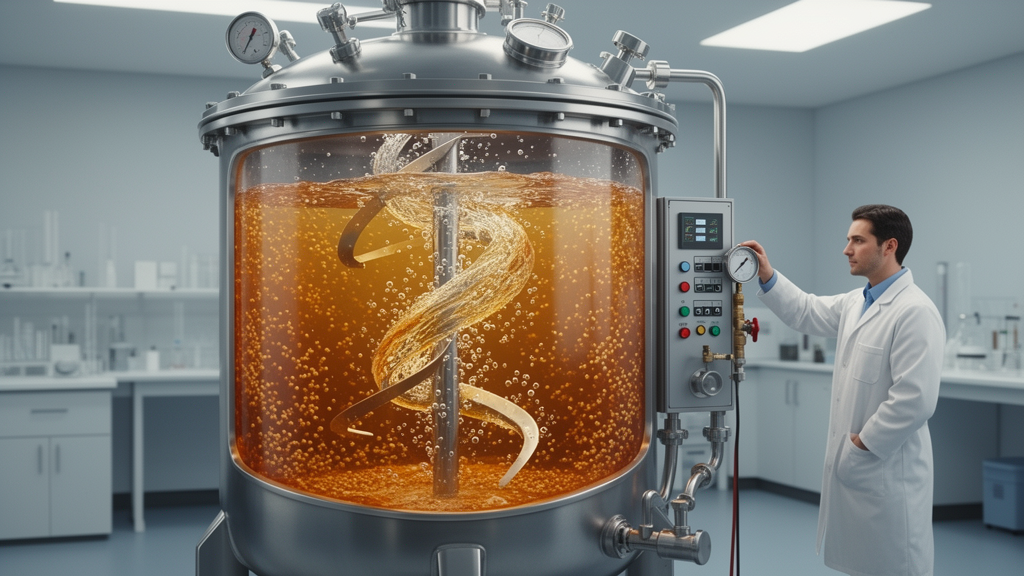
The team then carried the TSP strategy to a 1000-liter pilot bioreactor, scaling agitation by approximately constant specific power input per unit volume and adopting aeration at roughly 60 percent of the 5-liter values to avoid foaming and flooding in the larger vessel. During induction, headspace pressure was raised from 0.5 to 0.75 bar and then to 1.0 bar when dissolved oxygen repeatedly fell to about 25 percent after agitation and aeration had reached their upper limits. The scale-up proved remarkably faithful: peak OUR was 185.23 mmol/L/h at 1000 liters versus 179.93 at 5 liters, a difference of about 2.9 percent. At 136 hours, final dry cell weight reached 124.08 plus or minus 2.47 g/L and xylanase activity 225.07 plus or minus 3.64 KU/mL, with overall volumetric productivities of 1.568 and 1.655 KU/mL/h and biomass-specific productivities of 13.04 and 13.34 KU/gDCW/h at the two scales, respectively.
At the 30 cubic meter industrial scale, however, pressure regulation alone proved insufficient. In the original vessel equipped with four Rushton turbines, dissolved oxygen dropped below 25 percent at 54 to 62 hours even after pressure reached 1.0 bar, later falling under 10 percent, and the highest peak OUR observed across three batches was only 145.62 mmol/L/h. CFD simulation of the gas-liquid flow, using an Eulerian-Eulerian two-fluid framework with a population balance model for bubble sizes, revealed that the radial-flow-dominated Rushton configuration produced pronounced compartmentalization and insufficient axial circulation. The predicted average kLa of the original configuration was 121.6 per hour.
The redesign replaced the bottom Rushton impeller with a CD-6 radial-flow impeller for better gas dispersion, swapped the three upper impellers for 3KSX axial-flow impellers to strengthen axial circulation, and enlarged the impeller diameter from 0.7 to 0.8 meters. Under identical simulated conditions, the predicted average kLa rose 46.4 percent to 178.0 per hour and the predicted mixing time fell 43.3 percent, from 41.8 to 23.7 seconds. After the retrofit, fermentation with the TSP strategy kept dissolved oxygen stable through induction, and at 136 hours the final dry cell weight reached 134.01 plus or minus 2.98 g/L and xylanase activity 242.02 plus or minus 4.07 KU/mL, gains of about 15.0 and 21.8 percent over the original configuration. The authors emphasize that the CFD results, obtained in an air-water reference system, should be read as comparative predictions rather than absolute representations of fermentation broth behavior, and that the approach’s applicability to other strains and bioreactor configurations requires further evaluation.
Subject of Research: A multiscale strategy combining dynamic headspace-pressure regulation and CFD-guided agitation-system redesign to enhance oxygen transfer in high-density Komagataella phaffii fermentation for recombinant xylanase production.
Article Title: Multiscale oxygen transfer enhancement in high‑density Komagataella phaffii fermentation: dynamic pressure control and CFD‑guided industrial scale‑up
Article References: Duan, Q., Wang, F., Ding, Q., Xiong, B., Zhang, B., Yu, H., Zhang, J., Chen, Y., Li, C., Huang, Q., & Song, H. (2026). Multiscale oxygen transfer enhancement in high‑density Komagataella phaffii fermentation: dynamic pressure control and CFD‑guided industrial scale‑up. Bioresources and Bioprocessing, 13(1), Article 158. https://doi.org/10.1186/s40643-026-01155-9
Image Credits: AI Generated
DOI: 10.1186/s40643-026-01155-9
Keywords: Komagataella phaffii, oxygen transfer, high-cell-density fermentation, headspace pressure, CFD, bioreactor scale-up, xylanase, recombinant protein, kLa, impeller redesign, stirred-tank bioreactor, fermentation engineering
News Source: Audrey Campbell. (October 28, 2026). Dynamic pressure control and CFD-guided impeller redesign boost oxygen transfer in high-density yeast fermentation. Scienmag.