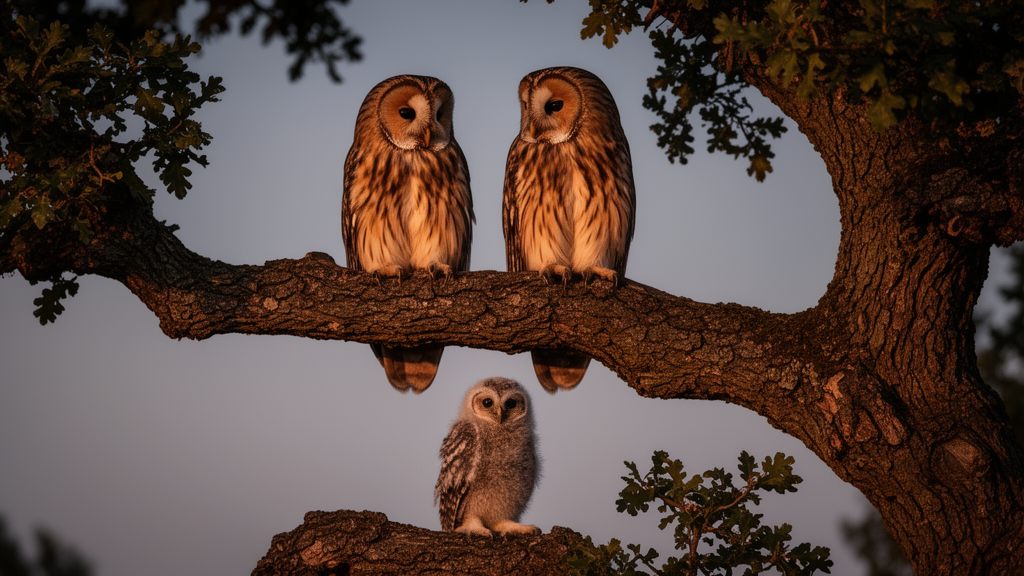
When young Tengmalm’s owls leave the nest, their parents keep feeding them for weeks. Who decides when that support ends — the adults or the chicks pushing for independence — has long divided evolutionary biologists. A new radio-tracking study of 91 fledglings from 31 nests, followed over six years in Czechia and Finland, comes down firmly on the side of the parents.
The research, published as an open-access research article in Biological Research on 14 October 2026, tracked the post-fledging dependence period, the span between a chick leaving the nest and becoming fully independent.
Evolutionary theory offers two competing predictions about who controls the timing. Under the age-of-independence hypothesis, parents determine how long offspring receive care, and young are kept dependent as long as the parents’ optimum allows. Under the early-dispersal hypothesis, offspring call the shots, departing as soon as they reach ontogenetic maturity. Because parents and offspring have different optimal strategies for allocating parental investment, the two parties are expected to be in conflict.
The tracking data revealed striking geographic variation. In Czechia, the mean post-fledging dependence period lasted 49.4 days, with a standard deviation of 6.4 days and a range from 34 to 61 days. In Finland, the mean was shorter at 38.3 days, with a standard deviation of 6.5 days and a range from 28 to 54 days. The same birds’ species, followed with the same method across two countries, produced care periods differing by more than a week on average.
Food availability emerged as a powerful driver. During seasons of rich food abundance, the dependence period was relatively short — 44.5 days in Czechia and 36.6 days in Finland. During poor seasons, it stretched dramatically, to 56.7 days in Czechia and 50.5 days in Finland.
Timing of breeding also mattered. Across the study sites, the dependence period was shorter for broods with delayed hatching dates. The researchers suggest two non-exclusive explanations. Early-nesting parents are likely of higher quality and able to invest more in their offspring, so their young may need less extended support. In addition, all parents face pressure to recover from the costs of parental effort before winter sets in, which may constrain how long care can continue late in the season.
Crucially, the pattern of results fits one hypothesis and contradicts the other. Longer dependence periods during food shortage, longer periods in Czechia than in Finland, and shorter periods when hatching was delayed all support the age-of-independence hypothesis, in which parents control the timing. Each of these findings is inconsistent with the early-dispersal hypothesis, under which mature young would be expected to disperse at a similar stage regardless of environmental conditions. The authors therefore conclude that parents primarily decide on the length and termination of the post-fledging dependence period.
Why would parents keep feeding young that can already fly? The study’s conclusions point to the value of prolonged care for the offspring’s future prospects. The additional weeks allow fledglings to develop flight skills that directly affect hunting success after independence — and independence marks the critical period for their survival.
The study also carries a broader message about life-history variation. According to the authors, these results demonstrate for the first time that differing environmental conditions across distant study sites — Central versus North Europe — are crucial in determining the duration of the post-fledging dependence period, an important life-history trait of altricial birds.
As with any field study, the findings describe one species, Tengmalm’s owl, observed at specific sites over six years, and the authors frame their conclusion as a suggestion supported by the observed patterns rather than a definitive resolution of the conflict. Nevertheless, the work offers a clear empirical answer to a classic evolutionary question: in this bird of prey, the parents, weighing food supply, breeding timing and their own need to recover before winter, hold the deciding vote over when their young must finally fend for themselves.
Subject of Research: Parent-offspring conflict over the duration of post-fledging parental care in Tengmalm's owls
Article Title: Parent-offspring conflict over the decision on the length and termination of parental care in a bird of prey
Article References: Kouba, M., Tulis, F., Stehlíková Sovadinová, S., Bartošová, J., Bartoš, L., & Korpimäki, E. (2026). Parent-offspring conflict over the decision on the length and termination of parental care in a bird of prey. Biological Research. https://doi.org/10.1186/s40659-026-00734-6
Image Credits: AI Generated
DOI: 10.1186/s40659-026-00734-6
Keywords: Tengmalm's owl, parent-offspring conflict, post-fledging dependence period, parental care, age-of-independence hypothesis, early-dispersal hypothesis, bird of prey, food abundance, hatching date, life-history traits, Czechia, Finland
News Source: Drew Townsend. (October 28, 2026). Owl parents, not chicks, call the shots on when care ends. Scienmag.