


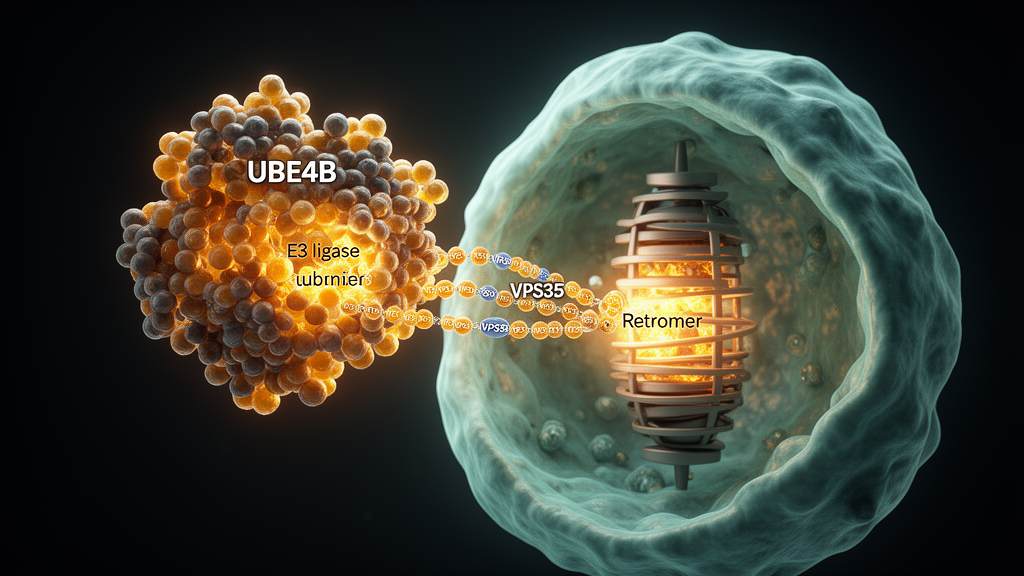
Scientists have identified a new post-translational mechanism that controls levels of VPS35, a core component of the retromer complex best known for its role in Parkinson’s disease. The work was published on 15 October 2026 as an open-access research article.
VPS35 dysfunction has previously been linked to Parkinson’s disease, with the D620N point mutation identified as a causative factor in familial cases. Yet the protein’s role in cancer progression and its post-translational modifications had remained poorly understood. The new study addresses that gap by showing that UBE4B directly ubiquitinates VPS35 and targets it for destruction, adding a regulatory layer connecting the retromer pathway to cancer cell behavior.
The team also examined how disease-associated variants behave under this control. The VPS35 D620N mutant, along with most non-small cell lung cancer (NSCLC)-associated mutants, was similarly degraded by UBE4B, mirroring what happens to wild-type VPS35. This suggests that the degradation mechanism applies broadly across both the familial Parkinson’s mutation and tumor-associated variants.
To explore clinical relevance, the researchers analyzed the Clinical Proteomic Tumor Analysis Consortium (CPTAC) and International Cancer Proteogenome Consortium (ICPC) databases. They found that UBE4B is upregulated in many cancers, particularly lung and breast cancers, while VPS35 expression is correspondingly downregulated, suggesting an inverse correlation between the two proteins in these malignancies.
Notably, the D620N mutation was absent in patients with NSCLC, a finding the authors say underscores distinct molecular mechanisms operating in lung cancer and Parkinson’s disease. The observation reinforces the idea that the same protein can participate in very different disease processes depending on tissue context.
Functional experiments in cell lines revealed divergent effects. In the NSCLC lines H1299 and H125, UBE4B promoted proliferation and migration, whereas VPS35, including the D620N mutant, suppressed these processes. Intriguingly, UBE4B enhanced apoptosis in a p53-dependent manner, while VPS35 had minimal impact on cancer cell apoptosis, indicating that the two proteins shape different aspects of cancer cell behavior through partly independent routes.
The picture changed in neuroblastoma cells. There, the UBE4B–VPS35 axis exhibited opposing roles: UBE4B inhibited proliferation and migration, while VPS35 promoted them. This reversal relative to the lung cancer cell findings highlights the context-dependent nature of the pathway and cautions against assuming uniform effects across cancer types.
Because the study relies on cell-line experiments and proteomic database analyses, its findings describe associations and mechanisms observed in those settings rather than confirmed outcomes in patients. The article is being shared early to provide faster access to peer-reviewed, accepted research; this version is citable and carries a permanent DOI but remains subject to further edits before the final Version of Record.
The authors conclude that UBE4B-mediated ubiquitination of VPS35 represents a novel regulatory mechanism in cancer progression, providing new insights into the context-dependent roles of the UBE4B–VPS35 axis across different cancer types.
Subject of Research: UBE4B-mediated ubiquitination and degradation of VPS35 and its context-dependent effects on cancer cell behavior
Article Title: UBE4B-mediated ubiquitination and degradation of VPS35 differentially regulate cancer cell behaviors in a context-dependent manner
Article References: Jin, B., Xu, P., Zhang, Y., Qu, J., Huang, S., Cai, K., Li, S., Xie, Q., Xu, S., Chen, S., Zhao, B., & Jiao, X. (2026). UBE4B-mediated ubiquitination and degradation of VPS35 differentially regulate cancer cell behaviors in a context-dependent manner. Cellular & Molecular Biology Letters. https://doi.org/10.1186/s11658-026-01017-4
Image Credits: AI Generated
DOI: 10.1186/s11658-026-01017-4
Keywords: UBE4B, VPS35, retromer complex, ubiquitination, K48-linked polyubiquitin, non-small cell lung cancer, neuroblastoma, Parkinson's disease D620N, CPTAC, proteomics, p53, cancer cell migration
News Source: Nathaniel Bowman. (October 28, 2026). E3 Ligase UBE4B Tags VPS35 for Destruction, Steering Cancer Cell Behavior in Context-Dependent Ways. Scienmag.



