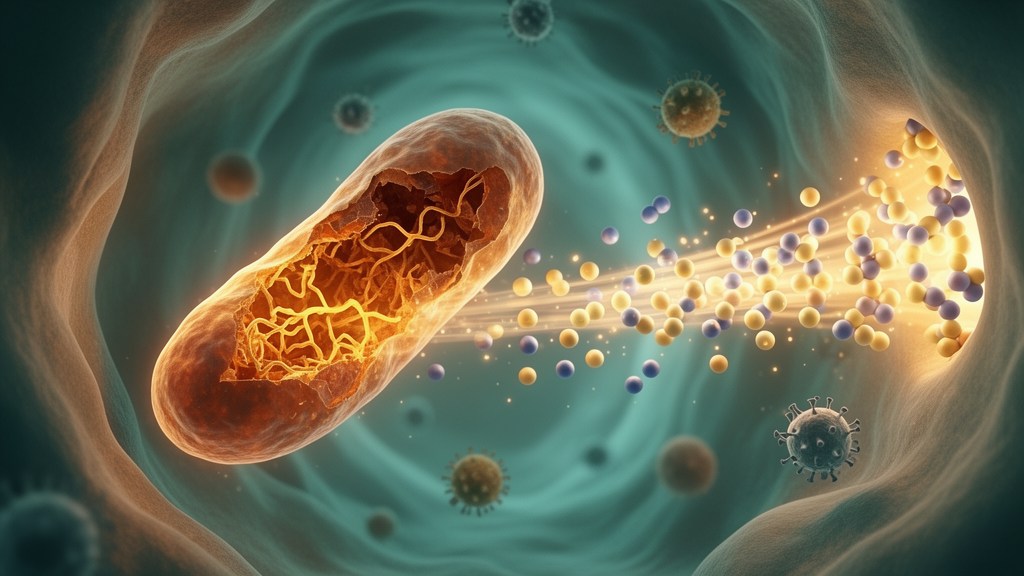
Mitochondria under stress do more than lose their ability to generate energy efficiently. According to a review published in August 2026 in the open-access journal Cell Signaling, Inflammation & Disease, when mitochondria malfunction they trigger a cascade of immunological events that extends far beyond simple energy failure. Fabrizio Marcucci and Cristiano Rumio, the authors of the review, argue that two parallel consequences of mitochondrial dysfunction— the release of inflammatory mediators from damaged organelles and the compensatory upregulation of fermentative glycolysis— work together to shape both innate and adaptive immune responses, sometimes amplifying them and sometimes holding them in check.
The review lays out the basic biochemistry first. Glycolysis converts glucose to pyruvate, and when oxygen is plentiful, pyruvate enters the tricarboxylic acid cycle and ultimately feeds oxidative phosphorylation, which can yield up to 36 molecules of ATP per molecule of glucose. Under hypoxic conditions, or when mitochondria are compromised, pyruvate is instead fermented to lactate, a pathway the authors call fermentative glycolysis, which generates only 2 ATP molecules per glucose molecule. Despite this low yield, fermentative glycolysis becomes the dominant energy-producing pathway in rapidly proliferating cells, including transformed cells, fibroblasts, and activated lymphocytes, and it supplies metabolic intermediates for the synthesis of nucleotides, lipids, and amino acids.
The authors trace the modern understanding of this metabolic switch back to Otto Warburg, who reported roughly a century ago that tumor cells rely predominantly on fermentative glycolysis even in the presence of oxygen, and proposed that irreversible damage to mitochondrial respiration was the underlying cause. While the review notes that Warburg’s assumption has been shown to be wrong in most cases, there are instances where mitochondrial dysfunction does contribute to tumorigenesis. Dysfunctional mitochondria also promote inflammatory responses that, when they become chronic, can contribute to inflammatory or autoimmune diseases and, indirectly through the role of inflammation in tumor initiation, to cancer itself.
The review catalogs a range of causes of mitochondrial dysfunction that carry pathogenic consequences and trigger compensatory glycolysis. In each case, the authors report that upregulation of fermentative glycolysis was observed as a compensatory response.
Damaged mitochondria release several classes of inflammatory mediators, according to the review. Reactive oxygen species, produced mainly at complexes I and III of the electron transport chain, increase upon mitochondrial dysfunction to levels that can overwhelm antioxidant defenses. Oxidized mitochondrial DNA escapes into the cytoplasm through mitochondrial permeability transition pores, and extracellular ATP is released upon cellular necrosis. These mediators act as damage-associated molecular patterns, binding to pattern recognition receptors and activating innate immune cells to produce sterile inflammatory responses. Oxidized mitochondrial DNA activates Toll-like receptor 9, the cGAS-STING pathway, and the NLRP3 inflammasome, leading to the production of inflammatory cytokines including tumor necrosis factor-alpha, interleukin-6, IL-1beta, and IL-18, as well as interferon-encoding genes through IRF3 activation.
The central proposal of the review is that upregulated fermentative glycolysis does not merely replace lost ATP production but actively integrates and amplifies the immune responses initiated by mitochondrial mediators. The authors describe numerous stimulatory effects of glycolysis on innate immunity. Upregulated glycolysis promotes the formation of neutrophil extracellular traps and activates inflammasomes. The glycolytic enzyme hexokinase 2 promoted inflammation in a mouse model of colitis, while pyruvate kinase isoform M2 promoted neutrophil activation through STAT3 phosphorylation, increased Toll-like receptor activation in macrophages contributing to inflammation and autoimmunity in disease models, and entered a complex with HIF-1alpha that upregulated IL-1beta expression. The metabolite phosphoenolpyruvate acted as a danger signal in macrophages, promoting polarization toward an inflammatory M1 phenotype, and lactate dehydrogenase A upregulated inflammatory cytokines, inducible nitric oxide synthase, and cyclooxygenase-2 through p38 MAPK activation.
Lactate itself can act as an inflammatory stimulus, promoting polarization of adipose tissue macrophages toward an inflammatory phenotype, and extracellular acidosis has been identified as a danger signal that activates innate immunity via the NLRP3 inflammasome. The review also describes how lactate drives a posttranslational modification called lactylation, which affects histones and influences gene expression. Histone lactylation promoted functional reprogramming of neutrophils within the brain tumor microenvironment, and in individuals vaccinated with bacillus Calmette-Guérin, lactylation of histone H3 at distal regulatory regions promoted active chromatin domains and increased gene transcription, persisting after elimination of the initial stimulus and appearing to underlie innate immune memory responses. The authors note that innate immunity can in turn upregulate glycolysis, suggesting a reciprocal amplificatory loop between the two processes.
On the adaptive immune side, the review describes how fermentative glycolysis promotes antigen presentation by supporting the activation and differentiation of dendritic cells, and how T cells actively engaged in effector functions rely predominantly on fermentative glycolysis for energy, while quiescent and regulatory T cells rely on oxidative metabolism. During early T-cell activation, TCR signaling activates pyruvate dehydrogenase kinase 1, which blocks pyruvate entry into the TCA cycle and promotes its conversion to lactate. The metabolite phosphoenolpyruvate prolonged TCR signaling by increasing cytoplasmic calcium levels, and lactate dehydrogenase A upregulated interferon-gamma expression in activated T cells. Lactate also acted as a positive regulator of ectopic lymphoid structures in Sjögren’s disease, an autoimmune rheumatic condition.
Yet the review emphasizes that upregulated glycolysis is not uniformly immunostimulatory. Pyruvate kinase M2 increased expression of programmed cell death ligand 1 in tumor-associated immune cells, promoting an immunosuppressive tumor microenvironment. Lactate inhibited inflammatory signaling in monocytes, macrophages, and dendritic cells, reprogrammed macrophages toward anti-inflammatory or tolerogenic phenotypes, and induced a stop signal to T-cell migration at sites of chronic inflammation. In CD4+ T cells lactate induced a switch toward the inflammatory Th17 subset, while in CD8+ T cells it caused loss of cytolytic function, illustrating how the same metabolite can exert contradictory effects depending on the target cell. A newly reported modification called pyruvilation, mediated by pyruvate, blocked the interaction of STAT1 with STAT2, suppressing type I interferon signaling and antiviral activity. Upregulated glycolysis also prevents necrotic death of affected cells by replacing missing ATP production, thereby avoiding systemic release of damage-associated molecular patterns that could pose an immunopathological threat.
The authors conclude by proposing an integrated model in which mitochondrial dysfunction acts as the initial driver, releasing inflammatory mediators that activate innate immunity while simultaneously inducing compensatory glycolysis that either amplifies immune responses or restrains them to prevent chronic inflammation and autoimmunity. They also address the relationship between fermentative glycolysis and the integrated stress response, noting that the stress response mediator ATF4 can induce serine biosynthesis from glycolytic intermediates while coexisting with upregulated glycolysis under certain conditions, though excessive or chronic activation of the stress response may trigger apoptotic cell death through CHOP. The review acknowledges that determining when lactate and its associated modifications exert immunostimulatory versus immunosuppressive effects remains difficult, as outcomes depend heavily on the target cell, the microenvironment, accompanying acidity, transporter expression, and metabolite concentration.
Subject of Research: How mitochondrial dysfunction and compensatory upregulation of fermentative glycolysis modulate innate and adaptive immune responses
Article Title: The consequences of mitochondrial dysfunction and upregulated glycolysis on innate and adaptive immune responses
Article References: Marcucci, F., & Rumio, C. (2026). The consequences of mitochondrial dysfunction and upregulated glycolysis on innate and adaptive immune responses. Cell Signaling, Inflammation & Disease, 1(1), Article 5. https://doi.org/10.1186/s44505-026-00005-x
Image Credits: AI Generated
DOI: 10.1186/s44505-026-00005-x
Keywords: mitochondrial dysfunction, fermentative glycolysis, innate immunity, adaptive immunity, lactate, inflammation, reactive oxygen species, mitochondrial DNA, NLRP3 inflammasome, lactylation, integrated stress response, immunometabolism
News Source: Drew Townsend. (October 28, 2026). Damaged Mitochondria and Runaway Glycolysis Reshape Immune Responses, Review Finds. Scienmag.