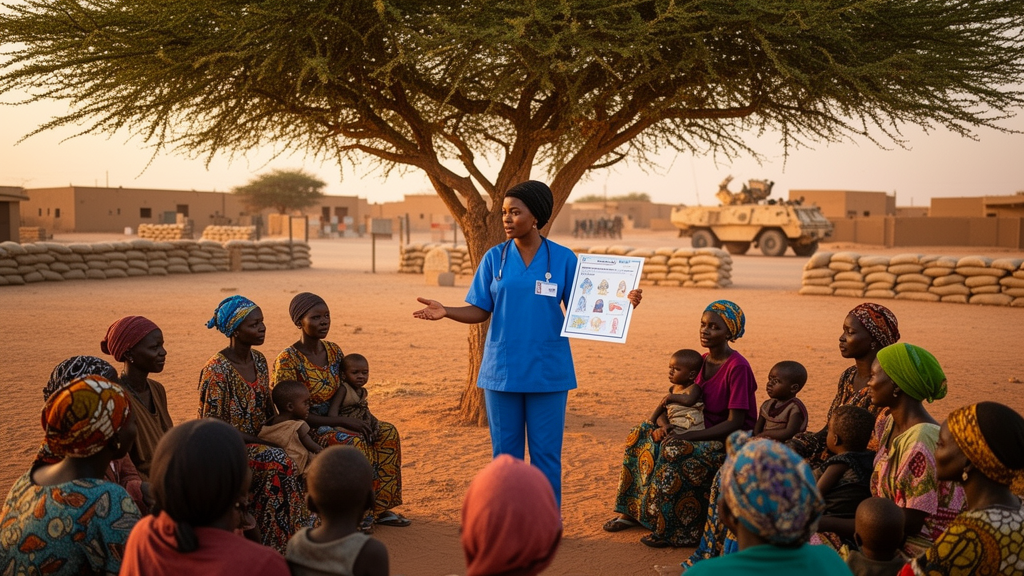
Community-based health education improves health knowledge in fragile and conflict-affected settings across Sub-Saharan Africa, but its effects on long-term health outcomes remain constrained, according to a systematic review published in the journal Conflict and Health. The review, released as an open access article on 22 October 2026, synthesizes evidence from eighteen studies examining how health education delivered at the community level performs in some of the world’s most difficult operating environments.
The research team, led by Amare Simegn with colleagues including Yitayal Ayalew Goshu, Agmasie Tigabu and Kamal Nand Singh, set out to assess the effectiveness of community-based health education interventions in improving health knowledge, service utilization and health outcomes in fragile and conflict-affected settings, and to explore the mechanisms and contextual factors that shape their success. In such settings, health service delivery is constantly disrupted, which creates a persistent need for creative solutions to sustain vital health education and encourage the consumption of health services.
Community-based health education has been extensively used in these contexts as a tactic to raise health awareness and promote healthy habits, yet the authors note that its overall efficacy and the mechanisms behind its impact had not been fully synthesized before. To address that gap, the reviewers carried out a systematic review with thematic synthesis of the eighteen included studies. They searched PubMed/MEDLINE, Scopus, Embase, CINAHL, the Cochrane Library and Google Scholar, and also conducted a grey literature search for relevant work.
The studies included in the review examined interventions delivered in fragile and conflict-affected environments by community health workers, peer educators, traditional birth attendants and informal community organizations.
The review’s central finding is that community-based interventions consistently improved health knowledge across three domains: maternal health, child health and infectious disease. The primary delivery methods identified were community health workers, peer educators and traditional birth attendants. This consistency across disease areas suggests that trusted local messengers can transmit health information effectively even where clinics and hospitals struggle to function.
Three contextual factors emerged as major determinants of effectiveness: accessibility, cultural tolerance and trust. Interventions worked best when community actors were physically reachable by the populations they served, when their messages and methods respected local cultural norms, and when communities trusted the people delivering the education. These findings align with the review’s broader conclusion that trusted local actors are central to how community-based health education strengthens resilience in fragile settings.
Service utilization told a more conditional story. According to the review, service utilization increased when community actors were integrated into formal health systems, while fragmented or exclusionary approaches decreased efficacy. In other words, community health workers, peer educators and traditional birth attendants were most effective at moving people from awareness into actual care when they were connected to, rather than operating apart from, the formal health infrastructure.
The review also identified systematic limitations that hinder the conversion of better knowledge into long-term health outcomes. Instability, poor coordination and supply chain interruptions all impeded that translation. People may learn about healthy practices or the importance of seeking care, but persistent insecurity, weak coordination between actors and broken supply chains prevent that knowledge from becoming sustained improvements in health.
The authors conclude that community-based health education and informal community health systems improve knowledge and strengthen resilience in fragile settings through trusted local actors, but that their impact on health outcomes remains constrained without stronger system integration and sustained structural support. The review was published in Conflict and Health, a Springer Nature journal, and is available as open access. As a synthesis of eighteen studies, it reflects the scope of the published and grey literature the search captured, and its thematic synthesis approach draws together findings across heterogeneous intervention contexts rather than pooling effect estimates from a single trial design.
Subject of Research: Effectiveness of community-based health education interventions in fragile and conflict-affected settings in Sub-Saharan Africa
Article Title: Effectiveness of community-based health education interventions in fragile and conflict-affected settings in Sub-Saharan Africa: a systematic review
Article References: Simegn, A., Goshu, Y. A., Endalew, T. L., Tigabu, A., Ayalew, T., Kassahun, E. A., Derseh, H. A., Asmare, T. B., Gobezie, N. Z., Wubet, H. B., Belete, K. G., Abate, B. J., Deress, G. M., Demissie, B., & Singh, K. N. (2026). Effectiveness of community-based health education interventions in fragile and conflict-affected settings in Sub-Saharan Africa: a systematic review. Conflict and Health. https://doi.org/10.1186/s13031-026-00857-3
Image Credits: AI Generated
DOI: 10.1186/s13031-026-00857-3
Keywords: community health education, fragile and conflict-affected settings, Sub-Saharan Africa, systematic review, community health workers, health service utilization, maternal health, child health, infectious disease, health systems, Conflict and Health, thematic synthesis
News Source: Courtney Benton. (October 28, 2026). Community Health Education Shows Gains but Limits in Conflict-Hit Africa. Scienmag.