


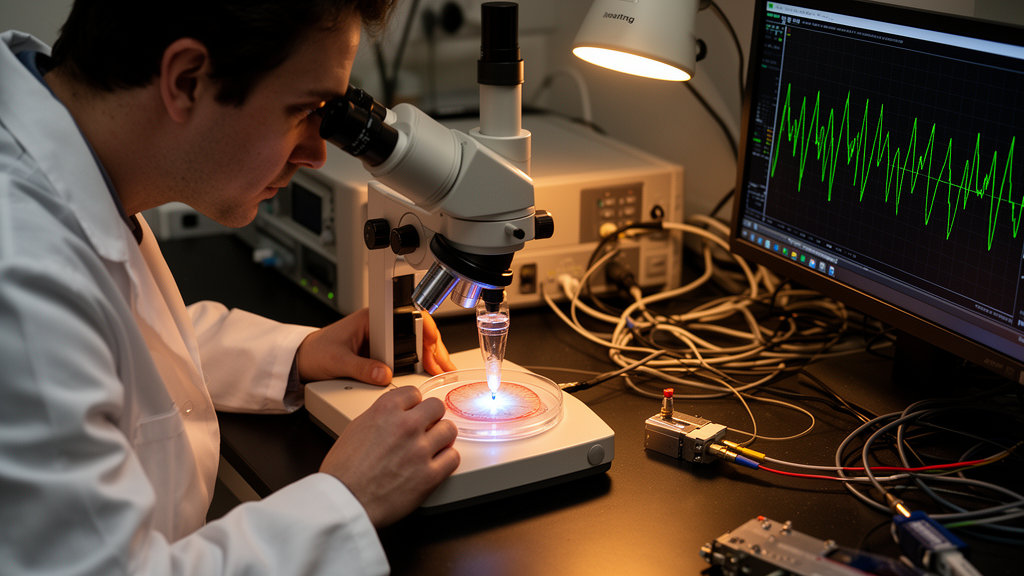
Neuroscientists have released an unusually detailed electrophysiological dataset capturing the electrical fingerprints of neurons in the thalamic reticular nucleus, a thin shell of inhibitory cells that wraps around the thalamus and acts as a gatekeeper for the sensory information flowing to the cerebral cortex. The resource, published as a FAIR² data article in Frontiers in Neuroscience by researchers at the Laboratory of Neural Microcircuitry of the École Polytechnique Fédérale de Lausanne, contains whole-cell patch-clamp recordings from 19 interneurons of juvenile male C57Bl/6J mice, all acquired between postnatal days 24 and 34. Rather than publishing only summary statistics, the team preserved every raw signal trace, amounting to 18,015 recorded sweeps and nearly 400 million digitized samples, packaged in formats designed to be queried directly by both human analysts and machine-learning pipelines.
The thalamic reticular nucleus, or TRN, occupies a privileged position in brain anatomy. It is the principal source of inhibition onto thalamocortical relay cells, meaning it can selectively dampen or permit the passage of signals traveling between the thalamus and cortex. Its neurons possess a distinctive intrinsic firing repertoire, most famously the low-threshold calcium bursts that rebound after the membrane is hyperpolarized. These rebound bursts are thought to help shape the rhythms of sleep and arousal, and they have been implicated in absence epilepsy and disorders of attention. Understanding how individual TRN neurons generate this repertoire requires recordings made under identical, standardized conditions, which is precisely the gap the new dataset is intended to fill.
All 19 neurons were recorded in acute horizontal brain slices of 300 micrometer thickness, cut on a vibratome in ice-cold, oxygenated cutting solution and then incubated before transfer to a recording chamber perfused with artificial cerebrospinal fluid at 33 degrees Celsius, plus or minus one degree. Neurons were visualized with infrared differential interference contrast video microscopy and targeted on the basis of their somatic position. Recordings were made in current-clamp mode with Axopatch 200B amplifiers, using borosilicate pipettes pulled to tip resistances of 5 to 10 megaohms. Signals were low-pass filtered at 2 kilohertz and sampled at either 10 or 50 kilohertz, and only recordings in which access resistance stayed below 20 megaohms throughout the full protocol were retained.
The heart of the resource is a standardized current-clamp stimulus battery applied identically to every cell. It comprises 28 distinct stimulus protocols covering electrode and recording-stability checks, subthreshold passive membrane behavior, hyperpolarization and afterhyperpolarization dynamics, action-potential threshold and waveform, suprathreshold firing patterns, spike recovery and refractoriness, and resonance and noise characterization. Protocols include incremental depolarizing current steps to probe firing patterns, paired hyperpolarizing-then-depolarizing step sequences designed to evoke rebound responses, sinusoidal current injections sweeping from 0 to 250 hertz for frequency analysis, and fixed injected current noise. Resting membrane potential was held at minus 70 millivolts, plus or minus 5 millivolts, with a steady holding current where necessary, so that every sweep across all cells began from a comparable baseline.
The scale of the release is considerable. Across the package, the dataset spans 19 recording sessions drawn from 13 individual animals, 18,015 recorded sweeps, and 399,619,819 digitized signal samples. Individual recordings hold a median of 912 sweeps, ranging from 658 to 1,494. The canonical raw signals are preserved as 19 NWB files in the community-standard icephys format, roughly 1.5 gigabytes, alongside the 19 original Igor Pro source files, roughly 1.9 gigabytes. In parallel, the full time series has been indexed into three tidy, ZSTD-compressed Apache Parquet tables: one row per recording session, one per sweep, and one per digitized sample, all linked by a normalized recording identifier so that queries can traverse from animal metadata down to a single voltage sample without opening any HDF5 file.
Each recording carries rich contextual metadata: animal identity, sex, strain, genotype, postnatal age, body weight, slice orientation and coordinate, recorded region, and the initial resting membrane potential measured at zero current injection. That initial resting potential spans minus 83 to minus 55 millivolts, with a mean of minus 68.7 millivolts, consistent with the held baseline near minus 70 millivolts. The recorded neurons sit along the dorsoventral axis between 3.16 and 4.12 millimeters below bregma, placing them within the first-order thalamus sector serving motor and somatosensory systems. Sampling rate is a property of the stimulus protocol rather than of the recording: 25 protocols were acquired at 10 kilohertz, accounting for 14,658 sweeps, while three protocols, Rac, IVRest, and APWaveform, were acquired at 50 kilohertz, accounting for 3,357 sweeps. No imputation or interpolation was applied anywhere in the release.
The packaging follows the FAIR² framework, meaning the data are described as findable, accessible, interoperable, reusable, AI-ready, and responsibly governed. Machine-readable metadata conform to the MLCommons Croissant specification, with QUDT-standardized units and PROV-O provenance linking every table and field back to the extraction scripts that transformed the original laboratory archives. A variable-level data dictionary documents every column with its type, unit, description, and ontology mapping. The dataset is released under the Open Data Commons Attribution License v1.0, permitting reuse, redistribution, and modification with attribution, and carries a registered DOI for citability. An automated integrity assessment scored 0.98, and the authors report that the package meets the FAIR² criteria.
For computational neuroscientists, the uniform protocol makes the recordings directly comparable across cells, supporting cell-type and firing-phenotype analysis, the fitting and validation of biophysically detailed single-neuron models, and in particular the modeling of the rebound-burst behavior that defines this population. For machine-learning researchers, the tidy tabular projection with a consistent session-to-sweep-to-sample join key lowers the barrier to large-scale ingestion, and the natural partitioning by recording session and stimulus protocol offers straightforward train, validation, and test splits. The authors also note that future extensions could add a derived feature table with quantities such as input resistance, rebound-burst latency and strength, firing rate, and adaptation index, or pair the electrophysiology with morphological reconstructions to build a cross-modal TRN resource.
The dataset’s limitations are stated plainly. The cohort consists of only 19 neurons from 13 male juvenile C57Bl/6J mice within a narrow developmental window, with no female animals included, and the coverage reflects the sampling of a single laboratory project rather than a population-representative survey. The release is electrophysiology only: no morphological reconstructions or histological imagery are distributed, and certain acquisition-level details survive only in the Igor Pro wave notes rather than as parsed per-sweep stimulus amplitudes. Even so, the authors argue that the resource provides real, stable recordings of TRN neurons with a thorough exploration of voltage responses within physiological ranges, all captured in a standardized manner that few single-laboratory collections can match.
For anyone who has struggled to compare patch-clamp results across papers, each with its own stimulus conventions, holding potentials, and analysis choices, the appeal is immediate: here is one battery of stimuli, applied identically to every cell, with the raw traces preserved at full resolution and the provenance of every processing step documented. Whether the goal is to characterize the passive membrane properties of inhibitory thalamic neurons, to fit conductance-based models of rebound bursting, or simply to teach a model what a genuine current-clamp recording looks like, the juvenile mouse TRN has just become one of the more openly documented corners of the brain.
Subject of Research: A standardized whole-cell patch-clamp electrophysiology dataset of juvenile mouse thalamic reticular nucleus neurons
Article Title: Single-cell dataset of juvenile mouse neurons from the thalamic reticular nucleus: whole-cell patch-clamp electrophysiology
Article References: Pezzoli, M., Perin, R., & Markram, H. (2026). Single-cell dataset of juvenile mouse neurons from the thalamic reticular nucleus: whole-cell patch-clamp electrophysiology. Frontiers in Neuroscience, 20, Article 1927631. https://doi.org/10.3389/fnins.2026.1927631
Image Credits: AI Generated
DOI: 10.3389/fnins.2026.1927631
Keywords: thalamic reticular nucleus, patch-clamp, electrophysiology, current-clamp, mouse brain, dataset, FAIR², NWB format, rebound bursts, machine learning, neuroscience data, EPFL
News Source: Cassandra Pierce. (October 29, 2026). Massive Patch-Clamp Dataset Opens a Window on the Mouse Brain’s Sensory Gatekeeper. Scienmag.



