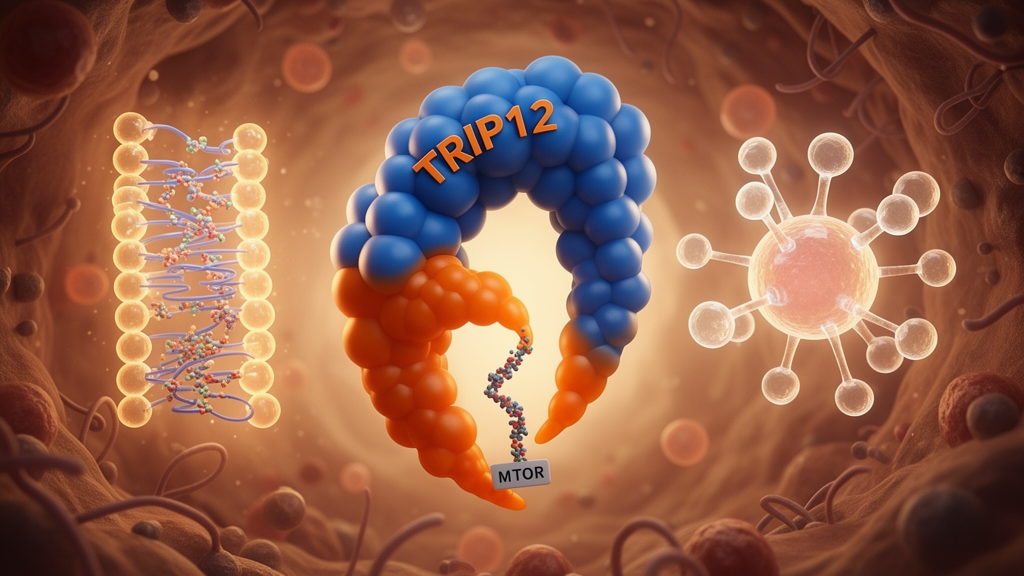
An E3 ubiquitin ligase called TRIP12 has been identified as a controller of protein translation in human cancer cells, acting through the mTOR signalling pathway and a stress granule protein known as G3BP1, according to a study published in the journal Cell Communication and Signaling. The work, led by Amira Kohil, Munia Hamdan and Omar Muhammad Khan with colleagues, used quantitative proteomics to build a picture of how this poorly understood enzyme shapes the fundamental cellular process of building proteins, and how that role may feed tumour growth.
TRIP12 is a HECT domain E3 ubiquitin ligase, a class of enzymes that attach ubiquitin tags to target proteins and thereby influence their fate and function. The gene has attracted attention in two very different fields: it is frequently mutated in neurological conditions such as Clarke–Baraitser syndrome and autism spectrum disorder, and its deregulation has been causally linked to several human cancers. Previous studies have placed TRIP12 in a range of context-dependent biological processes, including the DNA damage response, TGF-beta signalling, WNT signalling pathways and responses to chemotherapy. The new study adds protein translation to that list.
The researchers genetically inhibited TRIP12 in multiple human cancer cell lines and measured the consequences for protein synthesis using puromycin and its analogue O-propargyl-puromycin, standard tools for quantifying cellular translation. Translation dropped significantly in the TRIP12-depleted cells. That reduction was accompanied by a cluster of cellular phenotypes: the cells became smaller, their migration was impaired, and their ability to form tumour spheroids was diminished, pointing to a role for TRIP12-supported translation in growth and motility behaviours relevant to cancer.
In TRIP12-depleted cells, mTOR activity remained persistently reduced, as judged by the phosphorylation levels of two of its downstream targets, P70S6 Kinase and the S6 ribosomal protein. Because these phosphorylation events track mTOR’s output, their sustained decrease indicates that TRIP12 normally acts to keep this pathway active.
The proteomics data pointed to G3BP1 as the link. G3BP1 is described in the study as a key negative regulator of mTOR signalling, and TRIP12 depletion was found to reduce monoubiquitination of the protein. With that ubiquitin mark lowered, G3BP1 interacted more strongly with mTOR, an association the authors frame as a potential mTOR/G3BP1 nexus through which TRIP12 exerts its control over translation. In other words, TRIP12’s ubiquitin ligase activity appears to restrain a brake on mTOR, and removing TRIP12 lets the brake tighten.
A co-deletion experiment provided the strongest causal support for this model. When the researchers deleted both G3BP1 and TRIP12 together, most of the phenotypes caused by TRIP12 depletion were reversed. That result places G3BP1 downstream of TRIP12 in the pathway and ties the loss of translation, cell size, migration and spheroid formation to the G3BP1–mTOR axis rather than to unrelated off-target effects of TRIP12 removal.
The authors conclude that TRIP12 is a critical regulator of cellular protein translation via the mTOR/G3BP1 pathway, and they suggest that this aspect of TRIP12 signalling could be therapeutically targeted, particularly in cancers that rely on mTOR signalling for their growth. That framing is a proposal for future work rather than a demonstrated treatment: the evidence presented comes from human cancer cell lines in vitro, and no clinical testing is reported.
Several caveats are worth keeping in view. The findings rest on genetic inhibition in cell culture, so how TRIP12 regulates the mTOR/G3BP1 axis in living tumours remains to be established. The study is also shared as an accepted-manuscript version that is citable and carries a permanent DOI but is subject to further edits before the final version of record replaces it. For cancers dependent on mTOR-driven protein synthesis, that pivot offers a concrete molecular lead for future investigation.
Subject of Research: Regulation of protein translation and tumourigenesis by the E3 ubiquitin ligase TRIP12 through the mTOR/G3BP1 pathway in human cancer cell lines.
Article Title: E3 ubiquitin ligase TRIP12 controls protein translation and promotes tumourigenesis via a potential mTOR/G3BP1 nexus
Article References: Kohil, A., Hamdan, M., Abdelrahman, D., Dowle, A., Awan, A. B., Keyan, K. S., Yildiz Ozer, L., Amir, S. S., Sreenesh, B., Embarek, E., Da’as, S., Zen, A. A. H., & Khan, O. M. (2026). E3 ubiquitin ligase TRIP12 controls protein translation and promotes tumourigenesis via a potential mTOR/G3BP1 nexus. Cell Communication and Signaling. https://doi.org/10.1186/s12964-026-03326-9
Image Credits: AI Generated
DOI: 10.1186/s12964-026-03326-9
Keywords: TRIP12, E3 ubiquitin ligase, protein translation, mTOR signalling, G3BP1, cancer cell lines, quantitative proteomics, tumour spheroids, P70S6 kinase, ubiquitination, Cell Communication and Signaling, ubiquitin
News Source: Nathaniel Bowman. (October 27, 2026). E3 Ligase TRIP12 Drives Protein Synthesis and Tumour Growth Through mTOR Pathway. Scienmag.