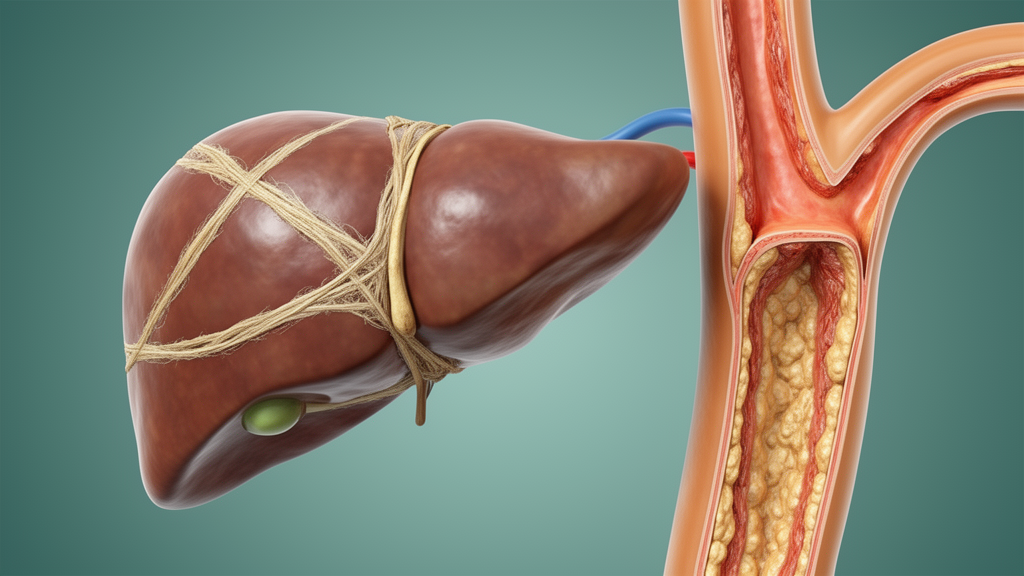
People with type 2 diabetes who show signs of liver fibrosis face a substantially higher likelihood of macrovascular alteration, according to a study published in BMC Endocrine Disorders, while simple fatty liver without fibrosis appears to carry no such added risk. The finding suggests that within the spectrum of metabolic dysfunction-associated steatotic liver disease, or MASLD, it is the fibrotic component rather than fat accumulation itself that tracks with vascular complications.
The research team, led by Yijun Liu and colleagues, drew on the National Metabolic Management Center database. After propensity score matching, 2,238 patients with type 2 diabetes were enrolled. Using abdominal ultrasound together with a FIB-4 index threshold of 1.3 or higher, the investigators sorted participants into four phenotypes: no steatosis or fibrosis, steatosis only, fibrosis only, and steatosis with fibrosis.
The prevalence of macrovascular alteration differed markedly across these groups, standing at 56.2 percent, 56.5 percent, 79.0 percent and 71.5 percent respectively, a difference that was statistically significant. In other words, patients whose livers showed fibrosis, whether or not steatosis was also present, were far more likely to display macrovascular changes than those without either feature.
In the fully adjusted multivariable logistic regression model, the fibrosis-only group had significantly higher odds of macrovascular alteration compared with the no-steatosis, no-fibrosis reference group, with an odds ratio of 1.63 and a 95 percent confidence interval of 1.25 to 2.13. The steatosis-with-fibrosis group also showed elevated odds, at 1.34 with a confidence interval of 1.02 to 1.77. By contrast, the steatosis-only group showed no significant association, with an odds ratio of 1.02, indicating that fatty liver on its own did not confer increased risk in this population.
The authors conclude that in patients with type 2 diabetes, liver fibrosis rather than simple hepatic steatosis independently predicts macrovascular alteration after full adjustment for traditional cardiovascular risk factors.
Subgroup analyses revealed that the fibrotic effect was more pronounced in certain patient groups. The association was strongest in males, with an odds ratio of 2.57, in patients with obesity, at 2.72, and in those with a diabetes duration of five to ten years, where the odds ratio reached 3.24. These patterns point to specific subgroups in which fibrosis screening may be particularly informative.
Based on these results, the researchers propose incorporating the FIB-4 index into routine cardiovascular risk assessment for patients with type 2 diabetes, arguing that this non-invasive measure could facilitate early identification of high-risk individuals. They suggest that targeted fibrosis screening is particularly warranted in male patients, those with obesity, and patients within the five-to-ten-year window after diabetes diagnosis, and that FIB-4-based screening could serve as a practical and cost-effective strategy for cardiovascular risk stratification.
It should be noted that the study demonstrates associations rather than proving that fibrosis causes macrovascular change. The FIB-4 index is a calculated, non-invasive marker rather than a direct biopsy-based measure of fibrosis, and the findings describe risk prediction within this specific population of 2,238 matched patients with type 2 diabetes. The authors frame the work as identifying high-risk individuals for earlier attention, rather than establishing a treatment effect. Even so, the central message is clear: among patients with type 2 diabetes and fatty liver disease, the presence of fibrosis, detectable through the non-invasive FIB-4 index, marks the group where macrovascular alteration is most likely to be found.
Subject of Research: The association between metabolic dysfunction-associated steatotic liver disease phenotypes and macrovascular alteration in patients with type 2 diabetes.
Article Title: Association between MASLD and macrovascular alteration in patients with type 2 diabetes mellitus
Article References: Liu, Y., Wang, X., Li, X., Yang, J., Zhou, J., Wu, H., Lu, Y., & Li, L. (2026). Association between MASLD and macrovascular alteration in patients with type 2 diabetes mellitus. BMC Endocrine Disorders. https://doi.org/10.1186/s12902-026-02632-0
Image Credits: AI Generated
DOI: 10.1186/s12902-026-02632-0
Keywords: MASLD, type 2 diabetes, liver fibrosis, FIB-4 index, hepatic steatosis, macrovascular alteration, cardiovascular risk, propensity score matching, cross-sectional study, risk stratification, Association, between
News Source: Ophelia Keating. (October 27, 2026). Liver Fibrosis, Not Fatty Liver Alone, Signals Macrovascular Risk in Type 2 Diabetes. Scienmag.