A new commentary published in Frontiers in Bioengineering and Biotechnology has thrown a spotlight on one of regenerative medicine's most promising materials — an engineered, scalable extracellular matrix grown from human fibroblasts — and issued a timely warning about the biological pitfall that could undermine it: cellular senescence. Writing in response to a 2026 study by Guo and colleagues, researchers from Yichang Central People's Hospital affiliated with China Three Gorges University broadly endorse the original findings but argue that the aging state of the donor cells during manufacturing may quietly reshape the very matrix proteins that make the material so effective. The original study that drew this attention described a human cell-derived extracellular matrix, abbreviated HE-ECM, produced from a commercial human fibroblast cell line through a standardized decellularization process.
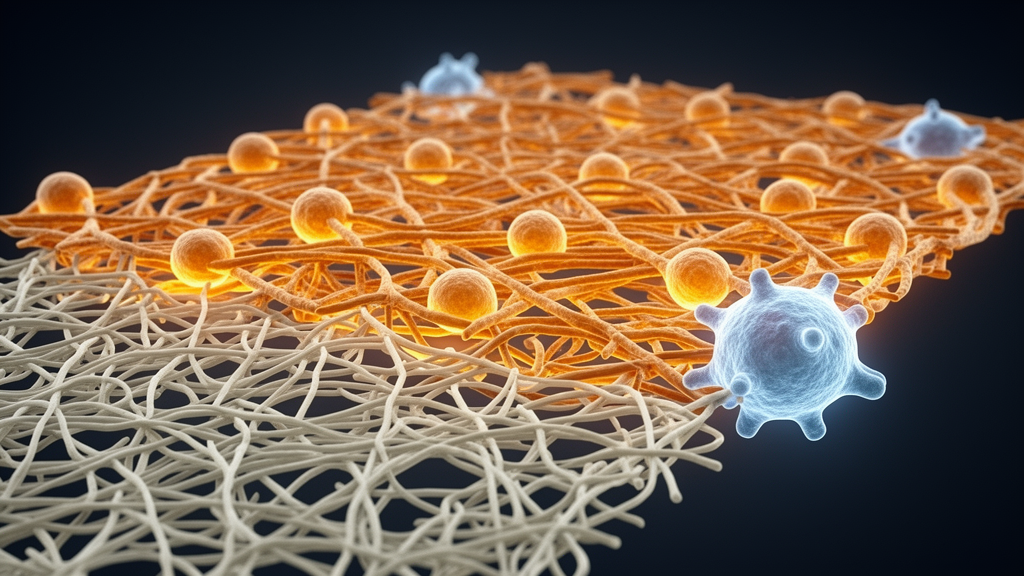
The strategy was designed to solve a persistent scaling problem in biomaterials manufacturing: how to generate large, consistent batches of a matrix that faithfully mimics the native tissue environment. According to the commentary authors, the original paper demonstrated through systematic in vitro and in vivo experiments that HE-ECM holds significant advantages in biomimetic properties, biological activity, and the promotion of wound healing, and they state that they fully agree with those conclusions and recognize the approach's clinical value. What makes HE-ECM attractive, the commentary explains, is that it retains the complex protein composition and the three-dimensional porous architecture of the native matrix.
That richness stands in sharp contrast to recombinant collagen, which offers a single purified protein rather than the full complement of collagens, fibronectin, proteoglycans, and matrix-remodeling enzymes that cells encounter in living tissue. Because fibroblasts naturally deposit this entire cocktail as they grow, harvesting and decellularizing their product yields a scaffold that is biochemically far closer to what wounded skin expects to see, which the original authors linked to superior fibroblast activity and accelerated wound closure. Yet the commentary authors identify a vulnerability that runs through any strategy built on living cells expanded in a dish: the state of those cells changes with time in culture.
Previous studies, the authors note, have shown that senescent fibroblasts display increased expression of the cyclin-dependent kinase inhibitors p16, encoded by CDKN2A, and p21, encoded by CDKN1A, along with elevated senescence-associated beta-galactosidase activity and significant changes in their extracellular matrix expression profile. The consequences for matrix quality are concrete. The commentary points out that mRNA levels encoding collagen type I alpha 1 and collagen type III alpha 1 — the two workhorse collagens of skin repair — are lower in senescent fibroblasts than in their younger counterparts.
In other words, a manufacturing batch grown from cells that have quietly aged in culture may produce a scaffold depleted of precisely the structural proteins that give it its wound-healing power, even if the decellularization process itself is perfectly standardized. The composition of the final product, in this sense, is only as young as the cells that built it. Senescence does not stop at altering what cells build; it changes what they secrete.
The commentary emphasizes that senescent fibroblasts adopt a pro-inflammatory and pro-fibrotic secretory profile that can exert detrimental effects on surrounding tissue. This phenomenon, known as the senescence-associated secretory phenotype, or SASP, operates through paracrine signaling, meaning that even a minority of senescent cells in a production culture could influence the behavior and matrix output of their still-healthy neighbors. For a scalable manufacturing process that depends on consistency from batch to batch, such a hidden variable represents a genuine quality-control challenge.
Interestingly, the commentary also connects this problem to a broader current in anti-aging therapeutics. The authors distinguish between senolytic agents, which physically clear senescent cells, and senomorphic agents, which suppress the senescent phenotype and its secretory fallout without killing the cells. Stem cell-derived extracellular vesicles, or SC-EVs, fall into the senomorphic category.
The practical recommendations that emerge from the commentary are specific and actionable. The authors argue that because the original study relied on commercial fibroblasts at passages 3 to 5, detection of cellular senescence markers should still be performed as a matter of routine. They call for experimental measurement of the fibroblast population doubling level, a cumulative count of how many times the cells have divided, alongside a panel of senescence phenotype markers including p16, p21, and senescence-associated beta-galactosidase.
Selecting reliable and robust detection markers, they write, is essential for stable quality control of the engineered HE-ECM approach. Looking further ahead, the commentary outlines three questions that should be addressed before the technology matures: the population doubling level or passage number at the point of ECM harvest, the inclusion of senescence marker panels as batch-release quality criteria, and the correlation of senescence marker levels with downstream functional outcomes of the resulting matrix. The commentary authors close on an affirming note: the engineered HE-ECM strategy, with its use of a standardized commercial cell line and decellularization workflow, enables scalable production of extracellular matrix with stable composition and enrichment of multiple matrix proteins, showing promising potential for clinical translation.
Their message is not a rejection of the technology but a refinement of it — a reminder that in cell-derived biomaterials, the manufacturing process is biological, and biology keeps records.
Subject of Research: Senescence-related quality control concerns for engineered human fibroblast-derived extracellular matrix in wound healing
Article Title: Commentary: An engineered and scalable human cell-derived extracellular matrix demonstrates advantages over recombinant collagen in biomimicry and wound healing
Article References: Liu, Z., Cui, L., Yao, M., & She, J. (2026). Commentary: An engineered and scalable human cell-derived extracellular matrix demonstrates advantages over recombinant collagen in biomimicry and wound healing. Frontiers in Bioengineering and Biotechnology, 14, Article 1986764. https://doi.org/10.3389/fbioe.2026.1986764
Image Credits: AI Generated
DOI: 10.3389/fbioe.2026.1986764
Keywords: extracellular matrix, fibroblasts, cellular senescence, wound healing, recombinant collagen, SASP, p16, p21, biomaterials, decellularization, senomorphic, quality control
News Source: Beatrice Stafford. (October 26, 2026). Engineered Human Cell-Derived Matrix Outperforms Recombinant Collagen, but Senescence Looms. Scienmag.