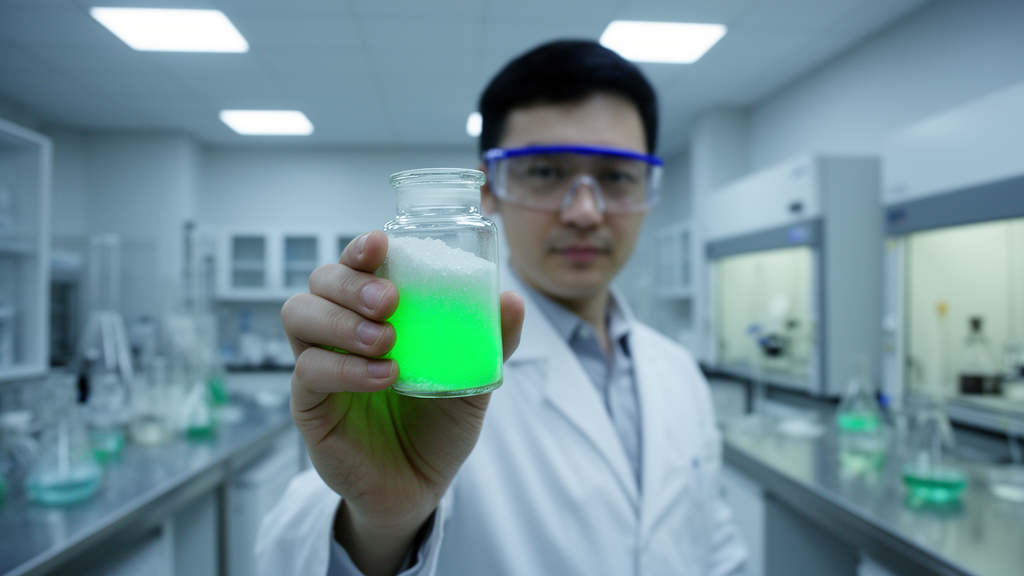
Chemists at the University of Iowa have accomplished something that has long resisted the efforts of rare-earth researchers: they isolated and characterized an unusual oxidation state of the metal terbium without the punishingly strict laboratory controls that such chemistry normally demands. The work, published in Nature Communications, describes how a carefully engineered molecular cage allowed terbium to shed an electron and transform into its plus-4 oxidation state under ordinary ambient conditions of temperature, humidity and pressure. The achievement matters because terbium, like all lanthanides, is notoriously reluctant to abandon its preferred chemical identity, and that stubbornness has historically made the element difficult to separate, study and deploy beyond its best-known applications.
Terbium is a silvery-gray rare-earth metal mined primarily in China, though deposits also exist in the United States and a handful of other countries. It is already embedded in everyday technology in ways most people never notice. The element underpins the green phosphors essential to televisions, fluorescent lamps and LED displays, and it plays a role in solid-state devices and fuel cells. In medicine, terbium-based materials have been used to improve the safety of X-ray imaging by allowing radiologists to produce images of the same diagnostic quality with a much shorter exposure time, reducing the radiation dose patients receive. Despite this versatility, the full range of terbium’s chemical behavior remains largely unexplored, precisely because accessing its less stable oxidation states has been so difficult.
The core of the problem lies in the nature of the lanthanides themselves. Terbium belongs to this family of fifteen chemically similar metals, and the elements share nearly identical physical properties, which makes separating one from another a formidable challenge. As the researchers explain, lanthanides prefer to sit in the same oxidation state, and coaxing one of them into a different state typically requires a tightly controlled environment such as a specialized laboratory setup. Without such control, the chemistry simply does not cooperate. The conventional route to terbium’s plus-4 state, in which one electron is stripped from the atom, has required rigorous air-free conditions, limiting who can attempt the chemistry and how easily it can be scaled or adapted.
Oxidation state is a measure of how many electrons an atom holds relative to its neutral form. Terbium, like its lanthanide cousins, is most stable in the plus-3 state, meaning three of its electrons are effectively free or delocalized relative to the nucleus. In that configuration, terbium’s properties have been well documented over decades of research. But removing one more electron, producing the plus-4 state, changes the atom’s charge and, in a very real sense, converts it into a new chemical species with potentially distinct optical, magnetic and electronic behavior. Those altered properties are exactly what researchers hope to exploit in emerging technologies, yet the transformation is energetically unfavorable, meaning the atom resists giving up the electron unless it is compelled to do so.
The Iowa-led team, headed by Korey Carter and Pere Miro, both of the university’s Department of Chemistry, found a way around this resistance by changing the chemical environment surrounding the terbium atom rather than forcing the transformation through brute-force conditions. They constructed a cage-like molecular assembly known as a polyoxometalate, a structure built primarily from tungsten and oxygen atoms, and augmented it with binding agents called ligands. When a terbium atom was sandwiched inside this architecture, the cage held the metal in a configuration primed for change. The researchers then introduced potassium persulfate, a chemical oxidant, which initiated a reaction that caused the trapped terbium atom to lose an electron, shift into the plus-4 oxidation state, and become isolable as a stable compound.
The striking part of the result is where it happened. The entire process was carried out under ambient conditions, without special controls on temperature, humidity or pressure. Carter offered an everyday analogy: the chemistry would be comparable to setting up an experiment in one’s own house rather than in a rigorously controlled glovebox or climate-regulated chamber. That simplicity is not merely a laboratory convenience. Removing the need for specialized infrastructure lowers the cost and complexity of accessing terbium in this unusual state, potentially making the chemistry practical for a far wider range of researchers and applications than the air-free techniques that preceded it.
Because the study is a proof of concept, its immediate significance lies in demonstrating a strategy rather than delivering a finished product. The researchers showed that terbium, and potentially other lanthanides, can be separated from one another more efficiently by manipulating oxidation states in ordinary environments. Separation is the bottleneck that has constrained rare-earth chemistry for generations, since the lanthanides’ near-identical properties make conventional purification difficult and expensive. A method that exploits subtle oxidation-state differences under mild conditions could open new avenues for how each of these metals is sourced, refined and used, and could allow scientists to explore the poorly documented characteristics of lanthanides in states other than their default plus-3 configuration.
Among the most tantalizing prospects is quantum technology, the domain where atoms and smaller constituents behave in strange, hard-to-predict ways that classical physics cannot fully describe. Rare-earth elements are already valued in this field for their distinctive electronic structures, and terbium’s less common oxidation states could offer properties useful for quantum computing and for advanced sensors. Such sensors, the researchers note, could find applications in navigation and medical imaging, among other fields. The team emphasizes that these are potential directions enabled by the new chemistry, not applications that have been realized; the current result is a structural and spectroscopic characterization of a terbium compound, not a functioning device.
The collaboration behind the paper was broad. Alongside the Iowa leadership, co-corresponding authors included Benjamin Stein and Stosh Kozimor of Los Alamos National Laboratory and Jennifer Wacker of Lawrence Berkeley National Laboratory. Contributing researchers came from Iowa, Los Alamos, Lawrence Berkeley, the Colorado School of Mines and the University of California, Berkeley, reflecting the distributed expertise needed to synthesize, characterize and theoretically model the new compound. The work was funded by the U.S. Department of Energy, an agency with a longstanding interest in securing domestic supply chains and processing capabilities for rare-earth elements, materials considered strategically critical for energy, defense and information technologies.
The Iowa group does not intend to stop at terbium. Carter says the team wants to extend what it learned about separating terbium to the actinides, a series of highly radioactive elements that includes uranium and plutonium and that is used in cancer-fighting treatments and in devices such as cardiac pacemakers and smoke detectors. Actinide chemistry poses its own formidable handling challenges, but the researchers argue that the polyoxometalate platform provides a foundation for that extension, and they point to the university’s radiochemistry laboratories as the place where it will be pursued. For now, the published result stands as a demonstration that one of rare-earth chemistry’s most rigid barriers, the difficulty of accessing and isolating alternative oxidation states, can be lowered with molecular design rather than extreme conditions, a shift that could ripple through separation science, fundamental lanthanide research and the technologies that depend on both.
Subject of Research: Isolation and characterization of terbium in its plus-4 oxidation state using a polyoxometalate cage under ambient conditions
Article Title: Chemists unlock new possibilities for rare-earth metal
Article References: Chemists unlock new possibilities for rare-earth metal. Original publication (Bibliographic details unavailable.)
Image Credits: AI Generated
DOI: Not provided
Keywords: terbium, lanthanides, rare-earth metals, oxidation state, polyoxometalate, separation chemistry, quantum technology, University of Iowa, Nature Communications, actinides, phosphors, ambient conditions
News Source: Bethany Barker. (October 26, 2026). Chemists Isolate Elusive Terbium State Under Everyday Lab Conditions. Scienmag.