Genome editing could become far more practical in finfish aquaculture if CRISPR-based changes are introduced, validated and expanded in cultured germline stem cells before those cells are transplanted into sterile surrogate broodstock, according to a mini review published in Frontiers in Genetics by researchers from The Roslin Institute in Edinburgh and the Institute of Marine Research in Bergen. The authors argue that this combination of cell culture and transplantation could bypass the manual embryo microinjection that currently limits the technology to small experimental studies, and could shorten breeding timelines in species such as Atlantic salmon, where each generation takes roughly three to four years.
Aquaculture has grown steadily in recent decades, but the sector remains young compared with terrestrial livestock farming, and selective breeding programmes face biological constraints. Long generation intervals in economically important species, and the difficulty of simultaneously improving multiple traits that may involve trade-offs, can slow the rate of genetic gain. Genome editing has been proposed as a complementary tool to introduce valuable traits related to reproduction and sterility, growth, disease resistance, and overall fish health and welfare more precisely and more quickly than conventional selection alone.
CRISPR/Cas editing has already been demonstrated in a range of aquaculture species, including Atlantic salmon, rainbow trout, Nile tilapia, common carp and channel catfish. Yet almost all of this work remains at the proof-of-concept stage. Only a small number of genome-edited fish are available as commercial products, in Japan, and both technical hurdles and an uncertain regulatory landscape restrict wider adoption. The review deliberately sets regulation aside, since frameworks vary substantially between countries and continue to evolve, and concentrates instead on the technical bottlenecks.
The central bottleneck is delivery. Genome editing in fish is currently performed mainly by manually microinjecting CRISPR/Cas components into newly fertilised eggs, ideally at the one-cell stage. The procedure is labour-intensive, demands high technical accuracy, and limits throughput. Injection can also cause mortality through mechanical damage to the embryo or through toxicity of the reagents introduced. Even when embryos survive, the resulting founder fish frequently show high levels of mosaicism, meaning they carry a mixture of edited and unedited cells, particularly when injection occurs at multicellular stages or when editing is slow or incomplete.
Mosaicism makes founder phenotypes hard to interpret. Editing efficiency varies between genomic target sites, and computational tools that predict guide RNA efficiency remain insufficiently accurate to prevent mosaic outcomes. Within a single founder fish, edited cells may carry different mutations at different frequencies, including frameshift mutations that disrupt gene function and in-frame mutations that retain partial or full protein activity. To obtain defined genotypes, edited founder males, which often mature earlier than females, are typically crossed with wild-type females to produce heterozygous F1 offspring, and breeding to the F2 generation is then needed to obtain biallelic mutants. In Atlantic salmon, with its three-to-four-year generation interval, this multigenerational process significantly delays the validation and implementation of edited traits.
Most aquaculture editing studies to date have produced gene knock-outs. In Atlantic salmon, reported knock-outs target genes involved in reproduction, such as dnd1, fshr, bmp15, piwil1 and stra8, as well as pigmentation, fatty acid synthesis and immunity. Some of these studies have shown outcomes with potential breeding relevance, including sterile fish, mono-sex populations and enhanced growth. Genetically sterile, germ-cell-free Atlantic salmon dnd1 mutants followed through a full production cycle showed long-term performance similar to wild-type counterparts. More complex modifications, however, remain difficult. Knock-in of genetic material is constrained by the low frequency of the homology-directed repair pathway relative to non-homologous end joining, although channel catfish studies have inserted transgenes that improved disease resistance and raised fatty acid content. In Atlantic salmon, small insertions and single nucleotide changes have been reported, but reliable insertion of larger genetic elements remains out of reach.
The alternative platform proposed in the review builds on germline stem cell biology. Primordial germ cells, specified during early embryogenesis from maternally deposited germplasm factors, migrate to the developing genital ridges, where after sexual differentiation a subset become adult germline stem cells, the undifferentiated oogonia and spermatogonia of females and males. These cells can either self-renew or enter oogenesis and spermatogenesis to produce mature gametes. Culturing them in vitro requires isolating a homogeneous cell population, which is technically demanding for embryonic primordial germ cells because of their low abundance and the small size of the genital ridges; fluorescence-based approaches, including a transgenic rainbow trout line expressing green fluorescent protein under germ cell-specific regulatory elements, are typically needed to identify and recover them. Long-term, stable primordial germ cell culture is practically non-existent in fish, with the exception of a four-month method in zebrafish. Adult germline stem cells are easier to isolate, and short- to medium-term cultures of spermatogonial cells have been reported in several species, supported by fish-specific serum, embryonic extract, recombinant growth factors such as FGF, LIF and GDNF, and gonadal somatic cell feeder layers that mimic the in vivo niche.
Surrogate broodstock technology then provides the route back to the germline. Gonadal cell suspensions containing germline stem cells are prepared from immature donors and transplanted into sterilised recipients around hatching. The transplanted cells migrate to and colonise the forming genital ridges, where the surrogate’s somatic environment supports their propagation, differentiation and maturation into functional donor-derived gametes. Notably, in Atlantic salmon, rainbow trout, masu salmon and Japanese flounder, the fate of transplanted cells is determined by the surrogate rather than the donor, so cells from either sex can produce both eggs and sperm. Germline stem cells from either sex can also be cryopreserved before transplantation, extending genetic preservation beyond the sperm cryopreservation that conventional practice relies on, since fish eggs tolerate freezing poorly. In medaka, researchers have already combined these elements: germline stem cells carrying an fshr knock-out, which renders females sterile while males remain fertile, were transplanted into sterile female recipients with a functional somatic gonadal environment, producing donor-derived eggs carrying the mutation; crossing these with edited sex-reversed males yielded all-female sterile offspring. Because fshr knock-out Atlantic salmon males and male and female rainbow trout are also sterile, the authors suggest that edited cells could in principle be transplanted into sterile male and female recipients with functional somatic gonads, enabling mass production of fully sterile offspring without sex reversal.
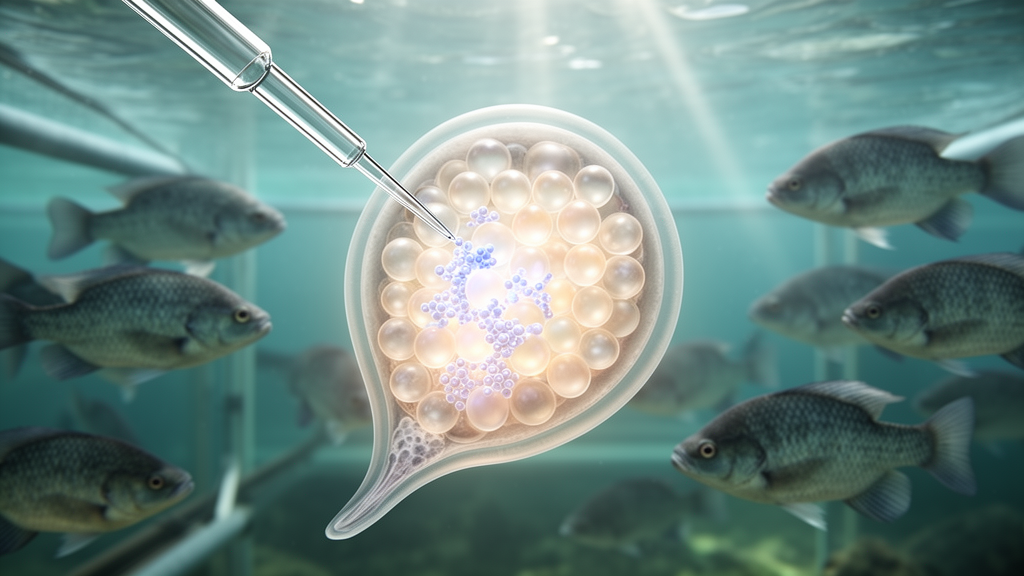
The envisioned workflow would isolate germline stem cells, edit them in vitro, select successfully edited cells, expand them clonally, and transplant validated populations into multiple sterile male and female surrogates to mass-produce gametes carrying identical mutations. Realising this, however, faces substantial unresolved challenges. No universal culture protocol exists, and requirements for growth factors and hormones appear highly species-specific, so medium composition, osmolality, temperature and supplements must be optimised for each species. Fluorescence- and magnetic-activated cell sorting tools are available for only a limited number of aquaculture species, and fish-specific recombinant proteins remain scarce compared with mammalian systems. Genome editing of cultured fish germline cells has been reported only once, in primary cells from ricefield eel, and that study did not test clonal expansion, transplantation or germline transmission of the edits. Any in vitro editing initially yields a mixed cell population, so single-cell cloning and screening would be needed to confirm the intended edit, exclude unintended on-target alterations and assess off-target changes and chromosomal stability before transplantation, yet fish germline stem cells are notoriously difficult to propagate as clones, and relying on few clones could erode genetic diversity. The effects of prolonged culture, editing and cloning on germline competence, including the capacity to colonise recipient gonads and form functional gametes, remain unknown, and transplantation efficiency in Atlantic salmon, though demonstrated with non-cultured wild-type cells, has so far been low.
Lessons from other animal groups offer a conceptual framework. In chickens, where one-cell embryo microinjection is not feasible, long-term cultures of primordial germ cells can be edited in vitro, expanded, selected and injected into the bloodstream of sterile surrogate embryos, producing non-mosaic genetically modified birds through germline transmission; porcine spermatogonial cells have also been edited in vitro, though long-term culture remains limited. Fish bring one decisive advantage: high fecundity, with many aquaculture species producing thousands of eggs in a single spawning. If robust species-specific culture and transplantation systems can be established, the authors conclude, the combination could enable efficient production of large numbers of genome-edited gametes, improving scalability, reducing mosaicism and shortening breeding timelines, and thereby accelerating genetic gain, fish health and welfare in finfish aquaculture, particularly in non-model species.
Subject of Research: Combining germline stem cell culture and transplantation with CRISPR genome editing to scale up precision breeding in finfish aquaculture
Article Title: The potential for large-scale genome editing in finfish aquaculture via germline stem cell culture and transplantation
Article References: Raudstein, M., Datsomor, A. K., Stewart, R., McGrew, M., Fraslin, C., Crespo, D., & Kleppe, L. (2026). The potential for large-scale genome editing in finfish aquaculture via germline stem cell culture and transplantation. Frontiers in Genetics, 17, Article 1924271. https://doi.org/10.3389/fgene.2026.1924271
Image Credits: AI Generated
DOI: 10.3389/fgene.2026.1924271
Keywords: aquaculture, genome editing, CRISPR, germline stem cells, surrogate broodstock, Atlantic salmon, germ cell transplantation, mosaicism, selective breeding, fish welfare, knock-in, cell culture
News Source: Juliet Wilcox. (October 26, 2026). Germline Stem Cell Transplantation Could Scale Up Genome Editing in Farmed Fish. Scienmag.