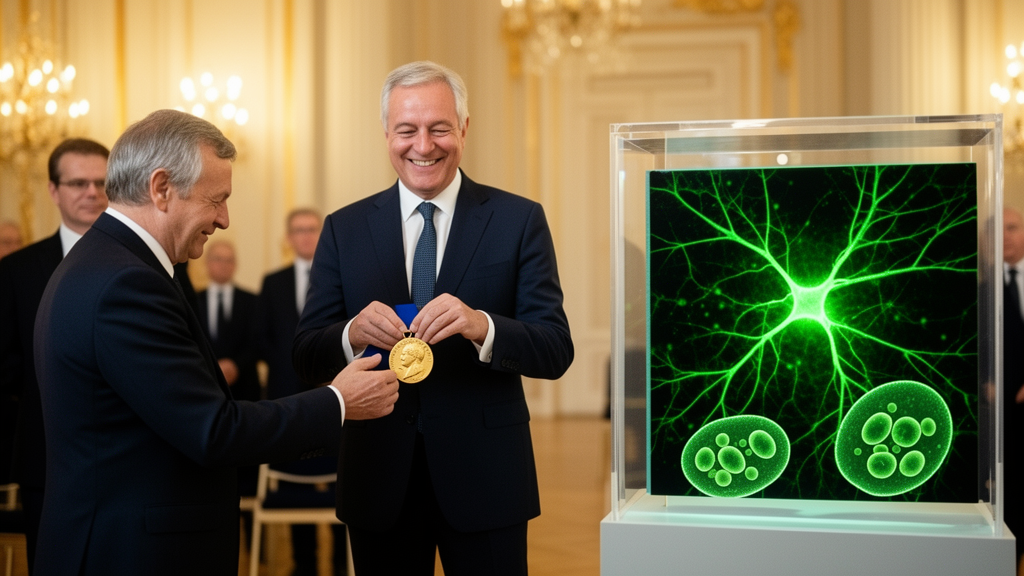
Georg Nagel has been awarded the 2026 Nobel Prize in Physiology or Medicine for discoveries concerning light-controlled ion channels and optogenetics, the University of Würzburg announced. The 73-year-old scientist shares the prize, worth approximately one million euros, with Karl Deisseroth of Stanford University and Peter Hegemann of Humboldt-Universität zu Berlin. Nagel, a senior professor at the university’s Institute of Physiology through the end of June 2026, learned of the award while in Italy. He held the Professorship of Molecular Plant Physiology at the Chair of Botany I and the Julius von Sachs Institute of the Biocentre from 2004 to 2021.
The laureates’ work made it possible to switch the activity of individual nerve cells in a living brain on or off using light, according to the Nobel Committee. Their discoveries established optogenetics as a method for controlling neural activity and have enabled researchers to reactivate memories, generate emotions, control behaviour, and investigate the types of nerve cells involved in psychiatric and neurological disorders. The committee said the method has fundamentally changed understanding of the brain and has provided insight into interactions between the nervous system and cells in other parts of the body, including the heart and gut. Optogenetics is now used in laboratories around the world.
Optogenetics has roots in light-sensitive ion channels in plant cells, including algae. Dirk Becker, a researcher at Würzburg’s Chair of Botany I who worked with Nagel for more than 20 years, said researchers recognised early that the system could be useful for studying the human brain. The Nobel-winning research connected discoveries in plant physiology with the development of tools for controlling nerve-cell activity in living organisms. Nagel, Deisseroth and Hegemann received the Wiley Prize in Biomedical Sciences and the Karl Heinz Beckurts Prize together in 2010, alongside Ernst Bamberg, for their work in this field.
Nagel was born in Weingarten on 24 August 1953 and began his academic career by studying biology and biophysics at the University of Konstanz. After a brief period working as a teacher at a Swiss secondary school, he started doctoral studies at Goethe University Frankfurt in 1984 and completed his doctorate in 1988. He subsequently spent five years conducting postdoctoral research in the United States at Yale University and Rockefeller University in New York. In 1993, he returned to the Max Planck Institute of Biophysics in Frankfurt am Main as a research group leader.
From 1995 to 2000, Nagel also worked as a research assistant at Goethe University Frankfurt’s Institute of Biophysics, where he completed his habilitation in biophysical chemistry. As part of that work, he spent time at the University of Naples as a Marie Curie Fellow in 1999. He moved to Julius-Maximilians-Universität Würzburg in 2004, served as Professor of Molecular Plant Physiology until 2021, and continued research and teaching as a senior professor at the Institute of Physiology until the end of June 2026. His honours include the International Prize for Translational Neuroscience in 2012, the Louis-Jeantet Prize and Brain Prize in 2013, the Rumford Prize in 2019, the Shaw Prize in 2020, and the University of Würzburg’s Röntgen Medal in 2024. University President Paul Pauli called Nagel the university’s 15th Nobel laureate.
Subject of Research: Recognition of Georg Nagel’s contributions to light-controlled ion channels and optogenetics
Article Title: Nobel prize for Würzburg professor Georg Nagel
Article References: Nobel prize for Würzburg professor Georg Nagel. Original publication (Bibliographic details unavailable.)
Image Credits: AI Generated
DOI: Not provided
Keywords: Georg Nagel, Nobel Prize, optogenetics, ion channels, neuroscience, plant physiology, brain research, University of Würzburg, Karl Deisseroth, Peter Hegemann, Nobel, prize
News Source: Cassandra Pierce. (October 26, 2026). Georg Nagel shares Nobel Prize for pioneering optogenetics. Scienmag.