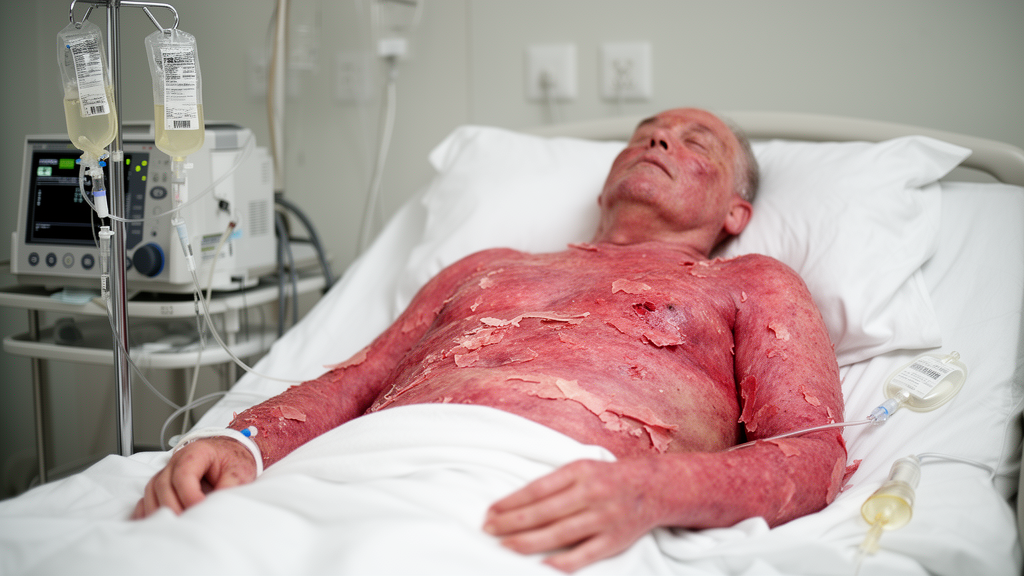
A man receiving pembrolizumab and enfortumab vedotin for metastatic urothelial carcinoma developed toxic epidermal necrolysis after six treatment cycles and died following 32 days in hospital, according to a peer-reviewed single-patient case report published in Oncoscience on September 30, 2026. The severe reaction involved extensive blistering, epidermal detachment and systemic complications. Although the authors judged pembrolizumab the more likely cause, they could not definitively establish which drug, or combination of factors, triggered the episode. The case therefore documents a rare, potentially fatal adverse event associated with combination cancer treatment rather than proving a general causal relationship or estimating how often it occurs.
The patient had high-grade urothelial carcinoma involving the left ureteral stump and a pelvic mass extending around the left iliac blood vessels, with regional lymph node involvement. His medical history included insulin-dependent diabetes, chronic kidney disease, obesity, obstructive sleep apnea and hypothyroidism thought to be related to immunotherapy. He received pelvic radiotherapy in August 2024, followed by pembrolizumab and enfortumab vedotin beginning in October 2024. The report notes that urothelial carcinoma develops in the lining of the urinary tract, most commonly in the bladder but also in the ureters and renal pelvis, and that advanced disease can be difficult to treat.
Pembrolizumab is an immune checkpoint inhibitor that blocks the programmed cell death protein 1 pathway, helping immune cells recognize and attack tumors. Enfortumab vedotin is an antibody-drug conjugate directed at nectin-4, a protein commonly expressed on urothelial cancer cells, that delivers a cytotoxic drug to its target. Their combination has improved treatment outcomes in advanced urothelial cancer, although both agents can cause serious skin reactions. Stevens–Johnson syndrome and toxic epidermal necrolysis sit on a spectrum of severe immune-mediated skin disorders marked by death of skin cells, blistering and epidermal detachment. SJS typically affects less than 10% of body surface area, while TEN involves more than 30%.
These reactions can also affect mucous membranes and cause life-threatening systemic complications, particularly in patients with cancer or other underlying illnesses. The first warning sign in the reported patient appeared after the initial treatment cycle, when he developed a severe generalized rash with blistering. A skin biopsy showed vacuolar interface dermatitis rather than SJS or TEN. His symptoms improved with corticosteroids, which allowed treatment to continue. This earlier episode was followed by additional cycles without further reported dermatological complications. The delayed course is important because the fatal reaction emerged even though an earlier rash had resolved and because the reported onset did not coincide with the first exposure to either anticancer agent.
In March 2025, after six cycles, the patient experienced acute skin burning that progressed to extensive blistering and epidermal detachment. He also developed metabolic acidosis, neutropenia and respiratory distress. Clinicians diagnosed toxic epidermal necrolysis and assigned a SCORTEN severity score of 5, which the report describes as indicating a high risk of death. The cancer treatments were discontinued, and the patient was admitted to the intensive care unit. This sequence supports close observation for rapidly worsening symptoms, including painful redness, blistering and skin detachment, throughout combination therapy rather than only during the earliest treatment cycles.
To assess possible drug causation, the researchers applied the Algorithm of Drug Causality for Epidermal Necrolysis, or ALDEN, a scoring system that evaluates potential relationships between drug exposure and severe skin reactions. Pembrolizumab received an ALDEN score of 5, indicating probable causality, whereas enfortumab vedotin received a score of 2, indicating possible causality. The investigators favored pembrolizumab because the delayed onset was consistent with the timing of immune checkpoint inhibitor-associated skin toxicity. Enfortumab vedotin-associated SJS or TEN more commonly occurs earlier in treatment, they noted. Nevertheless, both drugs have been linked to serious skin reactions, and the previous pelvic radiotherapy was considered a possible contributing or amplifying factor through enhanced immune activation; that proposed interaction remained unproven.
Initial immunosuppressive treatment with methylprednisolone was subsequently changed to cyclosporine and intravenous immunoglobulin, together with multidisciplinary supportive care. Cyclosporine suppresses T-cell activity involved in immune-mediated skin damage, while intravenous immunoglobulin has been investigated for the possibility of interfering with pathways that contribute to skin-cell death. The report states that these treatments may help control disease progression but that their effectiveness varies and that optimal management of TEN remains an area of clinical investigation. The case therefore cannot establish whether any one of these immunosuppressive approaches was superior, whether the treatment sequence improved the outcome, or whether a different approach might have produced a different result.
Despite aggressive treatment, the patient developed septic shock, bloodstream infections, acute-on-chronic kidney injury requiring continuous renal replacement therapy, and respiratory failure requiring mechanical ventilation. Partial skin healing was observed around days seven to eight, showing that the cutaneous injury was not uniformly irreversible. Persistent infection and multiorgan failure followed. He experienced cardiac arrest and died after 32 days in hospital. The outcome is consistent with the report’s description of TEN as a rare but life-threatening complication, but the single case cannot determine the combination therapy’s overall fatality rate, the probability of similar events for other patients, or the comparative safety of the two drugs when used together.
The report also distinguishes the timing patterns associated with the two agents. Enfortumab vedotin has been linked to early-onset SJS and TEN, while pembrolizumab and other immune checkpoint inhibitors can produce delayed reactions. Such differences may complicate diagnosis when patients receive both drugs, because the timing of symptoms does not by itself identify the responsible agent. The authors emphasize early recognition, drug discontinuation and prompt initiation of immunomodulatory therapy as critical for improving outcomes. They also call for early dermatological assessment and coordinated care involving oncology, critical care and other specialists when severe reactions are suspected, together with continued vigilance for worsening skin symptoms throughout treatment.
As a single-patient case report, the publication has clear limitations. It cannot establish the frequency of TEN with pembrolizumab plus enfortumab vedotin, determine which medication was definitively responsible, or compare the effectiveness of the immunosuppressive treatments administered. The patient’s diabetes, chronic kidney disease and other underlying conditions, as well as his previous radiotherapy, further complicate causal interpretation. Additional studies and pharmacovigilance monitoring are needed to clarify risk factors, onset patterns and management strategies. Even with those limitations, the documented course supplies a detailed clinical warning that a severe skin reaction can follow an earlier episode that appeared to resolve and can emerge after multiple treatment cycles have been completed without further skin complications.
Subject of Research: Delayed toxic epidermal necrolysis during pembrolizumab and enfortumab vedotin treatment for metastatic urothelial carcinoma
Article Title: Fatal skin reaction following combination therapy for urothelial cancer highlights need for vigilance
Article References: Fatal skin reaction following combination therapy for urothelial cancer highlights need for vigilance. Original publication (Bibliographic details unavailable.)
Image Credits: AI Generated
DOI: Not provided
Keywords: toxic epidermal necrolysis, urothelial carcinoma, pembrolizumab, enfortumab vedotin, immunotherapy, antibody-drug conjugate, severe skin reaction, case report, drug causality, multiorgan failure, Fatal, skin
News Source: Nathaniel Bowman. (October 26, 2026). Single case links delayed fatal TEN to urothelial cancer combination therapy. Scienmag.